*Humane* — The Family Euthanasia That Leaves Us Deader Than the Weather
Caitlin Cronenberg serves up this nightmare dinner where emotional cannibalism outdoes the ecological kind. Euthanasia or scam? Claqueta Ácida dissects the corpse.

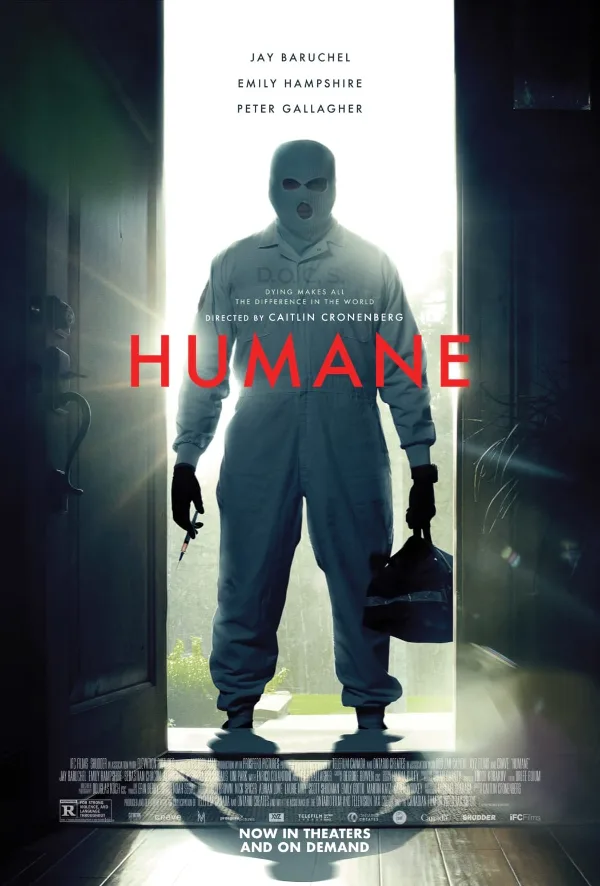
The celluloid flickers to life with the rotten stench of good intentions gone horribly wrong. Humane (or Humane, equally pretentious in both languages) arrives like a regurgitated eco-conscience disguised as a family thriller, directed by Caitlin Cronenberg, daughter of body horror maestro David Cronenberg. Yes, that surname weighs like a slab of rotting meat on the shoulders of anyone daring to approach cinema with artistic aspirations. But here, dear readers, genetics don’t save the day. The film is a cruel reminder that talent isn’t inherited—it’s suffered, and sometimes, as in this case, squandered on a script that reeks more of a college pamphlet than fresh, juicy meat that bleeds on screen with every poorly conceived shot.
We’re in 2024, a year where climate collapse isn’t some distant threat but a live reality show, complete with its own stars, villains, and—of course—its quota of opportunists ready to monetize the end of the world. Michael Sparaga, the screenwriter, seems to have taken notes from every TED Talk on sustainability and condensed them into a script that wavers between a by-the-book family drama and a bargain-bin dystopian thriller. The result is a Christmas Eve dinner where the turkey is more charred than humanity’s hopes, and the guests, instead of arguing over politics, bicker over who signs up first for the government’s euthanasia program. Because, of course, in this near future (which suspiciously smells like the present), the government has decided the solution to climate change is to eliminate 20% of the population. Does it sound like Soylent Green? Yes. Does it sound like Black Mirror? Also yes. Does it sound like something we haven’t seen a thousand times before? Absolutely. But here’s the kicker (or the tragedy): Humane doesn’t have the decency to be original or the brains to be entertaining.
The choice of Caitlin Cronenberg as director isn’t random, but it is cruel. The daughter of the body horror king inherited the surname but not the knack for turning pain into art. Where her father gutted human flesh with surgical precision, she barely scratches the surface with the clumsiness of someone who mistakes gore for drama. Humane is a film that wants to be unsettling but only manages to be boring. It wants to provoke but settles for the obvious. It wants to be a reflection on humanity but ends up as an instruction manual for a bargain-bin dystopia. And the worst part? It wants us to care about its characters, but they’re as flat as the cardboard in a low-budget set.
The industrial context of this film is as predictable as its plot. Produced by Victory Man and Elevation Pictures, two studios that reek of easy money and safe projects, Humane is the kind of movie that premieres at second-rate festivals before vanishing into obscurity, like a corpse in a mass grave. It’s not cult cinema, not even memorably bad cinema. It’s meh cinema—stuff you forget before the credits finish rolling. And yet, here it is, taking up space in our retinas and our patience, like a reminder that the apocalypse doesn’t always arrive with fanfare and special effects. Sometimes it comes with a sigh, a yawn, and the certainty that you’ve wasted 93 minutes of your life on something that doesn’t even deserve to be called trash.
Direction: The Trembling Hand of a Surgeon with Parkinson’s
If Caitlin Cronenberg inherited anything from her father, it’s the obsession with the human body as a battleground. But where David Cronenberg turned flesh into a nightmare canvas, his daughter seems content to scratch the surface. Humane is a film that wants to be visceral but only manages to be superficial. The shots are functional, almost televisual, as if the director filmed everything on an iPhone and then ran it through an indie thriller filter. There’s no tension in the framing, no rhythm in the editing, no sense that something’s about to break. Just a family sitting around a table, arguing about euthanasia like it’s the day’s special.
The problem isn’t the budget (though it shows), but the lack of ideas. Cronenberg seems more interested in following genre rules than subverting them. Every plot twist is as predictable as the next joke from a middling stand-up comedian. Every tense scene is so calculated it feels lifted from a screenwriting manual. And every attempt at visual shock (and there are some, as clumsy as they are unnecessary) falls flat because they lack the punch to land. This isn’t horror cinema, not even suspense. It’s textbook cinema—stuff you study in film school to learn what not to do.
Cast: A Ensemble Lost in Mediocrity Limbo
The cast of Humane is like a group of actors who wandered onto the wrong set. Jay Baruchel, Hollywood’s eternal sidekick with the face of someone who’s never broken a plate, plays the family patriarch—a guy who signs up for the euthanasia program like he’s joining a gym: with enthusiasm, followed by instant regret. His performance oscillates between flat and pathetic, as if he’s playing a character from The Office instead of a man willing to die for the planet. Emily Hampshire, on the other hand, is the only one who seems to grasp she’s in a horror movie. Her existential panic is the sole thing saving some scenes from total self-destruction, though even she can’t prevent the script from dragging her into the abyss of mediocrity.
The rest of the cast is a festival of familiar faces (for fans of low-budget Canadian cinema) trying to breathe life into characters as deep as a puddle. Sebastian Chacon and Alanna Bale do their best with dialogue that sounds like bad jokes, while Sirena Gulamgaus and Uni Park seem lost in a maze of clichés. They all act as if they’re in a different movie—one where characters have motivations, narrative arcs, and, you know, something to say. But no. Here, there are only platitudes, eco-sermons, and the constant feeling that someone should’ve told them this wasn’t The Bear but The Bore.
Technical Aspects: The Aesthetics of Controlled Disaster
The cinematography by Douglas Koch is as functional as the script. There’s no beauty in the shots, not even interesting ugliness. Just light, shadow, and the feeling that someone turned on a camera and said, “Let’s film this and see what happens.” The family home’s interiors are so generic they could be the setting for any low-budget horror flick, and the exteriors (when they appear) look like they’re lifted from a climate change documentary. There’s no style, no personality—just the void of a film that doesn’t know what it wants to be.
The production design is just as forgettable. The sets are as flat as the characters, and the costumes look like they’re pulled from a 2015 H&M catalog. There are no striking details, no elements that help build the dystopian world the film tries to sell. It’s as if the production team decided that since the script was bad, at least the sets wouldn’t distract. Mission accomplished.
The score, meanwhile, is as predictable as the rest of the movie. Suspense music when tension is needed, awkward silence when the weight of the family’s decision must be felt, and the occasional environmental tune to remind us—oh, surprise—the world is ending. No originality, no risk, just the sound of a film dragging itself toward its inevitable conclusion.
### The best
- The premise: Though it’s a rehash of ideas we’ve seen before, the concept of a family debating euthanasia as a climate solution has a morbid appeal. It’s like watching a car crash: you know you shouldn’t look, but you can’t help it.
- Emily Hampshire: The only one who seems to realize she’s in a horror movie. Her performance is the sole thing saving some scenes from total collapse.
- The attempt at provocation: Though the film fails to be unsettling, at least it tries. That’s more than can be said for an increasingly tame cinema landscape.
### The worst
- The script: A mishmash of clichés, poorly digested eco-rants, and dialogue that sounds like bad jokes. Michael Sparaga should reconsider his career.
- The direction: Caitlin Cronenberg seems more interested in following genre rules than subverting them. The result is a film as predictable as it is boring.
- The characters: As flat as the cardboard sets. No narrative arcs, no motivations—just puppets moved by a clumsy script.
- The pacing: 93 minutes that feel like 93 hours. Every scene drags like it’s in slow motion.
### The Verdict of Claqueta Ácida
Humane is that unwanted guest at dinner: it promises to be interesting but ends up being a nuisance. Caitlin Cronenberg had the chance to inherit her father’s legacy and create something memorable, but instead, she’s gifted us an instruction manual for a bargain-bin dystopia. The script is clumsy, the characters are flat, the direction is predictable, and the eco-message sounds like a Sunday morning sermon. This isn’t bad cinema—it’s forgettable cinema, the kind that evaporates from your memory before the credits finish. If the end of the world arrives this boringly, maybe euthanasia isn’t such a bad idea after all. But please, don’t waste your time on this. The real climate crime is this movie. 💀🎬 Tráiler Oficial
💬 El Veredicto de la Comunidad
¿Qué te ha parecido la película? Deja tu nota de 0 a 10 para contrastarla con el análisis de la redacción.
Aún no has votado
📢 ¿Te ha gustado el ácido?
Comparte esta crítica con tus amigos cinéfilos o desata la polémica en redes.
📩 📩 Get the poison in your inbox
Join our weekly mailing list. Honest film reviews, acid festival coverage, and cult recommendations every Sunday morning. Zero spam, pure celluloid.
🔒 We promise weekly poisonous reviews and exclusive coverage.Related Reviews
Recommended autopsies for demanding film buffs.
 ⚠️ Ácido Sulfúrico4.0
*Humane*: The Family Euthanasia That Leaves Us Deader Than the Weather
Caitlin Cronenberg serves up this nightmare dinner where emotional cannibalism outdoes the ecological kind. Euthanasia or scam? Claqueta Ácida dissects the corpse.
 ⚡ Ácido Cítrico6.2
*Exit 8*: The Horror Station That Can’t Find Its Way Out (And Neither Can You)
Genki Kawamura adapts *The Exit 8* video game with more loops than a politician’s campaign promises. Will it escape the purgatory of J-horror, or is it doomed to linger in its own terminal?
 ⚠️ Ácido Sulfúrico4.2
**Good Boy: The Dog That Saved No One (Not Even Itself)**
A supernatural canine stars in a film that barks up the wrong tree. *Claqueta Ácida* dissects this rural dud with the precision of a scalpel in a slaughterhouse.