*Airbag — The 90s’ Orgy of Chaos with Style (or How the Decade Taught Us to Laugh at Death)*
Juanma Bajo Ulloa turns mayhem into art with this psychedelic road movie, where the A/C reeks of cheap whiskey and the celluloid sweats testosterone. A cult gem that time hasn’t been able to tarnish.

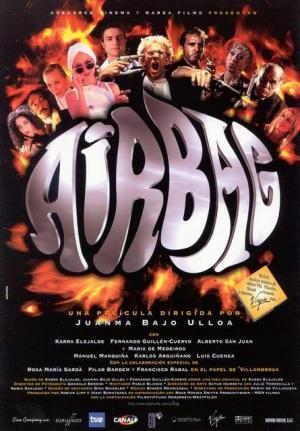
The celluloid of Airbag smells like a roadside dive bar with poor ventilation, like the synthetic leather of a stolen car, and like that cheap cologne wannabe tough guys wore in the 90s to mask the stench of existential failure. Juanma Bajo Ulloa, that enfant terrible of Spanish cinema who already left us gaping with Butterfly Wings (1991), decided the nineties deserved an epitaph as decadent as the decade itself: a road movie that’s simultaneously a testosterone-fueled orgy, a philosophical treatise on friendship, and an instruction manual for surviving a night of debauchery without ending up in the morgue. Or, at least, without ending up too badly. Because let’s be honest—no one walks away unscathed in Airbag: not the characters, not the audience, not even the poor projector spitting out frames like it’s possessed by the spirit of a kamikaze pilot with a chronic hangover.
We’re in 1997, a year when Spain was still licking its wounds from the Movida but had already discovered that ecstasy wasn’t just a drug—it was the natural state of a generation raised on Stories of the Fucked-Up Military and dreaming of being Trainspotting, just without the British elegance or the budget for quality heroin. Bajo Ulloa, who had flirted with psychological drama in The Dead Mother (1993), decided it was time to cut loose and embrace the chaos with the same devotion a drunk reserves for a lamppost—because, after all, someone’s got to hold you up when the world starts spinning like a flaming merry-go-round. And boy, did he deliver. Airbag isn’t just a movie; it’s a collective exorcism, a catharsis disguised as an absurd cautionary tale, an initiatory journey where the treasure isn’t an engagement ring but the certainty that, no matter what, you’ll always have a friend willing to torch a car with you.
The script, penned by Juanma Bajo Ulloa, Karra Elejalde, and Fernando de Garcillán, is a masterpiece of cinematic collage: it blends corrosive black humor with moments of unexpected tenderness, as if Aki Kaurismäki and Álex de la Iglesia had decided to make a movie together after a night of drinking with Quentin Tarantino. The narrative structure is as chaotic as life itself, jumping from one visual gag to the next with the same grace as a drunk driver swerving through traffic cones. And yet, there’s something deeply coherent about this madness: Airbag is, above all, a tribute to male friendship in its purest, most primitive form—where hugs blur with judo throws and intimate confessions are shouted over blaring radio static, windows rolled down so the wind can carry away tears (or vomit, depending on the situation).
But what truly makes Airbag a cult object isn’t just its script, direction, or even its all-star cast (though we’ll get to that later). No, what makes this film eternal is its grungy music-video aesthetic, that neon-and-squalor mix that seems plucked straight from a David Lynch fever dream after three days of bingeing Mad Max and listening to Loquillo. The cinematography by Gonzalo F. Berridi is a statement of intent: every frame looks bathed in the light of a dying nightclub, with electric blues and blood-reds turning the screen into a living, pulsing canvas, as if the celluloid itself were sweating booze and bad living. And then there’s the editing—this frenetic rhythm dictated by a heart about to burst, with cuts so abrupt you sometimes can’t tell if you’re watching a chase scene or an epileptic fit. But oh, what a glorious dizziness it is.
The Direction: Bajo Ulloa as the Master of Ceremonies of Disaster
Juanma Bajo Ulloa doesn’t direct Airbag; he choreographs it like he’s leading a cult of lunatics with a license to kill (or at least to total a car). Every scene is a circus act where the actors seem to be competing to see who can overact the most without tipping into ridicule, and the result is a symphony of exaggerated gestures, lecherous glances, and dialogue that sounds like it was written in a roadside bar at 3 AM. Bajo Ulloa demonstrates absolute mastery of controlled chaos: he knows exactly when to loosen the reins and let his characters run wild, but also when to pull back to keep the film from derailing entirely. Because deep down, Airbag is like a car without brakes—you know you’re going to crash, but the thrill of the ride makes it worth it.
The Basque director plays with genres like a kid with broken toys: here, an action scene straight out of a B-movie spaghetti western; there, a moment of physical comedy reminiscent of Jacques Tati’s best gags; and suddenly, a dramatic twist that leaves you clutching your chest. But the most impressive thing is how Bajo Ulloa makes it all fit together, as if the script were a puzzle whose pieces only he knows how to assemble. The film flows with the naturalness of a flooding river, sweeping up everything in its path—social satire, cheesy melodrama, moments of pure surrealism that seem plucked from a Luis Buñuel dream after an Almodóvar overdose.
And then there’s the pacing, that relentless heartbeat that turns Airbag into a physical, almost tactile experience. Bajo Ulloa doesn’t give you a second to breathe: from the first shot, where we see Juantxo (Karra Elejalde) losing his engagement ring in the most inappropriate place imaginable, to the final frame, the film barrels forward like a derailed train, dragging the viewer on an emotional rollercoaster that flips from laughter to horror in seconds. It’s as if the director decided cinema should be, above all, a sensory experience: you don’t just watch Airbag—you smell it (gasoline, sweat, cheap perfume), you feel it (on your skin, like the cold night wind when you roll down the car windows), and you even taste it (that bitter aftertaste of a night of excess).
The Cast: A Freak Show with a License to Thrill
If Airbag proves anything, it’s that in cinema, talent isn’t measured by the ability to keep a straight face but by the skill to overact with style. And in this regard, the film’s cast is a veritable legion of sacred monsters, each more exaggerated than the last, yet all united by that divine gift that turns histrionics into art. At the center of this circus of wonders is Karra Elejalde, who plays Juantxo, the rich kid dragged into a spiral of criminals, mobsters, and absurdities who ends up as the unwitting engine of the entire story. Elejalde doesn’t act; he inhabits his character with the same naturalness as an octopus curling around a rock, deploying a range of gestures and expressions that shift from the grotesque to the moving in seconds. His Juantxo is both a sad clown and a tragic hero, a man who’s turned his life into a constant performance but never loses sight of the humanity behind the spectacle.
Beside him, Fernando Guillén Cuervo brings Konradín to life, probably the most unpredictable and unhinged of the trio. Guillén Cuervo has a gift for physical comedy: his Konradín is a bundle of nerves, a guy who always seems on the verge of a heart attack but still manages to convey a vulnerability that makes the audience root for him despite his many flaws. Then there’s Alberto San Juan, who plays Pako, the third vertex of this male friendship pushed to its limits. San Juan provides the perfect counterpoint to Elejalde’s exuberance and Guillén Cuervo’s clumsiness: his Pako is more restrained but no less memorable, with a screen presence that recalls the great supporting actors of classic cinema.
But if there’s one actor who steals the show with every appearance, it’s Manuel Manquiña, who plays Pazos, a Galician hitman with such a unique way with words and logic that he redefines the concept of a thug in Spanish cinema. Manquiña is simply hypnotic: his character is a mix of comic-book villain and street philosopher, a guy who could put a bullet between your eyes with the same ease as he drops a profound one-liner about professionalism. And then there’s Maria de Medeiros, who plays Fátima do Espírito Santo, a key figure in the criminal war that runs through the film. Juantxo’s fiancée, Araceli, is played by Raquel Meroño, while Vanessa is brought to life by Vicenta N’Dongo. De Medeiros doesn’t just add a touch of decadent elegance to the film; she also demonstrates a chameleonic ability to adapt to Airbag’s tone, shifting from absurdist aristocratic comedy to moments of collective hysteria with effortless ease.
And, of course, we can’t forget Karlos Arguiñano, who plays Don Serafín, one of the film’s most delirious and memorable characters. All of this under the watchful eye of the hilarious Albert Pla, who brings the unhinged and mystical Father Arruza to life—a priest who turns religion into a shootout and a musical number within the film itself. In short, the cast of Airbag is like a Molotov cocktail: each actor brings their own ingredient, and the result is an explosion of talent that leaves the audience breathless.
The Technical Side: When Chaos Becomes Art
If anything defines the technical aspects of Airbag, it’s the sense that every element was designed to disorient, excite, and ultimately seduce the viewer. The cinematography by Gonzalo F. Berridi is simply brutal: every frame seems bathed in light that isn’t natural but chemical, as if the celluloid had been dipped in a bath of neon and alcohol. Berridi plays with contrasts in an almost painterly way, creating images that seem plucked from a David Lynch fever dream after a night of bingeing Blade Runner. Electric blues, blood-reds, and sickly greens blend into a color palette that doesn’t just set the film’s tone but envelops the viewer in an atmosphere of decadence and excess.
The editing, meanwhile, is a masterclass in organized chaos. Bajo Ulloa and his editor, Pablo Blanco, seem to have decided that the film’s rhythm should be as unpredictable as life itself, with abrupt cuts that sometimes look like continuity errors but are actually perfectly calculated to keep the viewer in a state of constant tension. Some scenes race forward at breakneck speed, as if they’re being projected in fast-forward, while others linger in long takes that let you savor every detail, every gesture, every glance. And then there are the visual gags—those moments when the film seems to break the fourth wall just to remind us that, after all, cinema is just a game, an illusion that depends as much on the director’s skill as on the audience’s willingness to be fooled.
The score, composed by Bingen Mendizábal, is another of the film’s triumphs. Mendizábal mixes electronic sounds with distorted guitars and tribal rhythms, creating a soundtrack that seems to emerge straight from the bowels of the night. There are moments when the music becomes a character in its own right, like in that scene where the protagonists flee from an unknown danger while a melody that sounds like it’s from a satanic ritual plays. And then there are the songs—those pieces of Spanish rock and alternative music that don’t just set the mood but define the characters, as if each one had their own theme song. In short, the soundtrack of Airbag is like a time machine: it transports you straight back to the 90s, to an era when the future seemed bright and the only worry was whether you’d end up in the hospital or jail by the weekend.
The visual design of the sets is another of the film’s strengths, showcasing absolute mastery of grungy realism and visual hyperbole, creating spaces that feel plucked from real life but with a surreal twist that makes them unique. From Juantxo’s luxurious apartment to the brothels, underground casinos, and mob hideouts tied to Villambrosa, where the story reaches its most delirious heights, every setting is packed with details that not only enrich the narrative but also reinforce the film’s tone. And then there’s the costume design by Bina Daigeler and Inma Artigas, which turns the characters into veritable cult icons: from Juantxo’s expensive but wrinkled suits to the iconic looks of the hitmen and mobsters, every outfit seems chosen to define its wearer, to tell a story without words.
### The Best
- Bajo Ulloa’s Direction: A masterclass in controlled chaos that turns mayhem into art. Bajo Ulloa proves that cinema can be both an orgy of excess and a technical masterpiece.
- Berridi’s Cinematography: A neon-and-decadence color palette that envelops the viewer in an atmosphere of excess and bad living. Every frame looks bathed in the light of a dying nightclub.
- Pablo Blanco’s Editing: A frenetic, vertiginous rhythm that keeps the viewer in a state of constant tension. Blanco turns chaos into a visual symphony.
- Set Design: Spaces that are both realistic and surreal, packed with details that enrich the narrative and reinforce the film’s tone.
- Mendizábal’s Score: A mix of electronic sounds, distorted guitars, and tribal rhythms that seems to emerge from the bowels of the night. The music becomes a character in its own right.
### The Worst
- Repetitive Gags: While most of the jokes land, there are moments when the film seems obsessed with scatological humor, as if Bajo Ulloa had decided the audience couldn’t laugh at anything else.
- Forced Detours: Though Karlos Arguiñano’s delirious culinary interlude or Albert Pla’s mystical outburst are memorable on their own, their appearances sometimes feel like forced detours from the main plot just to shoehorn in cameos.
- Uneven Pacing: There are moments when the film seems to lose steam, especially in the second half, where some plot twists feel predictable and others seem to come out of nowhere.
- Underdeveloped Side Characters: While the trio of leads shines, some side characters—like the women at the club who trigger the plot—feel unfinished, as if their arcs were trimmed in the final cut.
### The Verdict of Claqueta Ácida
Airbag isn’t a movie; it’s an act of rebellion, a kick in the groin of conventional cinema that, against all odds, ends up as a masterpiece. Juanma Bajo Ulloa pulled off the impossible: he created a Spanish road movie that reeks of burnt rubber and broken dreams but also has the heart of a deranged drama and the rhythm of a 90s music video. It’s chaotic, excessive, sometimes repetitive, and undeniably flawed—but it’s also addictive, visceral, and profoundly human. In a world where cinema seems increasingly sanitized, Airbag is a reminder that art, like life, should be dirty, messy, and wonderfully free. 💀
🎬 Tráiler Oficial
💬 El Veredicto de la Comunidad
¿Qué te ha parecido la película? Deja tu nota de 0 a 10 para contrastarla con el análisis de la redacción.
Aún no has votado
📢 ¿Te ha gustado el ácido?
Comparte esta crítica con tus amigos cinéfilos o desata la polémica en redes.
📩 📩 Get the poison in your inbox
Join our weekly mailing list. Honest film reviews, acid festival coverage, and cult recommendations every Sunday morning. Zero spam, pure celluloid.
🔒 We promise weekly poisonous reviews and exclusive coverage.Related Reviews
Recommended autopsies for demanding film buffs.
 🔥 Fusión Nuclear8.0
Evil: Juanma Bajo Ulloa and the Poetics of Analog Horror in the Age of Soulless Streaming
Juanma Bajo Ulloa returns with a gothic thriller that reeks of scorched celluloid and dried blood. Does *Evil* escape the folklore of domestic terror, or does it drown in its own symbolism?
 🔥 Fusión Nuclear8.5
*Airbag: The 90s’ Orgy of Chaos with Style (or How the Decade Taught Us to Laugh at Death)*
Juanma Bajo Ulloa turns mayhem into art with this psychedelic road movie, where the A/C reeks of cheap whiskey and the celluloid sweats testosterone. A cult gem that time hasn’t been able to tarnish.
 🔥 Fusión Nuclear9.0
*The Dead Mother: The Basque Gothic That Left Us With Our Hearts in Our Throats (And Our Brains in the Freezer)*
Juanma Bajo Ulloa dissects trauma with a butcher’s knife and frames that reek of mold and dried blood. Claqueta Ácida performs an autopsy on his macabre masterpiece.