"Mandy — A Nightmare Forged in Steel and Fire"
**"Nicolas Cage embarks on a blood-soaked rampage in this psychedelic revenge fever dream."**

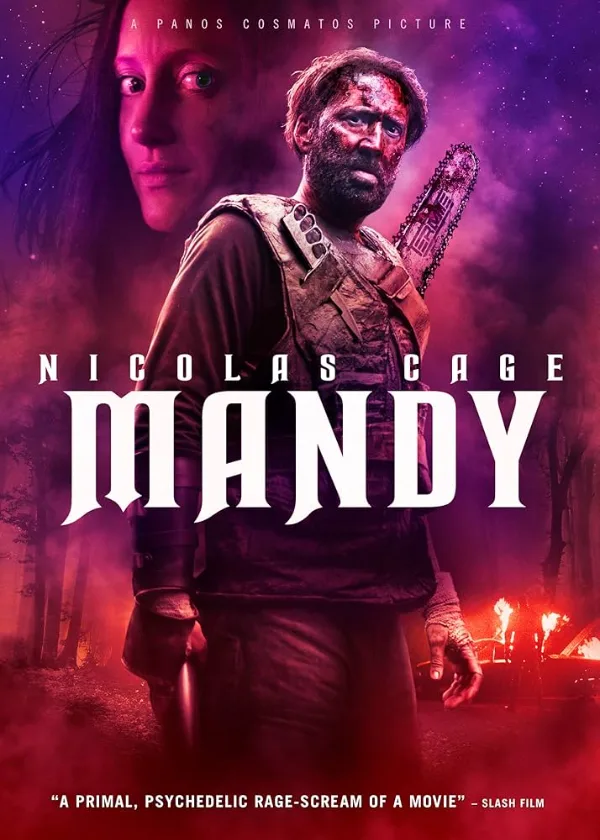
In the festering heart of the film industry—that slaughterhouse of dreams where originality drowns in a sea of sequels, reboots, and corporate franchises reeking of reheated plastic—Mandy emerges like a shriek of poisoned celluloid, a throat-punch to the algorithms that decide what deserves to be seen. Directed by Panos Cosmatos, son of the legendary George P. Cosmatos—that maestro of kitsch spectacle who gifted us Rambo: First Blood Part II and Tombstone—Mandy isn’t just a movie. It’s a visual exorcism, a psychedelic nightmare carved onto 35mm with the precision of a surgeon and the delicacy of a rusted axe. Premiering at Sundance in 2018, where it was met with that intoxicating mix of ecstasy and bewilderment reserved for films that dare to unsettle their audience, Mandy is the kind of movie that divides viewers like a butcher’s knife at a cannibal feast: you either love it with the devotion of a religious zealot, or you hate it with the fury of someone forced to watch their childhood trampled by a coked-up elephant. Clocking in at 121 minutes that feel like a time-traveling descent into hell—where the color red is patented by Satan himself and distorted guitars blare like the official anthem of the Apocalypse—Mandy is a sensory assault that lodges in your retina like a rusted nail in a dying eye.
The genesis of Mandy is as fascinating as its final product. Panos Cosmatos, a director who until then had only helmed Beyond the Black Rainbow (2010)—a retro-futuristic sci-fi gem that looked like it was filmed inside a VHS tape abused by an obsessive collector—somehow convinced Nicolas Cage—that actor who oscillates between genius and absurdity with the grace of a drunk tightrope walker—to dive into a role that demanded more of his physique than his line-memorizing skills. Cage, in one of those bursts of creative madness that have made him a living legend of cult cinema, accepted the challenge without batting an eye, as if he knew Mandy would be the film to redeem him in the eyes of those who only remembered him for his eccentricities in The Wicker Man (2006) or Ghost Rider (2007). The screenplay, penned by Cosmatos himself alongside Aaron Stewart-Ahn, is a masterclass in narrative economy: no superfluous dialogue, no unnecessary explanations, no concessions to conventional logic. It’s as if Samuel Beckett and Alejandro Jodorowsky teamed up to write a script after a night of absinthe and peyote, with the sole purpose of crafting a story that flows like a river of thick, gleaming blood.
The film opens with a quote from Henry Miller—"The world around us is but a reflection of our inner being"—which serves as an omen of what’s to come: a descent into the bowels of madness, where reality and hallucination merge in an incestuous embrace. Red Miller (played by Nicolas Cage), a lumberjack with a gaunt appearance and the gaze of a man who’s seen too much, lives in a cabin in the woods with his partner, Mandy Bloom (Andrea Riseborough), a woman of ethereal beauty and the smile of someone who’s accepted her fate like a martyr accepts the cross. Their life is tranquil, almost idyllic, until one day—like in a twisted fairy tale—a cult of religious fanatics led by Jeremiah Sand (Linus Roache), a guru with the charisma of an insurance salesman and the morals of an organ trafficker, decides Mandy must be his. What follows is a spiral of violence, revenge, and surrealism that culminates in a 20-minute sequence straight out of a David Lynch fever dream after binge-watching The Texas Chain Saw Massacre for a week.
But Mandy isn’t just a revenge flick—it’s a visual art piece that defies genre conventions. Panos Cosmatos doesn’t direct this movie; he paints it with light, color, and shadow, crafting compositions that look like they’ve been ripped from a 1970s underground comic or a Dario Argento wet dream at his most psychedelic. Every frame is loaded with symbolism, every camera movement a statement of intent, and every lighting choice a stab in the viewer’s eye. The cinematography by Benjamin Loeb, a frequent Cosmatos collaborator, is a symphony of blood-reds, electric blues, and sickly greens that pierce the retina like hypodermic needles filled with acid. It’s no exaggeration to say Mandy is one of the best-photographed films of the last decade—a work where color doesn’t just complement the narrative, it is the narrative.
Direction: The Controlled Delirium of a Visionary
Talking about Panos Cosmatos’ direction in Mandy is like discussing a master of controlled chaos, an alchemist who turns disorder into art with the same ease Nicolas Cage turns rage into guttural screams. Cosmatos doesn’t just direct this film; he choreographs it like a nightmare ballet, where every movement, every frame, and every transition is calculated to provoke a visceral reaction. From the opening shot of Mandy painting with watercolors in her notebook, bathed in golden light that seems to filter down from heaven itself, to the final sequence where Red bathes in blood like an inverted baptism, Cosmatos demonstrates absolute mastery of cinematic language.
One of the film’s most brilliant moments is the sequence where Red is drugged and locked in a cell by Jeremiah’s cult. Cosmatos films this scene as if we’re seeing the world through the eyes of a man poisoned with LSD and meth simultaneously. Colors distort, shadows stretch like skeletal fingers, and sounds muffle as if we’re underwater. It’s an overwhelming sensory experience, a hallucinogenic trip that makes Gaspar Noé’s Enter the Void (2009) look like a documentary about life in a Buddhist monastery. Cosmatos isn’t afraid to play with time and space, stretching shots to the limit of the viewer’s patience, only to abruptly cut to an explosion of violence that leaves you breathless. It’s as if Stanley Kubrick and John Carpenter teamed up to direct an episode of The Twilight Zone after a night of heavy drinking with Ken Russell.
But what truly sets Cosmatos apart as a director is his ability to balance style with substance. Mandy isn’t just a parade of striking images and trippy sequences; it’s a film with a dark heart, a story of love and loss unfolding in a world where madness is the only logical response to human cruelty. Cosmatos understands that genre cinema doesn’t have to be shallow—that even in a blood-soaked revenge tale, there’s room for poetry, melancholy, and reflection. And he pulls it off without resorting to cheap sentimentality or easy moralizing. Mandy is a film that punches you in the face and then whispers in your ear that everything will be alright, even though you both know it’s a lie.
Performances: Nicolas Cage and the Art of Creative Self-Destruction
If Mandy is a cult cinema masterpiece, Nicolas Cage is its prophet, its messiah, and its martyr. His portrayal of Red Miller is one of the most intense, physical, and emotionally brutal performances seen in recent years. Cage doesn’t play Red—he becomes him, as if his body and soul have been possessed by the spirit of a man who’s lost everything and has nothing left but rage. From the moment he appears on screen, with his unkempt beard, hollow gaze, and hunched posture, Cage exudes a sense of vulnerability and danger that’s impossible to ignore. It’s as if Marlon Brando and Charles Manson teamed up to create the most unsettling character in modern cinema.
But what truly makes Cage’s performance unforgettable is his ability to balance stillness with explosion. For much of the film, Red is a broken man, a ghost wandering the world as if already dead. Cage conveys this despair with an economy of gestures that’s simply staggering: a sigh, a blink, a barely perceptible muscle twitch. But when rage consumes him, when his thirst for vengeance drags him into the abyss, Cage transforms into a force of nature, a hurricane of fury that levels everything in its path. The sequence where Red forges an axe in his workshop—muscles tense, sweat glistening on his skin, eyes burning with a determination that seems capable of cutting through steel—is one of the most iconic moments in action cinema in recent years. It’s no exaggeration to say Cage steals the movie, but not in the traditional sense of "scene-stealing." No, he devours it, consuming it from within and spitting it back out as something entirely new.
The rest of the cast, though overshadowed by Cage’s titanic presence, also deliver standout performances. Andrea Riseborough, as Mandy, conveys a mix of sweetness and sorrow that makes her character far more than the typical "damsel in distress." Riseborough doesn’t play Mandy as a victim but as a woman who’s accepted her fate with a serenity bordering on the supernatural. Her chemistry with Cage is palpable, and when the film ventures into surreal territory, Riseborough proves herself a chameleon, shifting from tenderness to madness with the ease of horror cinema’s great actresses of the 1970s, like Barbara Steele or Daria Nicolodi.
Linus Roache, meanwhile, delivers a memorable performance as Jeremiah Sand, the cult leader who kidnaps Mandy. Roache avoids turning Jeremiah into a cartoonish villain; instead, he plays him as a man who genuinely believes in his own madness, a guru who’s confused megalomania with spiritual enlightenment. His scene where he sings an acoustic song to Mandy, with a smile carved into his face like a knife, is one of the film’s most unsettling and fascinating moments. It’s as if Charles Manson decided to audition for American Idol after a cocktail of LSD and mescaline.
Technical Aspects: A Feast for the Senses (and an Assault on Good Taste)
If Mandy were a dish, it would be a banquet of raw guts, hallucinogenic mushrooms, and moonshine distilled in a back-alley lab. Every technical aspect of the film is designed to provoke a visceral reaction—whether of ecstasy, revulsion, or a mix of both. Let’s start with the cinematography, because you can’t talk about Mandy without mentioning Benjamin Loeb’s work, a director of photography who seems to have been born with a camera in hand and an obsession with colors saturated to the point of madness. Loeb doesn’t just light the film; he paints it with a palette straight out of a Mario Bava fever dream after binge-watching Suspiria (1977) for a week. The reds are so intense they look like fresh blood, the blues so cold they burn, and the greens so sickly they seem to sprout from rot itself. Every frame is composed with surgical precision, as if Loeb were carving light with a scalpel.
But what truly makes Mandy’s cinematography exceptional is its ability to create atmosphere. Loeb and Cosmatos understand that terror isn’t always in what you see, but in what you feel. The scenes in Red and Mandy’s cabin, with their golden light and elongated shadows, exude a warmth that makes the ensuing violence even more jarring. In contrast, the forest scenes, with their bluish lighting and twisted trees, look like they’ve been plucked from a fairy tale written by H.P. Lovecraft. And then there are the hallucinogenic sequences, where Loeb goes completely off the rails, distorting colors and shapes as if the camera were possessed by the spirit of a mescaline-fueled German Expressionist painter.
The production design, by Hildur Guðnadóttir (yes, the same composer behind Joker and Chernobyl), is another highlight. Mandy isn’t a period piece, but its retro aesthetic—with its rusted cars, 1970s furniture, and thrift-store clothing—gives it a timeless quality, as if the story could be unfolding anytime from the 1960s to the present. The design of Jeremiah’s cult, with their white robes, animal masks, and temple that looks like a cross between an abandoned church and a slaughterhouse, is especially memorable. It’s as if Jim Jones and Aleister Crowley joined forces to create a religion that worships the devil with the same devotion others reserve for God.
The score, composed by Jóhann Jóhannsson (in one of his final collaborations before his tragic death in 2018), is a masterpiece of atmospheric terror. Jóhannsson, a maestro of electronic music and minimalism, crafts a soundtrack that seems to rise from the bowels of the earth, with synthesizers that sound like distorted screams and percussion mimicking the heartbeat of a dying man. The music doesn’t just accompany the film—it drives it, dragging the viewer into an abyss of despair and ecstasy. The main theme, with its hypnotic melody and obsessive rhythm, is one of those pieces that burrows into your brain like a worm and refuses to leave. It’s as if Ennio Morricone and John Carpenter teamed up to compose the soundtrack for a David Cronenberg wet dream.
And then there’s the editing, by Brett W. Bachman, which is as precise and brutal as an axe cleaving flesh. Bachman understands that the rhythm of a revenge film can’t be linear—it has to speed up and slow down like the heartbeat of a sick man. Transitions between scenes are often abrupt, as if the film is jumping from one thought to another without apparent logic, but always with purpose. The editing of the final sequence, where Red confronts the cult members, is a masterclass in suspense, with rapid cuts and tight close-ups that make the violence even more jarring. It’s as if Sam Peckinpah and Nicolas Winding Refn teamed up to edit a film after a night of drinking with Quentin Tarantino.
### The Best
- Panos Cosmatos’ direction: A masterclass in style and substance that proves genre cinema can be as poetic as it is violent, as beautiful as it is disturbing.
Nicolas Cage’s performance: A physical and emotional tour de force that oscillates between the stillness of a monk and the fury of a vengeful god. Cage doesn’t play Red—he becomes* him.
- Benjamin Loeb’s cinematography: A symphony of saturated colors and flawless compositions that turn every frame into a work of art. Mandy is one of the best-photographed films of the last decade.
- Jóhann Jóhannsson’s score: A hypnotic, obsessive soundtrack that seems to rise from the earth’s core, dragging the viewer into an abyss of despair and ecstasy.
- The production design: A retro aesthetic that gives the film a timeless quality, as if the story could be unfolding anytime from the 1960s to the present.
### The Worst
- Gratuitous violence: While Mandy’s violence serves a narrative and aesthetic purpose, there are moments where it feels excessive, even by cult cinema standards. Some viewers may find certain scenes hard to stomach.
- Underdeveloped characters: Though Red and Mandy are well-fleshed-out, other characters, like the cult members, are little more than caricatures. More depth in their motivations would’ve been welcome.
- Uneven pacing: The film has moments of near-unbearable slowness, especially in the first half, which might cause some viewers to lose interest before the plot kicks into gear.
- Excessive surrealism: While the hallucinogenic sequences are visually striking, they sometimes feel forced, as if Cosmatos crammed in more symbolism than necessary.
- Lack of dialogue: Mandy relies heavily on atmosphere and aesthetics, but the scarcity of dialogue can make some moments feel hollow or incomplete.
### The Verdict of Claqueta Ácida
Mandy is one of those films that comes along once a decade—a celluloid hurricane that levels everything in its path, leaving the viewer exhausted, bewildered, and, above all, alive. It’s a work that defies genre conventions, blending horror, drama, and surrealism with the grace of a drunk tightrope walker, proving that cinema can be both an art form and an act of war. Panos Cosmatos has crafted a film that’s as beautiful as it is brutal, as poetic as it is violent, one that lodges in your mind like a rusted knife in a dying eye. Nicolas Cage, for his part, delivers one of the most intense and physical performances of his career, an acting masterclass that swings between the stillness of a monk and the fury of a vengeful god. Mandy
🎬 Tráiler Oficial
💬 El Veredicto de la Comunidad
¿Qué te ha parecido la película? Deja tu nota de 0 a 10 para contrastarla con el análisis de la redacción.
Aún no has votado
📢 ¿Te ha gustado el ácido?
Comparte esta crítica con tus amigos cinéfilos o desata la polémica en redes.
📩 📩 Get the poison in your inbox
Join our weekly mailing list. Honest film reviews, acid festival coverage, and cult recommendations every Sunday morning. Zero spam, pure celluloid.
🔒 We promise weekly poisonous reviews and exclusive coverage.Related Reviews
Recommended autopsies for demanding film buffs.
 🔥 Fusión Nuclear8.5
**"Mandy: A Nightmare Forged in Steel and Fire"**
**"Nicolas Cage embarks on a blood-soaked rampage in this psychedelic revenge fever dream."**
 🔥 Fusión Nuclear8.5
*Mandy: Hell on Celluloid or How Cosmatos Turned a Garage Budget into a Psychedelic Nightmare*
Panos Cosmatos delivers a visual orgy of revenge, acid, and chainsaws that makes Tarantino look like an altar boy. There’s no redemption here—just charred flesh and demonic synthesizers.
 ⚡ Ácido Cítrico7.5
**Bugonia: The Cosmic Snatch**
Two young men convinced an executive is an alien kidnap her. Will they save Earth—or just their own delusions?