Appofeniacs — Silicon Valley’s Hangover in Low-Budget Nightmare Form
Chris Marrs Piliero attempts to exorcise the demons of tech addiction with a script that reads like it was spat out by a TikTok algorithm. The result? A visual hangover more painful than a thousand fake likes.

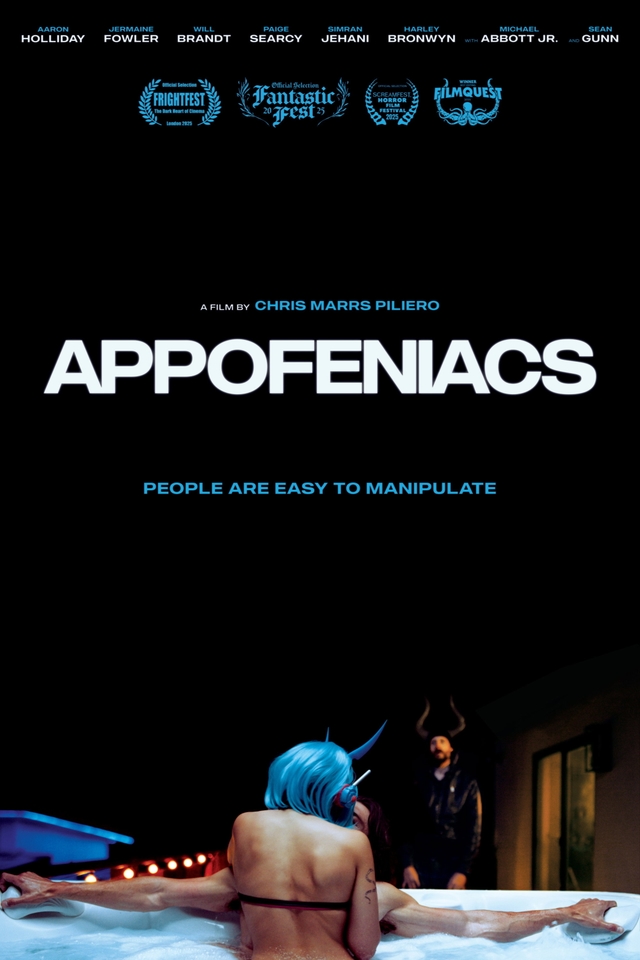
The scent of stale popcorn mingles with the artificial aroma of wireless earbuds in this neighborhood cinema, where Appofeniacs has chosen to premiere as if it were a low-budget social experiment funded by the same people who think NFTs are art. The screen flickers with the intensity of a dying fluorescent light, and the projector spews images with the precision of an influencer attempting to explain the theory of relativity. Chris Marrs Piliero, that enfant terrible who once gifted us the glorious chaos of Hansel vs. Gretel: Witch Hunters (2013), returns with a project that reeks of Kickstarter crowdfunding, sleepless nights justifying why his film deserves to exist, and the desperation of a director who, after years of silence, seems to have discovered that cinema isn’t made with just memes and good intentions. Odin's Eye Entertainment, a production company whose name evokes a Norwegian black metal band more than a serious film studio, has bet on a theme as worn-out as social media addiction, but with the subtlety of a sledgehammer to an iPhone 15 Pro Max. The problem isn’t the premise—God knows the world needs more films that spit in Silicon Valley’s face with the elegance of an anonymous dickpic—but that Piliero seems to have confused satire with an Instagram reel: fast, superficial, designed to be forgotten before the scroll ends, and with the intellectual depth of an Elon Musk tweet.
The film throws us headfirst into a world where likes are currency, followers determine your worth as a human being, and dopamine is as addictive as crack in the 80s. The protagonist, Luna, played by the ever-interesting Sophia Lillis, is an influencer whose life unravels when her addiction to an app called Appofenia (yes, that psychological term describing the human tendency to see patterns where none exist, applied here with the subtlety of an elephant in a china shop) drags her into a spiral of self-destruction. The app in question, designed by a tech bro with more ego than neurons (David Dastmalchian, in a role that seems written for him), promises to connect people on a “deep and meaningful” level but instead plunges them into a vortex of paranoia, anxiety, and digital dependency. The premise, in theory, is brilliant: a fierce critique of surveillance capitalism, the attention economy, and that modern obsession with quantifying every aspect of our existence. But in practice, Appofeniacs stays on the surface, like an influencer scratching the epidermis of social issues just to sell you a €999 mindfulness course.
The film’s opening shot greets us with a close-up so tight on a human eye that we could count the veins in the sclera. The camera slowly pulls back, revealing that the eye belongs to Luna, who is recording a vlog in which, with a toothpaste-ad smile, she tells us how her life has changed thanks to Appofenia. The lighting is cold, almost clinical, with blue and green tones reminiscent of Black Mirror’s palette, but without that show’s visual elegance. The editing is frenetic, with rapid cuts mimicking the rhythm of a TikTok feed, but here it only manages to make the viewer feel dizzy, as if suffering a real-time doomscrolling attack. Piliero seems obsessed with the idea that cinema should imitate the experience of scrolling through social media, but he forgets that cinema, when done well, is a sensory experience that goes beyond replicating the mediocrity of an endless timeline. The soundtrack, composed by Joseph Trapanese (a name that sounds like a mix between a Star Wars villain and a Spotify algorithm), is a mishmash of electronic sounds attempting to convey tension but ending up like a 2005 phone ringtone.
Direction: Chaos as Style (or the Lack Thereof)
Chris Marrs Piliero directs Appofeniacs as if competing in a reality show of cinema: rushed, unplanned, and hoping the audience settles for anything as long as it’s “modern.” His visual style is as chaotic as the mind of an influencer after a true crime binge-watch. In a key scene, Luna discovers that Appofenia is manipulating her memories, and the sequence is resolved with a split screen straight out of 24, but with the quality of a Stranger Things fan film. Shots overlap, colors saturate to the point of resembling an LSD overdose, and the visual effects—straight out of 2010 After Effects—attempt to convey reality distortion but only make the viewer wonder if the cinema’s projector is about to explode.
Piliero has moments of brilliance, like when he films Luna in a long take as she walks through her apartment, a minimalist and aseptic space that seems designed by a Pinterest algorithm. The camera follows her as she moves between objects that gleam with the coldness of an Apple Store, and the ambient sound reduces to a constant hum, as if we’re inside her head while her brain melts from screen overexposure. But these moments are rare and drown in the rest of the footage, which seems more concerned with imitating the style of films like Uncut Gems or Searching than developing its own voice. Appofeniacs wants to be a cool movie but ends up as cool as a dad attempting to dance perreo at a wedding.
Actors: Cardboard Chemistry and Paint-by-Numbers Performances
The cast of Appofeniacs is a mishmash of actors who seem to have been chosen by a casting algorithm looking for “recognizable faces willing to work for peanuts.” Sophia Lillis, an undeniably talented actress who already proved herself in films like Dungeons & Dragons: Honor Among Thieves and I Am Not Okay With This, does what she can with the material at hand. Her Luna is a mix between an Instagram influencer and a psychiatric patient, and though her performance has moments of genuine despair—like when she smashes her phone in a fit of rage straight out of a Twitter meme—the script forces her to recite lines as profound as a puddle in August. In one scene, she tells her boyfriend (played by Justice Smith, whose charisma is as absent as his screen time): «Social media doesn’t connect us, it isolates us within our own bubbles», a line that sounds as original as a Paulo Coelho tweet.
David Dastmalchian, that supporting actor who always seems on the verge of stealing the scene but never quite does, plays the creator of Appofenia, a tech bro with more red flags than a traffic light in an earthquake. His character is a mix between Mark Zuckerberg and Elon Musk, but with the psychological depth of a 9GAG meme. Dastmalchian tries to humanize his role, but the script forces him to spout lines like «Technology isn’t good or bad, it’s just a tool», which sound as inspiring as a 90s Microsoft slogan. The rest of the cast—including Justice Smith as the millennial boyfriend who only exists to state the obvious and Brittany Snow as the best friend straight out of a Gossip Girl episode—pass without glory, like extras at a Coachella afterparty.
Technical Department: When the Budget Shows (and Not in a Good Way)
The production design of Appofeniacs is a homage to the tech aesthetic of the 2010s, with minimalist apartments full of white furniture, giant screens, and LED lights straight out of an IKEA showroom. The problem is that everything feels as fake as an influencer’s smile in an unboxing video. The spaces are cold, aseptic, and devoid of personality, as if the art director confused “modern” with “boring.” The costumes, meanwhile, are a disaster: Luna dresses like she’s in a Pinterest moodboard, with outfits designed to be photographed in flat lays but that, in motion, look like they came from a dodgy outlet store.
The cinematography, by Zachary Shedd, is one of the few technical aspects that saves the film from being a total disaster. Shedd plays with lighting to create an oppressive atmosphere, using blue and green tones reminiscent of films like Her or Ex Machina. However, even here, the lack of budget is noticeable, like in the digital flashback scenes where the visual effects look like they were made in Windows Movie Maker. The music by Joseph Trapanese, meanwhile, is a mishmash of electronic sounds trying to convey tension but ending up like the ringtone of a Nokia 3310. In a key scene, when Luna discovers that Appofenia is manipulating her memories, the music climaxes with a drop that sounds as forced as a jump scare in a low-budget horror film.
The editing, by Brian Scofield, is another weak point. Scofield tries to mimic the frenetic pace of films like Uncut Gems or The Social Network, but ends up creating a visual experience as exhausting as a 3 AM TikTok binge. The cuts are rapid, the zooms are abrupt, and the transitions between scenes look like they came from an iMovie tutorial. At one point, the film even resorts to a split screen straight out of 24, but with the quality of a Stranger Things fan film. Appofeniacs wants to be a modern and avant-garde film but ends up as avant-garde as a 2018 Instagram reel.
The best
The cinematography: Zachary Shedd manages to create an oppressive and claustrophobic atmosphere with a cold color palette reminiscent of films like Her or Ex Machina*. The shots of Luna in her minimalist apartment are visually striking and convey the isolation the character suffers. Sophia Lillis: Despite the script, Lillis conveys the desperation and fragility of Luna with a performance that, at its best, recalls the intensity of Florence Pugh in Midsommar*.- The premise: Though the execution leaves much to be desired, the idea of critiquing social media addiction and surveillance capitalism is relevant and necessary in today’s cinema.
The worst
The script: A mishmash of clichés, pretentious dialogue, and predictable situations that reads like it was written by an AI trained on self-help tweets*. The pacing: The frenetic editing and rapid cuts make the film exhausting to watch, like suffering a real-time doomscrolling* attack. The visual effects: Straight out of a 2010 After Effects tutorial, with digital glitches that look like they were made in Windows Movie Maker*. The lack of originality: Appofeniacs wants to be a cool and avant-garde film but ends up a rehash of ideas already seen in Uncut Gems, Searching, and Black Mirror*. The supporting cast: Justice Smith and Brittany Snow pass without notice, like extras at a Coachella* afterparty.The Verdict of Claqueta Ácida
Appofeniacs is what happens when a talented director becomes obsessed with imitating the style of films he admires instead of developing his own voice. Chris Marrs Piliero has moments of brilliance, but his film ends up a rehash of ideas already seen, with a pretentious script, low-budget visual effects, and a cast lost in an endless timeline. The premise is interesting, but the execution is as superficial as an Instagram reel. Appofeniacs isn’t a bad movie, but it’s a movie that stays on the surface, like an influencer scratching the surface of social issues just to sell you a life-coaching course. At Claqueta Ácida, we believe cinema should be a sensory experience, not an endless scroll. And this film, unfortunately, is the latter. 💀
🎬 Tráiler Oficial
💬 El Veredicto de la Comunidad
¿Qué te ha parecido la película? Deja tu nota de 0 a 10 para contrastarla con el análisis de la redacción.
Aún no has votado
📢 ¿Te ha gustado el ácido?
Comparte esta crítica con tus amigos cinéfilos o desata la polémica en redes.
📩 📩 Get the poison in your inbox
Join our weekly mailing list. Honest film reviews, acid festival coverage, and cult recommendations every Sunday morning. Zero spam, pure celluloid.
🔒 We promise weekly poisonous reviews and exclusive coverage.Related Reviews
Recommended autopsies for demanding film buffs.
 ⚠️ Ácido Sulfúrico4.8
Appofeniacs: Silicon Valley’s Hangover in Low-Budget Nightmare Form
Chris Marrs Piliero attempts to exorcise the demons of tech addiction with a script that reads like it was spat out by a TikTok algorithm. The result? A visual hangover more painful than a thousand fake likes.
 ⚠️ Ácido Sulfúrico0.0
**PUFA 2026: "Bad Haircut" Wins the Festival—and Its Barber Gives Us a One-Way Ticket to Nuremberg (The Definitive Palmares, or How to Learn to Love the Absurd)**
*"Bad Haircut" takes home Best Film at the third edition of the Valladolid International Fantastic and Horror Film Festival, while the jury and critics remain deeply divided over the film’s quality.*
 ⚡ Ácido Cítrico5.0
Quantum Rave: The Neon Feast Nobody Asked For (And We All Deserved)
Paco Campano serves us a cocktail of cheap psychedelia and rusted robotics in 'Quantum Rave.' Art or cosmic vomit? Claqueta Ácida decides with boxing gloves on.