*Chime — The Japanese Whisper No One Asked For (And Everyone Deserved to Ignore)*
*The Japanese Whisper No One Asked For (And Everyone Deserved to Ignore). Kiyoshi Kurosawa dives into domestic horror with *Chime*, a series that whispers more than it screams and bores more than it terrifies. Art or visual nap time?*

By Silvia Mordaz | Green Dogs
The firmament of Asian horror—that dark, fascinating cosmos that gifted us the existential dread of Ringu and the viral paranoia of Kairo—once had a favorite comet: Kiyoshi Kurosawa. A name that, for the seasoned cinephile and the masochist of subtly unsettling cinema, was synonymous with a school of horror that operated at the antipodes of cheap scares, delving instead into the depths of the psyche and the slow erosion of sanity. Kurosawa didn’t scream; he whispered. He didn’t show the monster; he showed the void it left behind. Or at least, that’s how it used to be. His filmography, a labyrinth of urban ghosts, alienating technologies, and nightmarish bureaucracies, had conditioned us to a kind of discomfort that burrowed under the skin, fermenting a malaise that rarely exploded into cathartic climax, opting instead for a coda of desolation.
But time, that relentless devourer of legacies, seems to have played a trick on the master. The industry, with its insatiable hunger for content and its tendency toward regurgitation, often pressures established talents to keep producing, regardless of whether the muse has decided to take an indefinite vacation in a ryokan with no signal. And so, we get Chime, the latest offering from the man who was once a goldsmith of dread. It’s sold as “domestic horror,” a label that, in Kurosawa’s hands, should mean the pulverization of the everyday, the irruption of the inexplicable in your miso soup or the doorbell’s ring. The promise is tantalizing: horror nesting in banality, the specter lurking in the reflection of your microwave. But what we’re served is watered-down ginger tea—a lukewarm infusion of recycled ideas that, far from unsettling, induces an unsettling drowsiness.
The expectation, of course, was a slow poison. Kurosawa’s pedigree, his track record of masterpieces like Cure or the aforementioned Pulse, had raised the bar to stratospheric heights. But Chime slithers under that bar with all the grace of a dying snail. It’s not that we expected gory fireworks or textbook jump scares; in fact, that would’ve been a betrayal of his style. What we yearned for was that subtle distillation of unease, that masterful use of off-screen space and ambient sound to hint at a horror the image dared not show. But here, the whisper has become inaudible, the insinuation diluted into absence, and the terror transformed into a near-autistic monotony. One begins to suspect that Kurosawa, in his quest to perfect the art of the anti-climax, has reached a point of no return where suspense evaporates before it’s even conceived. Is this avant-garde? Or is it simply the fatigue of an auteur who’s said it all and now just murmurs into his own echo?
Direction (Kiyoshi Kurosawa): The Maestro’s Rusty Rattle
Kiyoshi Kurosawa, the man who taught us to fear computer keyboards and broken elevators, presents Chime with a style we might call “Kurosawa-core”: static shots stretched into eternity, a color palette so desaturated that life itself seems to bleed out on screen, and a predilection for brutalist architecture and empty spaces that, in theory, should resonate with the existential vacuity of the characters. But what was once a sublime exercise in restraint now feels like forced restraint, a self-imitation without the original spark.
The director seems to have adopted the philosophy that less is more—so much so that “less” has become “nothing.” The long takes that in Cure generated an unbearable crescendo of discomfort now simply invite you to check your phone or ponder the meaning of your own existence—not because of the depth of what’s on screen, but because of its desperate absence. The tempo is so languid that scenes drag like a rheumatic ghost, every second stretched until any tension, if it ever existed, dissolves into the ether of indifference. Kurosawa seems to confuse subtlety with narrative starvation, leaving the viewer in a limbo of frustrated expectations. The camera, which should be a surgical eye observing the unraveling of reality, is here a passive, almost apathetic observer of events that barely matter.
Cast: Anodyne Silences and Screams Drowned in Yawns
The cast of Chime, led by Mutsuo Yoshioka, Ichimaru Kotoha, and Shota Sometani, embodies Japanese restraint to the point of pathological inexpression. Yoshioka, in the central role, moves through the film with the same emotion as a bureaucrat filling out forms. His character is supposedly haunted by a supernatural force manifested in a persistent chime, but his face rarely betrays more than vague perplexity or mild annoyance—as if the house were possessed by a spirit that refuses to fold the laundry. Is this minimalist acting in line with the tone? Or is it simply that the direction gave them nothing substantial to work with?
Ichimaru Kotoha brings an ethereal presence that, while aesthetically coherent with Kurosawa’s universe, gets lost in the fog of the subplot and the vagueness of the threat. And Shota Sometani, an actor with proven range in films like Himizu, feels underutilized here, a cog in a narrative machine running on fumes. The chemistry between the characters is nonexistent; their interactions are as cold and distant as the interiors of Japanese apartments. You don’t connect with their terror because they themselves don’t seem entirely sure they’re supposed to feel it. It’s an orchestra of silences where each musician seems to have forgotten their sheet music—or their instrument altogether.
Technical Aspects: The Aesthetics of Nothingness
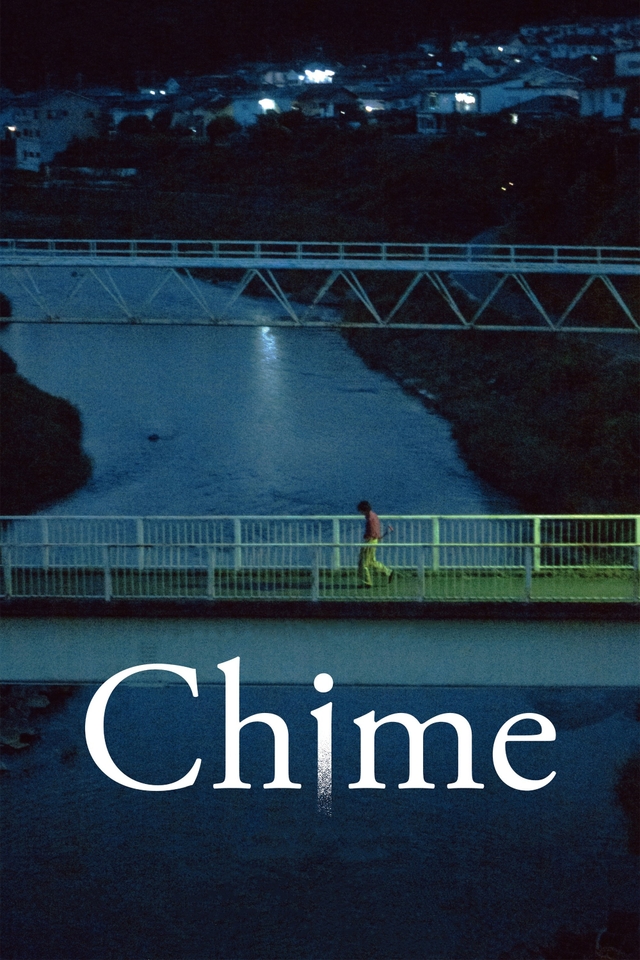
Technically, Chime is unmistakably Kurosawa. The cinematography, with its palette of grays, muted blues, and deep blacks, is atmospheric in theory but monotonous in practice, almost suffocating. Every frame seems stripped of any hint of joy or vitality, leaving only the husk of the real. The production design reinforces this sense of desolate domesticity: apartments that are minimalist prisons, everyday objects that become symbols of an elusive threat. But the most crucial element—the “chime” that gives the film its title and should be the epicenter of the horror—is a sonic letdown. At first, its persistence is unsettling, but it quickly becomes just another irritant, a bicycle bell ringing for no apparent reason, losing all its capacity to generate anxiety or dread. We were promised a symphony of subtle terror and got the jingle of a bored cat playing with a bell ball. The atmosphere, which in Kurosawa’s work used to be a character in itself, here feels like an empty wrapper, a visual promise that never materializes into a visceral experience.
### The Best
- Aesthetic consistency: If you were expecting a visually recognizable Kurosawa, you got it—love it or hate it.
- The initial concept of the “chime”: For the first ten minutes, the idea of an omnipresent sound sparks a flicker of curiosity.
- No cheap jump scares: Kurosawa remains true to his anti-formula for easy frights, which is appreciated if you’re in the mood for a nap.
### The Worst
- Lethargic pacing: The slowness is mistaken for stagnation, and any suspense, if it ever existed, evaporates within minutes.
- Apathetic performances: The cast seems infected by the general indifference, leaving little room for emotional connection.
- Lack of narrative progression: The film goes in circles, stretching a minimal idea to exhaustion.
- Insipid “horror”: What’s sold as psychological horror becomes a series of tedious, impactless events.
- Abuse of empty symbolism: Too many long shots that “suggest” something without ever actually saying anything.
### The Verdict of Claqueta Ácida
Chime is, in essence, Kiyoshi Kurosawa on autopilot—a distant echo of his past genius. What in other hands would be a misfire hides here under the veil of “authorship” and “slow cinema.” We were promised a whisper that would chill our blood and got an inaudible murmur, a lullaby for insomniac cinephiles who confuse subtlety with vacuity. A failed experiment in self-indulgence that, sadly, proves even masters can lose their tone and melody. If you’re looking for unsettling horror, rewatch Cure. If you’re looking for a naptime excuse, Chime is your movie. 💀💬 El Veredicto de la Comunidad
¿Qué te ha parecido la película? Deja tu nota de 0 a 10 para contrastarla con el análisis de la redacción.
Aún no has votado
📢 ¿Te ha gustado el ácido?
Comparte esta crítica con tus amigos cinéfilos o desata la polémica en redes.
📩 📩 Get the poison in your inbox
Join our weekly mailing list. Honest film reviews, acid festival coverage, and cult recommendations every Sunday morning. Zero spam, pure celluloid.
🔒 We promise weekly poisonous reviews and exclusive coverage.Related Reviews
Recommended autopsies for demanding film buffs.
 ⚡ Ácido Cítrico5.0
*Chime: The Japanese Whisper No One Asked For (And Everyone Deserved to Ignore)*
*The Japanese Whisper No One Asked For (And Everyone Deserved to Ignore). Kiyoshi Kurosawa dives into domestic horror with *Chime*, a series that whispers more than it screams and bores more than it terrifies. Art or visual nap time?*
 ⚡ Ácido Cítrico6.2
*Exit 8*: The Horror Station That Can’t Find Its Way Out (And Neither Can You)
Genki Kawamura adapts *The Exit 8* video game with more loops than a politician’s campaign promises. Will it escape the purgatory of J-horror, or is it doomed to linger in its own terminal?
 ⚠️ Ácido Sulfúrico4.2
**Good Boy: The Dog That Saved No One (Not Even Itself)**
A supernatural canine stars in a film that barks up the wrong tree. *Claqueta Ácida* dissects this rural dud with the precision of a scalpel in a slaughterhouse.