*Blood Harvest — The Claqueta Ácida Verdict*
When the corn turns red and Frendo the clown sows terror with a grin from ear to ear. Eli Craig grows horror in a rotten cornfield: a killer clown, insufferable teens, and a harvest of clichés.

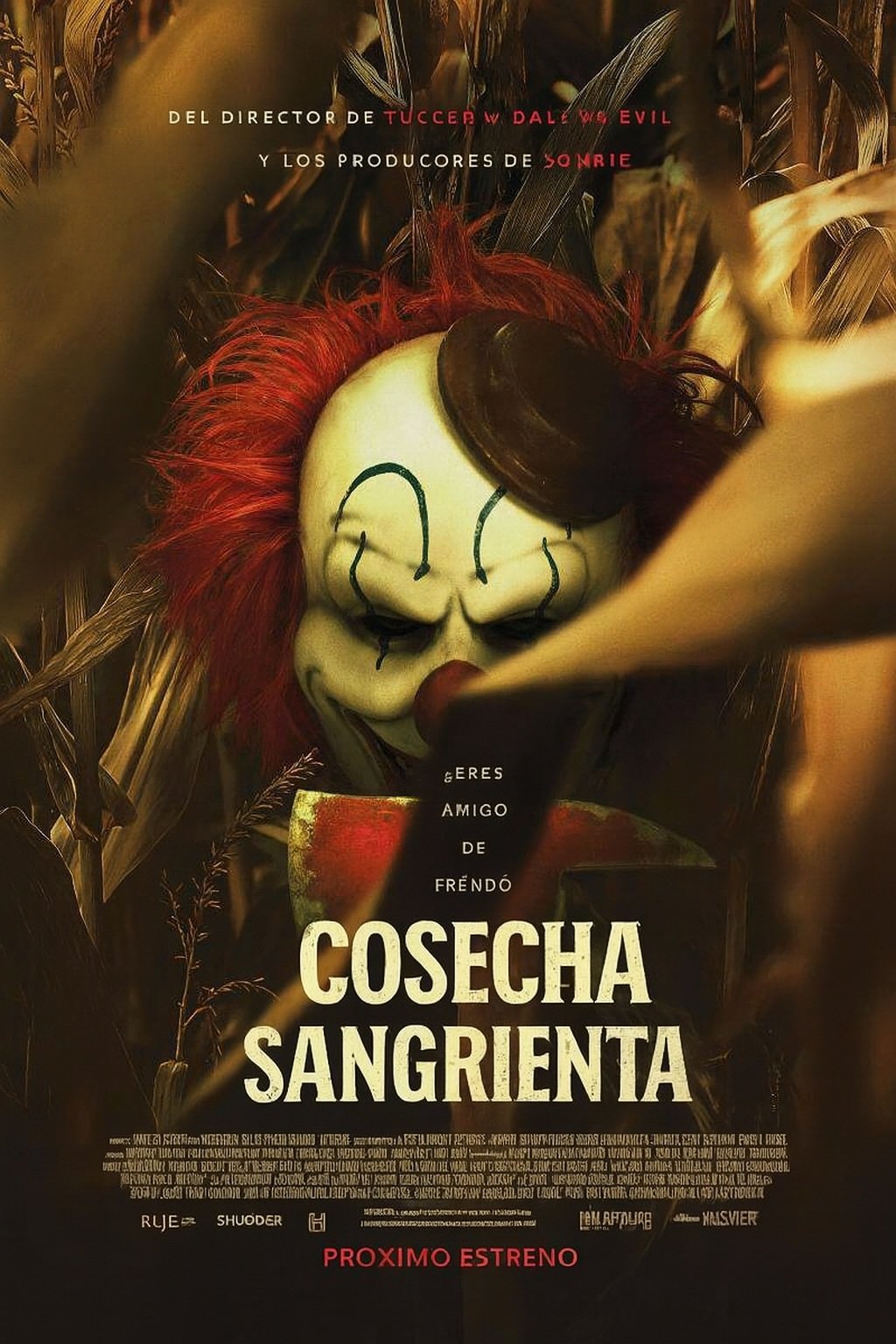
In the vast and often barren landscape of contemporary horror cinema—where nostalgia is recycled to the point of exhaustion and originality is as scarce as self-awareness at an indie film festival—the mere existence of a movie like Blood Harvest feels almost like an act of defiance. Directed by Eli Craig, a name that will ring in the ears of the most perverse cinephiles thanks to his unforgettable Tucker & Dale vs. Evil, this new foray into rural horror promised more than just a simple salad of corn and guts. Craig, a master of black humor and subverting tropes, had proven with his debut a rare talent for turning horror clichés inside out, transforming blood into laughter and paranoia into a delicious comedy of errors. The question hanging in the air of 2025, thick with smoke and broken promises like any third-rate film festival, was whether the director could replicate that magic—or if he would succumb to the genre’s gravitational pull, the very thing he once playfully deconstructed.
Blood Harvest arrives at a time when killer clowns have gone from being a legitimate cultural phobia to a subgenre as worn-out as demonic possessions featuring Latin-spouting teens. From Pennywise to a slew of bargain-bin knockoffs, the fear of the evil circus man has been milked dry, leaving audiences with a bland aftertaste. Yet, the premise here is as simple as country bread: a cornfield, a homicidal clown named Frendo, and a family—or what’s left of one—trying to survive. The official synopsis, that pearl of advertising conciseness—"When the corn turns red and Frendo the clown sows terror with a grin from ear to ear. Eli Craig grows horror in a rotten cornfield: a killer clown, insufferable teens, and a harvest of clichés"—not only spoils the plot but also feels like a kamikaze manifesto. Is this a statement of intent or just another layer of irony? At Claqueta Ácida, we lean toward the latter, because Eli Craig’s art, even when wallowing in the muck of tropes, is rarely naive.
The industrial context of a film like this is just as revealing. In an era dominated by endless franchises, anemic reboots, and sequels no one asked for, an original film (within the subgenre’s limits, of course) that isn’t based on an ‘80s toy or a Stephen King novel (though echoes of Children of the Corn are inevitable) is almost an anomaly worth studying. Craig doesn’t have the safety net of a pre-existing cinematic universe or the pressure to please a fanbase with millennia-old expectations. Instead, he has the freedom to play in his own sandbox—even if that sandbox is littered with the same stereotypes the synopsis promises to drench in blood. The question, then, isn’t whether Blood Harvest is original, but whether it can be interesting despite its glaring lack of novelty. Can it, through direction, script, or performances, lift us above mere repetition and offer more than an afternoon of popcorn and cheap scares? Against all odds—and despite his own track record—Eli Craig flirts with success, though his Frendo the Clown may not quite reach the heights of the myths it emulates.
Direction
Eli Craig is a craftsman of visual irony, a director who knows when gore should be crude and when comic timing is deadlier than any knife. In Blood Harvest, he largely abandons the brash comedy of his earlier work to dive into a more direct—and surprisingly effective—brand of terror. There are no grand displays of stylistic virtuosity here; the camera is functional, chasing its victims with brutal efficiency, paying homage to old-school slashers. Craig understands that fear in a cornfield doesn’t lie in grandiose shots but in the claustrophobia of endless rows, in the whisper of the wind carrying malevolent laughter. The direction is restrained but intelligent, using the environment as another character. There are moments where tension builds with commendable patience, exploding into scares that, while predictable, hit their mark with a competence many novice directors would envy. Craig isn’t reinventing the wheel, but he makes it spin with unsettling smoothness, proving he knows the rules of the game even when he chooses the conventional path. The problem, perhaps, is that this restraint sometimes borders on a lack of personality, leaving the film in no-man’s-land between serious horror and self-parody.
Cast
The cast of Blood Harvest is a collection of archetypes as necessary as they are exasperating in this kind of film. Quinn, the teenage protagonist (played with a mix of defiance and vulnerability that wavers between believable and irritating), becomes the epicenter of the nightmare. Her evolution from spoiled brat to hardened survivor is a path we’ve walked a thousand times, but here it’s traversed with a brutal honesty that barely avoids caricature. Quinn’s father, the stoic yet ineffective protector, embodies the desperate adult who, in a subversive twist, doesn’t always have the answers or the ability to save the day, adding a layer of tragic realism to the narrative. But the true star, the film’s gravitational force, is Frendo the Clown. Played with unsettling physicality and a mastery of body language that transcends the need for dialogue, Frendo is a pure terror entity. He’s not a clown with a complex backstory or a psychological monster; he’s an unstoppable force of chaos, a smile that twists into a death rictus. The choice to keep Frendo as a figure of primal horror, without concessions to humanity or explanation, is a resounding success that elevates him above his more talkative—and often less terrifying—cinematic peers. His presence is the film’s burning nail.
Technical Aspects
If Blood Harvest excels at anything, it’s enveloping us in its atmosphere of rural decay. The cinematography, handled by a team that understands the eerie beauty of agricultural landscapes, plays with the light and shadows of dawn and dusk, transforming golden corn into a nightmarish labyrinth. The colors are earthy, saturated in an autumnal palette that foreshadows death and decay. The soundtrack, meanwhile, is a silent but omnipresent character. It avoids orchestral excesses, focusing instead on amplified diegetic sounds: the crunch of dry leaves, the moan of the wind, strange whistles that seem to come from nowhere, all seasoned with a minimalist score that knows when to be subtle and when to strike hard in key moments. The production design is austere but effective, recreating a rural America that feels authentic in its decay. And of course, the special effects—both practical and digital—are a feast for gore lovers. Blood flows generously, but never gratuitously; every wound, every mutilation, has weight and texture that contribute to the brutality of the experience. This isn’t a pristine film; it’s dirty, sticky, and painfully real in its depictions of violence.
### The best
- The atmosphere: The cornfield and its use as a claustrophobic labyrinth is a character in itself, oppressive and beautifully shot.
- Frendo the Clown: A primal terror entity, stripped of unnecessary frills or explanations, whose physicality and presence are magnetic and terrifyingly effective.
- Honest brutality: The gore is unflinching and without concessions, always serving the narrative rather than mere exhibitionism.
- Eli Craig’s direction: Despite embracing clichés, he demonstrates technical and narrative mastery in building tension and delivering solid scares.
### The worst
- Predictable plot: The script follows a well-trodden path, with few deviations to surprise seasoned genre fans.
- Archetypal characters: While they serve their purpose, Quinn and her father are figures we’ve seen hundreds of times, lacking the depth that would elevate the story.
- The ending: Though effective in its brutality, it doesn’t offer a resolution that feels fresh or particularly memorable.
### The Verdict of Claqueta Ácida
Blood Harvest is, at its core, a love letter to rural horror clichés, written in blood and acidic ink by Eli Craig. It’s a competent film, even brilliant in its execution of conventions, but it rarely dares to step out of line. Frendo the Clown is an instant iconic villain, and the atmosphere ensnares you like a rusty trap. Yet, its lack of real risk dooms it to being a solid guilty pleasure, not a transcendent one. A 7/10 for fans of well-crafted, predictable gore. An experience that leaves you satisfied but with a bitter aftertaste of what could have been if Craig had unleashed his subversive genius. 💀
💬 El Veredicto de la Comunidad
¿Qué te ha parecido la película? Deja tu nota de 0 a 10 para contrastarla con el análisis de la redacción.
Aún no has votado
📢 ¿Te ha gustado el ácido?
Comparte esta crítica con tus amigos cinéfilos o desata la polémica en redes.
📩 📩 Get the poison in your inbox
Join our weekly mailing list. Honest film reviews, acid festival coverage, and cult recommendations every Sunday morning. Zero spam, pure celluloid.
🔒 We promise weekly poisonous reviews and exclusive coverage.Related Reviews
Recommended autopsies for demanding film buffs.
 ⚡ Ácido Cítrico7.0
*Blood Harvest: The Claqueta Ácida Verdict*
When the corn turns red and Frendo the clown sows terror with a grin from ear to ear. Eli Craig grows horror in a rotten cornfield: a killer clown, insufferable teens, and a harvest of clichés.
 ⚡ Ácido Cítrico6.2
*Exit 8*: The Horror Station That Can’t Find Its Way Out (And Neither Can You)
Genki Kawamura adapts *The Exit 8* video game with more loops than a politician’s campaign promises. Will it escape the purgatory of J-horror, or is it doomed to linger in its own terminal?
 ⚠️ Ácido Sulfúrico4.2
**Good Boy: The Dog That Saved No One (Not Even Itself)**
A supernatural canine stars in a film that barks up the wrong tree. *Claqueta Ácida* dissects this rural dud with the precision of a scalpel in a slaughterhouse.