*Exit 8* — The Horror Station That Can’t Find Its Way Out (And Neither Can You)
Genki Kawamura adapts *The Exit 8* video game with more loops than a politician’s campaign promises. Will it escape the purgatory of J-horror, or is it doomed to linger in its own terminal?


Japanese horror cinema has spent decades playing hide-and-seek with our sanity, but Genki Kawamura appears to have cracked the code for getting hopelessly lost: adapt a psychological horror video game and transform it into an abandoned subway station where the script circles the drain like a driverless train. Exit 8 (or 8番出口 for purists who relish deciphering titles like they’re hieroglyphics) arrives in 2025 with the promise of a bloody Groundhog Day, only to deliver a Groundhog Minute—every second looping with the same intensity as a toothpaste ad on repeat. Kawamura, best known for Your Name (yes, that film that made half the planet weep over its body-swap twist), here attempts to explore horror from a claustrophobic angle but ends up trapped in his own premise like a commuter in a carriage with no doors. The result? A film that moves forward, backward, and forward again, but never arrives anywhere interesting—like a GPS stuck in demo mode inside a hall of shattered mirrors.
The industrial context of Exit 8 is as predictable as its plot: TOHO, the studio behind gems like Godzilla and Battle Royale, rolls the dice once more on J-horror, a genre that’s lately oscillated between low-budget J-horror (with its long-haired ghosts and cursed children) and video game adaptations that promise more than they deliver. The Exit 8, the original game by KOTAKE CREATE, is a first-person horror puzzle where players navigate a subway station while avoiding visual anomalies that reset their progress. Sounds intriguing, right? Well, Kawamura, in his zeal to bring the premise to the big screen, decides the best approach is to turn terror into a mechanical exercise of repetition, as if the script were written by a YouTube algorithm that only knows how to recommend the same video over and over. The issue isn’t the premise itself—psychological horror based on time loops has birthed masterpieces like Triangle (2009) and The Infinite Man (2014)—but that Exit 8 seems more interested in replaying scenes with minor variations than exploring the narrative or emotional potential of its own concept. It’s like watching a chef obsessed with preparing the same dish repeatedly, only changing the plate’s color.
The cultural climate in which Exit 8 arrives is as confusing as its plot. Japanese horror cinema has lost steam over the past decade, drowned by unnecessary sequels (Ju-On, Ringu) and the unfair competition from Korean and American productions that have raised the genre’s bar. While films like The Wailing (2016) and Train to Busan (2016) proved Asian horror could be intelligent, visceral, and emotionally complex, Exit 8 settles for being a hollow stylistic exercise, where the only thing repeating more than the plot loop is the nagging sense that someone forgot to write a script with substance. Kawamura, who demonstrated solid narrative chops in Your Name, here seems more preoccupied with recreating the video game’s aesthetic than crafting a story that hooks the viewer. The result is a film that feels like an extended demo, a two-hour teaser where the only recurring element is a guy sprinting through dark corridors, as if the director mistook horror for a mobile endless runner.
Then there’s the cast, led by Kazunari Ninomiya, an actor who’s more than proven his talent in films like Letters from Iwo Jima (2006) but here seems adrift in a maze with no exit, as if someone told him his job was to run, scream, and repeat. The supporting actors, like Nana Komatsu (the only one who seems to grasp she’s in a horror film) and Yamato Kawauchi, try to inject some life into their roles, but the script dooms them to be little more than cardboard cutouts moving through a cardboard set. The production design is competent but generic: dimly lit hallways, flickering lights, and graffiti-covered walls that look lifted straight from an Unreal Engine asset pack. In short, Exit 8 is a film that doesn’t know if it wants to be a psychological thriller, a slasher, or an existential horror experiment, and ends up being a bit of everything and nothing at all—like a fast-food buffet where every dish tastes the same: a missed opportunity.

The direction: Kawamura on autopilot
Genki Kawamura directs Exit 8 as if following a tutorial on how to make a Japanese horror film in 2025: take a claustrophobic setting, add a time loop, mix in a confused protagonist, and serve cold. The problem is that, in his eagerness to stay faithful to the original game, Kawamura forgets that cinema isn’t an interactive puzzle but a medium that demands pace, tension, and character development. Scenes repeat with surgical precision but lack the spark of creativity that could’ve made them interesting. For instance, there’s a moment where the protagonist discovers a corpse in a restroom, and instead of using the discovery to build tension or advance the plot, the film simply replays the same scene from another angle, as if the director mistook horror for a making-of of itself. The editing, handled by a competent but uninspired team, reinforces this sense of mechanical repetition, as if the film were assembled by a Python script that only knows copy-paste.
The cinematography by Keisuke Imamura is, without doubt, Exit 8’s most standout aspect. The subway station shots are bathed in a dim, bluish light that evokes the oppressive atmosphere of Dark or The Platform, though it never quite reaches the visual depth of either. Imamura plays with shadows and reflections to create disorientation, but the script insists on reminding us, over and over, that there’s nothing new under this cursed platform. The score, composed by a team whose names aren’t even worth remembering, is functional but forgettable—like the elevator music in an abandoned office building. In short, Kawamura’s direction is technically competent but artistically bland, like a hyperrealistic painting of a mundane object: impressive in execution, empty in meaning.
The acting: A cast lost in the loop
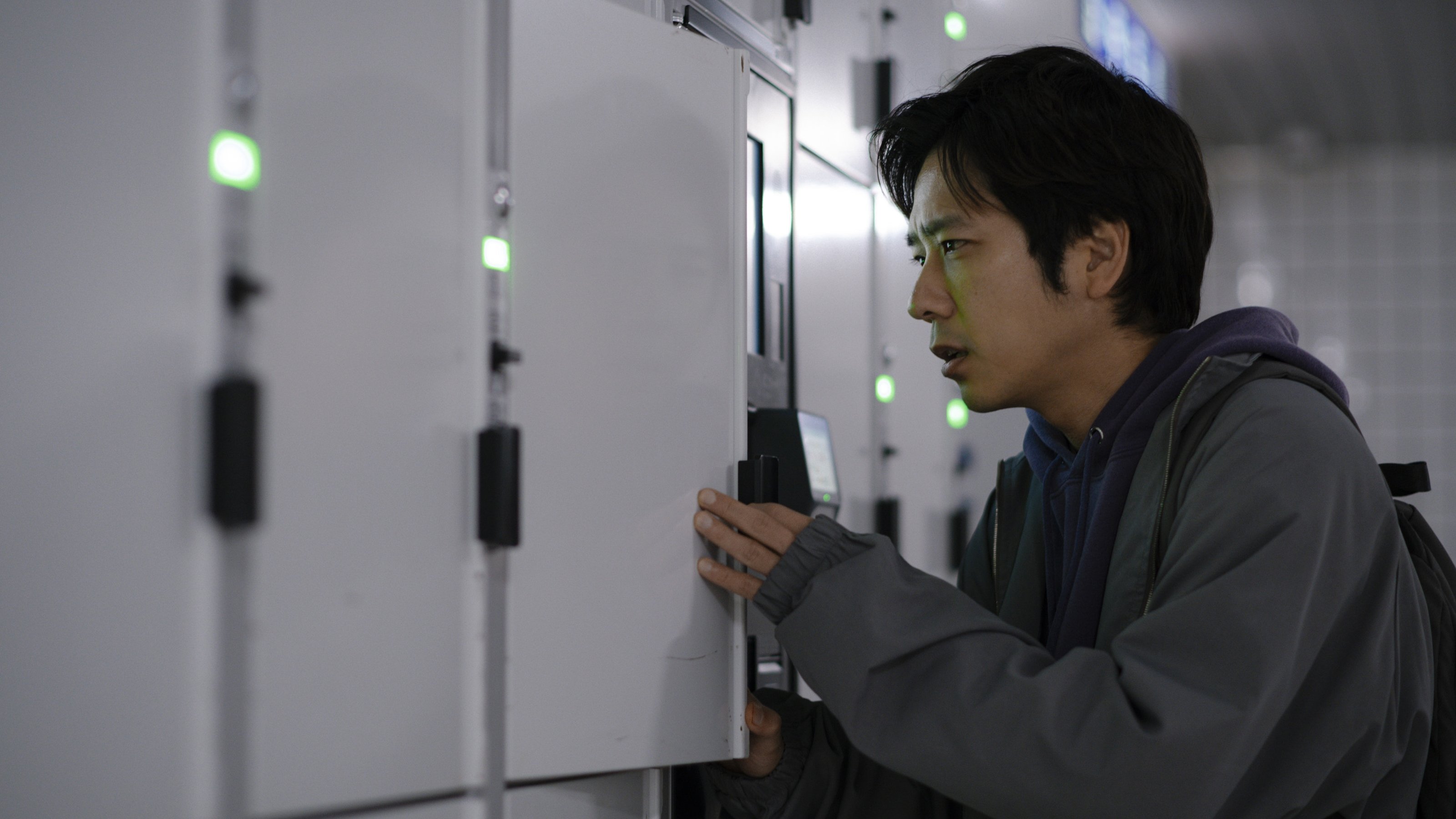
The Exit 8 ensemble seems to have received contradictory instructions: act like you’re in a horror film, but don’t get too scared. Kazunari Ninomiya does what he can with a character who’s little more than the player’s avatar in the original game, but his performance is limited to running, screaming, and looking confused, as if someone told him horror consists of cycling through the same three facial expressions on loop. Nana Komatsu, meanwhile, is the only one who manages to convey any humanity amid this mess, but her character is so underdeveloped that her performance feels like a cameo in her own film. Supporting actors like Yamato Kawauchi and Narumi Asanuma have even fewer chances to shine, doomed to be little more than cannon fodder in a script written by someone who despises side characters.
The most frustrating part is that Exit 8 could’ve been a great film if Kawamura had chosen to explore the emotional possibilities of his premise. Imagine a horror Groundhog Day, where the protagonist doesn’t just repeat actions but learns, evolves, and confronts his fears with each iteration. Instead, we’re left with a film that repeats itself like a scratched record, where the only thing that changes is the camera angle or the bloodstain’s color on the wall. The performances, therefore, feel as repetitive as the plot, as if the actors filmed their scenes against a green screen and the editors just copy-pasted them into the final cut.
The technical department: A cardboard set
The production design of Exit 8 is competent but generic, as if someone raided the prop warehouse of The Grudge and Dark Water to build a subway station straight out of a Half-Life mod. The dimly lit hallways, flickering lights, and graffiti-covered walls are well-executed but lack the visual personality that could’ve made them memorable. The costumes, meanwhile, are as bland as the script: neutral-colored casual wear, as if the wardrobe department was ordered not to draw attention under any circumstances. The makeup for the monsters or anomalies (calling them villains would be too generous) is as predictable as the plot: pale faces, sunken eyes, and torn clothing, as if the designer watched The Ring once and decided that was enough.
The sound is another aspect that could’ve elevated the film but ends up as forgettable as the rest. The train sound effects, footsteps in the hallways, and the protagonist’s screams are well-recorded but bring nothing new to the genre. The score, as mentioned earlier, is functional but forgettable, like the muzak in a liquidation-sale mall. In short, Exit 8’s technical department is correct but insipid, like a meal that fulfills its nutritional purpose but leaves no lingering taste. It’s the kind of film you could watch on a plane and forget before landing.
The best
- Keisuke Imamura’s cinematography: Manages to create an oppressive, claustrophobic atmosphere that, at least visually, justifies the 95-minute runtime.
- Nana Komatsu: The only one who seems to understand she’s in a horror film and not a survival reality show in a mall.
- The original premise: The concept of a time loop in a subway station is intriguing and has potential to explore themes like loneliness, despair, and obsessive repetition.
- Sound design: The train and hallway footstep effects are well-executed and help build tension in some scenes.
The worst
The script: Repetitive, predictable, and lacking character development. Seems written by someone who mistook horror for a mobile endless runner*.- Genki Kawamura’s direction: Competent but bland. Kawamura seems more interested in recreating the video game’s aesthetic than telling a story with substance.
- The pacing: The film moves forward, backward, and forward again but never arrives anywhere interesting. It’s like watching a two-hour teaser.
The Verdict of Claqueta Ácida
Exit 8 is a film that gets stuck in its own station, like a ticketless passenger on a train that never reaches its destination. Genki Kawamura had an intriguing premise—a time loop in a subway station—but chose to turn it into a hollow stylistic exercise, where the only thing repeating more than the plot is the nagging sense that someone forgot to write a decent script. The cinematography saves the furniture, Nana Komatsu saves the acting, and the sound design saves... well, something had to save. But in the end, Exit 8 is a film that doesn’t scare, doesn’t move, and doesn’t surprise, like a 1,000-piece puzzle where every piece is the same color. If you’re looking for intelligent psychological horror, watch The Wailing. If you want a faithful video game adaptation, play the original The Exit 8. And if you’re looking for a film that won’t make you yawn every five minutes, catch the next train and get the hell out of this cursed station. 💀
🎬 Tráiler Oficial
💬 El Veredicto de la Comunidad
¿Qué te ha parecido la película? Deja tu nota de 0 a 10 para contrastarla con el análisis de la redacción.
Aún no has votado
📢 ¿Te ha gustado el ácido?
Comparte esta crítica con tus amigos cinéfilos o desata la polémica en redes.
📩 📩 Get the poison in your inbox
Join our weekly mailing list. Honest film reviews, acid festival coverage, and cult recommendations every Sunday morning. Zero spam, pure celluloid.
🔒 We promise weekly poisonous reviews and exclusive coverage.Related Reviews
Recommended autopsies for demanding film buffs.
 ⚡ Ácido Cítrico6.2
*Exit 8*: The Horror Station That Can’t Find Its Way Out (And Neither Can You)
Genki Kawamura adapts *The Exit 8* video game with more loops than a politician’s campaign promises. Will it escape the purgatory of J-horror, or is it doomed to linger in its own terminal?
 ⚠️ Ácido Sulfúrico4.2
**Good Boy: The Dog That Saved No One (Not Even Itself)**
A supernatural canine stars in a film that barks up the wrong tree. *Claqueta Ácida* dissects this rural dud with the precision of a scalpel in a slaughterhouse.
 🔥 Fusión Nuclear8.5
*Mandy: Hell on Celluloid or How Cosmatos Turned a Garage Budget into a Psychedelic Nightmare*
Panos Cosmatos delivers a visual orgy of revenge, acid, and chainsaws that makes Tarantino look like an altar boy. There’s no redemption here—just charred flesh and demonic synthesizers.