Life of Brian — The Satire That Spit in the Face of Hypocrisy (And Had Us Laughing Until We Bled)
Monty Python drives a dagger into religious sanctimony with a comedy so razor-sharp it still stings 45 years later. Blasphemy or brilliance? You decide (but we already know the answer).

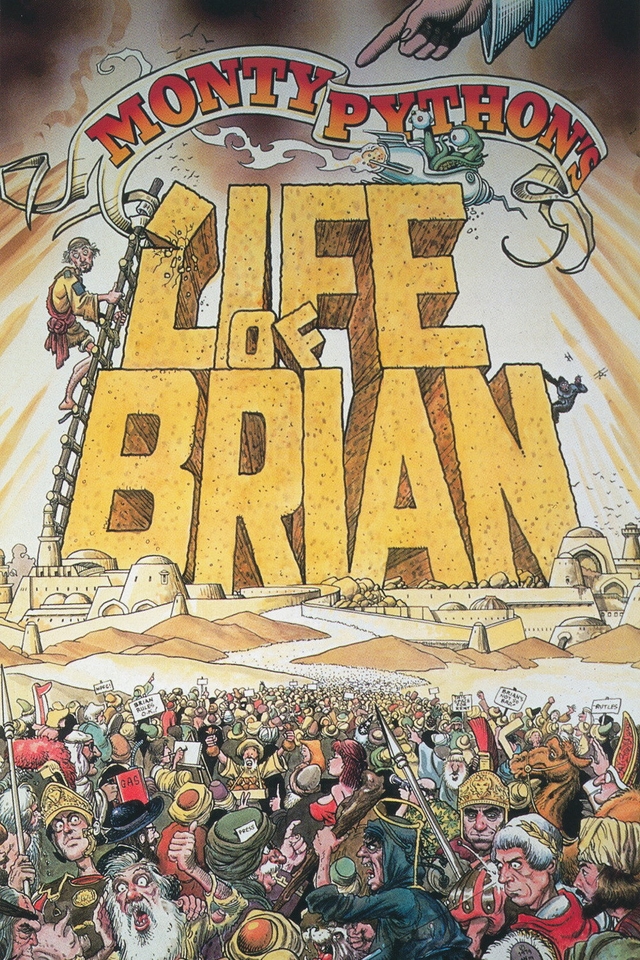
The celluloid ignites with a spark of heresy. The once-pristine screen is defiled by the opening frames of Life of Brian, a film born not as some extended sketch but as an act of war against piety, hypocrisy, and the existential absurdity that’s plagued humanity since someone decided a guy nailed to a stick was the solution to all our problems. It was 1979, and the Monty Python crew—those six horsemen of the comedic apocalypse—had already proven with Monty Python and the Holy Grail that cinema could be both a feast of wit and a gut-punch. But Brian was different: it wasn’t just a comedy; it was a manifesto. A manifesto that spat in the face of political correctness before the term even existed, doing so with the elegance of a dandy wiping his shoes on the flag of moralism.
The project emerged from the ashes of a prior failure: Monty Python in Hollywood, a TV special for American audiences that never took off. George Harrison, the ex-Beatle with more money than sense, mortgaged his house to finance the film because, in his own words, "he wanted to see it." Yes, you read that right: a man risked his fortune for the sheer joy of laughing at the wrong messiah. This isn’t cinema; it’s punk in its purest form. The Pythons, accustomed to navigating surrealism and the darkest humor, suddenly found themselves with a real budget and a blank canvas. And boy, did they fill it. The film was shot in Tunisia, repurposing the sets from Franco Zeffirelli’s Jesus of Nazareth, as if fate itself wanted to mock solemnity. Picture Terry Jones, with his Oxford-professor-gone-to-seed mustache, directing crowd scenes while Graham Chapman, the group’s only medically trained member, injected gin to keep his composure. The result could only be gloriously chaotic.
But Life of Brian isn’t just a string of hilarious gags; it’s a surgical dissection of human nature. The Pythons understood something many "serious" filmmakers still haven’t grasped: that religion, fanaticism, and collective stupidity are fertile ground for the sharpest comedy. The film doesn’t mock Jesus Christ—who appears briefly and respectfully—but the people who blindly follow any sandal-wearing charlatan. Brian, the poor sap played by Chapman, isn’t a messiah, but the people need to believe in something, even if it’s some guy who doesn’t want to save them. It’s the perfect metaphor for how humanity clings to absurd dogmas like a drowning man to a plastic floatie. And the best part? It does all this without losing an ounce of humor. From "Always Look on the Bright Side of Life" to the stoning with foam rocks, every scene is a reminder that absurdity is the essence of life.
The cultural climate of the time couldn’t have been riper for a film like this. The 1970s were winding down, and the Western world was caught between postmodern cynicism and the hangover of countercultural movements. Organized religion was no longer untouchable, but it still wielded enough power to get Life of Brian banned in several countries for "blasphemy." In the UK, some theaters received bomb threats. In Italy, the Catholic Church branded it an "offense to faith." Even Norway censored it—though the ban didn’t last long: the Swedes, with their characteristic pragmatism, released it with the tagline, "It’s so funny even the Norwegians banned it!" Far from being intimidated, the Pythons rubbed their hands together. They knew they’d hit the mark: a comedy that unsettled the powerful was, by definition, a necessary comedy.

Direction: Terry Jones’ Organized Chaos
Terry Jones, the film’s official director, was the least "cinephilic" of the group, but perhaps that’s why his approach worked so well. While a more traditional director might have tried to impose order on the chaos, Jones let the material breathe, as if he knew the Pythons’ humor was a living organism that needed room to grow. There are no Tarkovsky-esque long takes or Kubrickian obsessive framing, but there is a mise-en-scène that feels like it’s straight out of a fever dream. The opening sequence, with the three wise men mistaking the wrong manger, is a perfect example: the camera moves with deliberate clumsiness, as if the operator were drunk, and the actors improvise dialogue that sounds both sacred and ridiculous. It’s raw, unpretentious cinema, but with surgical precision in its comic timing.
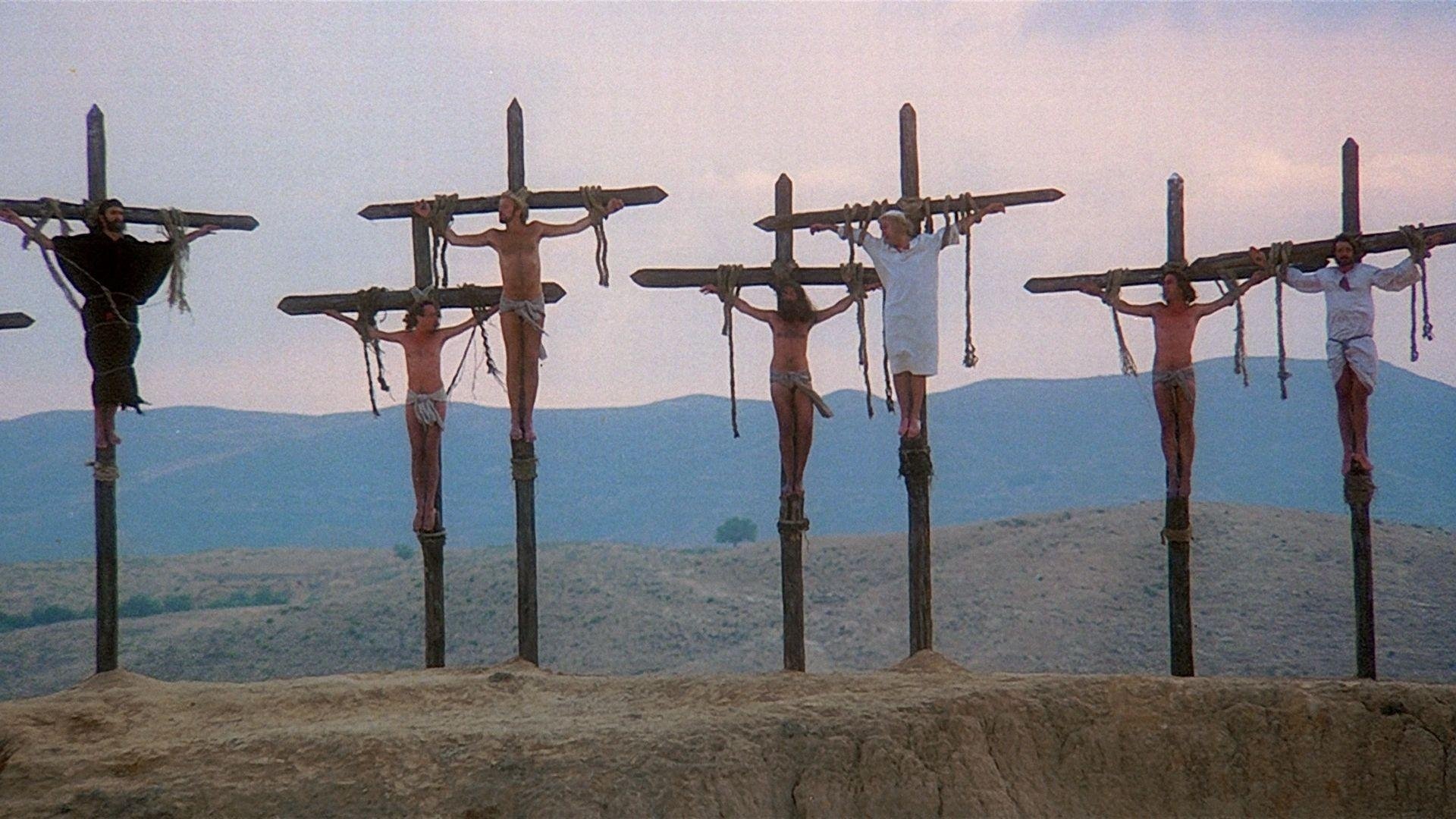
What’s most fascinating about Jones’ direction is how he balances absurd humor with moments of unexpected tenderness. The scene where Brian writes "ROMANES EUNT DOMUS" on the palace wall, only to be sadistically corrected by an illiterate centurion (played by John Cleese), is a masterclass in physical comedy. But then there’s the moment when Brian, crucified, tells Judith (his revolutionary lover) not to worry about him because "there’s always hope." It’s such a sudden shift that it almost hurts, as if the Pythons are reminding us that even in the midst of the most delirious absurdity, there’s room for humanity. Jones doesn’t force the tone; he lets the film flow between corrosive satire and genuine emotion, like a river carrying both laughter and tears.
Performances: Six Madmen in Search of a Messiah
The cast of Life of Brian is, quite simply, perfect. There isn’t a single actor who stands out for the wrong reasons, because they’re all Monty Python, and that’s already a guarantee of excellence. Graham Chapman, with his faded Shakespearean leading-man looks, plays Brian with a mix of desperation and resignation that’s hilarious. He’s the most normal man in a world of lunatics, and his ability to convey "why me?" with just a glance is worthy of study. But if there’s one actor who steals every scene he’s in, it’s Michael Palin. His portrayal of the ex-leper who complains that Brian’s charity has ruined his business ("I had a disease with a future!") is one of the greatest comic performances in cinema history. Palin has a unique ability to make the absurd feel real, as if his character actually exists in that universe of nonsense.
John Cleese, meanwhile, proves why he’s one of the greatest comic actors of all time. His Roman centurion, with that British sergeant-major voice and restrained sadism, is pure dynamite. The scene where he forces Brian to write "ROMANI ITE DOMUM" a hundred times is a perfect example of how humor can be both intelligent and physically painful (for the character, at least). Then there’s Eric Idle, the master of double entendres and absurd songs. His "Always Look on the Bright Side of Life" isn’t just a musical number; it’s an anthem to human resilience, sung by a crucified man who seems to be enjoying himself more than the audience. Even Terry Gilliam, who appears briefly as a street prophet, manages to steal the scene with just a few seconds of screen time. His rant about the "people of the shoes" is so delirious you can’t help but wonder if he was improvising under the influence of something.
Screenplay and Pacing: Satire as a Weapon of Mass Destruction
The screenplay of Life of Brian is a work of art in itself. Written by all six Pythons in a creative marathon, every line seems designed to provoke laughter, reflection, or both at once. What’s most impressive is how they maintain a perfect balance between absurd humor and political satire. The film doesn’t just mock religion; it also takes aim at politics, nationalism, fanaticism, and even cinema itself. The scene where the People’s Front of Judea argues with the Judean People’s Front ("Splitters!") is such a razor-sharp critique of revolutionary groups that it could’ve been written yesterday. And then there’s the moment when Brian, fleeing the crowd, hides at a political rally and ends up being hailed as the messiah without saying a word. It’s such a perfect metaphor for how leaders emerge by accident that it stings.
The film’s pacing is relentless. There isn’t a single moment to catch your breath, but it never feels rushed. The Pythons knew that humor works best when it’s dosed, so they alternate action-packed scenes (like the final chase) with slower dialogues, like the philosophical debate between Brian and the old sage who only spouts nonsense. The editing, by Julian Doyle, is another strong point. The transitions between scenes are fluid, and there’s a clever use of match cuts to link gags. For example, the sequence where Brian is chased by the crowd and ends up hanging from a balcony is a masterclass in how editing can enhance physical comedy. Every cut is calculated to the millimeter, as if the Pythons had studied Eisenstein before picking up a camera.
The best
- The screenplay: A masterpiece of intelligent satire that remains relevant 45 years later. Every line is a dagger wrapped in laughter.
- The performances: Six actors at the top of their game, especially Michael Palin and John Cleese, who steal every scene they’re in.
- Terry Jones’ direction: Organized chaos with perfect comic timing. He makes the absurd feel real without losing an ounce of humor.
- The soundtrack: From "Always Look on the Bright Side of Life" to the Roman choruses, the music is another character in this comedy.
- The message: It doesn’t mock religion; it mocks human stupidity. And that, dear readers, is universal.
The worst
- Some dated gags: A couple of jokes about women’s liberation sound a bit stale today, though they were progressive in their context.
- The original censorship: That such a brilliant film was banned in several countries for "blasphemy" is a reminder of how fragile free speech can be.
- The ending: It’s not bad, but after so much genius, you expect something more... explosive. Though "Always Look on the Bright Side of Life" makes up for it all.
The Verdict of Claqueta Ácida
Life of Brian isn’t just a film; it’s a miracle. A miracle of wit, courage, and intelligent humor. The Monty Python crew achieved something few filmmakers ever have: making us laugh out loud while forcing us to think. It’s not just another comedy; it’s a philosophical treatise disguised as farce, a social critique wrapped in absurdity, a punch in the face to hypocrisy that still stings. Forty-five years later, it’s as fresh, necessary, and hilarious as the day it premiered. If cinema is the art of storytelling, Life of Brian proves that the best stories are those that make us laugh, reflect, and, above all, question. And that, dear readers, is what makes it a masterpiece. May the gods—or whoever’s up there—forgive us for laughing so hard. 💀
🎬 Tráiler Oficial
💬 El Veredicto de la Comunidad
¿Qué te ha parecido la película? Deja tu nota de 0 a 10 para contrastarla con el análisis de la redacción.
Aún no has votado
📢 ¿Te ha gustado el ácido?
Comparte esta crítica con tus amigos cinéfilos o desata la polémica en redes.
📩 📩 Get the poison in your inbox
Join our weekly mailing list. Honest film reviews, acid festival coverage, and cult recommendations every Sunday morning. Zero spam, pure celluloid.
🔒 We promise weekly poisonous reviews and exclusive coverage.Related Reviews
Recommended autopsies for demanding film buffs.
 🔥 Fusión Nuclear9.0
Life of Brian: The Satire That Spit in the Face of Hypocrisy (And Had Us Laughing Until We Bled)
Monty Python drives a dagger into religious sanctimony with a comedy so razor-sharp it still stings 45 years later. Blasphemy or brilliance? You decide (but we already know the answer).
 🔥 Fusión Nuclear8.2
The Boarding School: A Dormitory of Dread
The Boarding School (1969), a film that revives terror within the walls of a girls' boarding school—where repression and sadism dance a waltz in crinoline
 🔥 Fusión Nuclear9.0
The Texas Chain Saw Massacre: The Bloody Dawn of Modern Terror (Or How Tobe Hooper Gifted Us Nightmares with a Chainsaw and Zero Budget)
Tobe Hooper turned $140,000 and an abandoned slaughterhouse into hell on Earth. Claqueta Ácida dissects this horror classic with a chainsaw, pitch-black humor, and a devotion to bloodstained celluloid.