In the Mouth of Madness — When John Carpenter Swallowed Lovecraft (And Spat Out Our Sanity)
John Carpenter delivers a Lovecraftian nightmare with Sam Neill teetering on the edge of the abyss. A masterpiece of cosmic horror or a self-parody with literary pretensions? Here’s the autopsy.

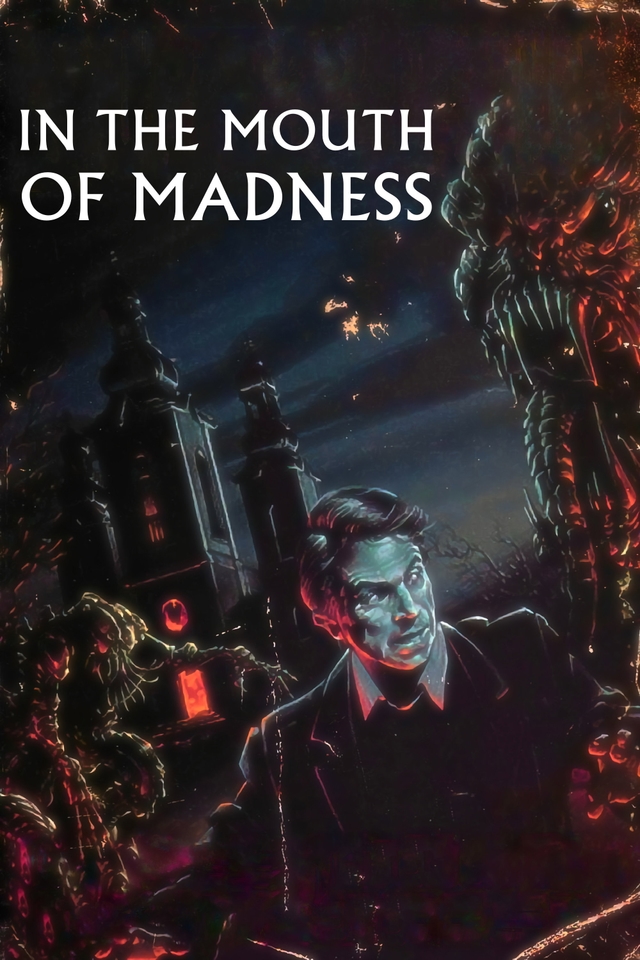
The celluloid coils around the projector like a sickly serpent, spewing frames that reek of fresh ink and library nightmares. John Carpenter, that old sea wolf of terror with more scars than a Vietnam vet, wades into waters in 1995 that H.P. Lovecraft would have navigated with a grin of rotten teeth. In the Mouth of Madness isn’t just a film; it’s a literary exorcism shot on 35mm, a desperate attempt to capture the essence of the cosmic with the limited resources of a studio that, in all likelihood, just wanted another Nightmare on Elm Street sequel. But Carpenter, bless his cynicism, gave them something far worse: a meditation on the power of words, the fragility of perception, and the terror of discovering that, perhaps, the entire universe is merely the rough draft of a drunk writer in a Providence dive bar.
The project was born at a time when horror was mutating into something unrecognizable. The ‘90s were the era of rehashed slashers (Scream was sharpening its knife on the horizon), remakes with cardboard digital effects, and franchises refusing to die like steroid-fueled zombies. New Line Cinema, that factory of nightmares smelling of stale popcorn, gave Carpenter the green light in hopes he’d replicate the formula of Prince of Darkness or, worse, deliver something “commercial.” But Carpenter, who had already flirted with Lovecraft in The Thing (1982) and Prince of Darkness (1987), decided it was time to go further. Not content with merely adapting the master of the cosmic, he wanted to devour him alive and spit out his bones in the form of a film. The script, penned by Michael De Luca, is an amalgam of Lovecraftian references, postmodern paranoia, and a homage that bridges Stephen King’s universe with The Dunwich Horror. But the truly terrifying thing isn’t the plot—it’s the sensation that Carpenter is playing with fire: what if a writer’s words don’t just describe horror, but create it?
The shoot was, by all accounts, a controlled hell. Carpenter, fresh from the catastrophic studio experience of Memoirs of an Invisible Man (1992), worked with a tight budget and an even tighter schedule. Gary B. Kibbe, his trusted cinematographer, painted every frame with a palette of sickly colors: bilious greens, bloody reds, and blues that seem plucked from a bruise in its final stages of decay. The lighting, always expressionistic, turns the sets into something alive, as if the walls breathe and the hallways stretch like intestines. And then there’s Sam Neill, that New Zealand actor with the face of a man who’s seen too much, reaching heights of paranoia here that he hadn’t even brushed against in The Possession (1981). Neill doesn’t act; he decomposes in real time, as if Carpenter’s script were corroding his synapses from within. His performance is so physical you can almost smell the cold sweat and stale coffee oozing from his character, John Trent, an insurance investigator who discovers that the world might just be the rough draft of a writer with too much imagination and too few scruples.
But In the Mouth of Madness isn’t merely a Lovecraftian style exercise. It’s, above all, a film about artistic creation and its dangers. Carpenter, who’s always had an ambivalent relationship with Hollywood (that monster that crowned him with Halloween before leaving him to rot in obscurity), seems to be asking: what happens when the artist loses control of their work? What if the stories we write aren’t just entertainment, but viruses that infect reality? The character of Sutter Cane, played by a Jürgen Prochnow who seems plucked from a Klaus Kinski nightmare, embodies that fear: a writer who no longer distinguishes between fiction and reality, dragging his readers into an abyss from which there’s no return. The film, in that sense, is prophetic. Carpenter, already a filmmaker marginalized by the big studios in 1995, seems to be warning us: be careful what you create, because it might just devour you.
Direction: Carpenter in Lovecraft Mode (Or How to Turn Terror into a Literary Nightmare)
John Carpenter doesn’t direct In the Mouth of Madness; he conjures it. Every frame is a spell, every camera movement an invocation. From the first shot, where we see Sam Neill locked in an asylum (a brazen nod to the asylum-centric tradition of cosmic horror), we know we’re in for something different. Carpenter doesn’t just adapt Lovecraft; he filters him through his own obsessions with isolation, paranoia, and the fragility of the human mind. The result is a film that functions like a sickly clockwork mechanism, where every scene seems designed to destabilize the viewer. The long takes, like that initial tracking shot through the asylum hallway, are pure hypnosis. The camera moves as if it’s alive, as if it knows something we don’t. And then there are the moments of pure Lovecraftian terror, like the scene where Trent and Linda (Julie Carmen) discover the town of Hobb’s End—a place that shouldn’t exist but is, with its deserted streets and inhabitants smiling like ventriloquist dummies.
But Carpenter’s true brilliance lies in how he toys with the viewer’s perception. The film is packed with moments where we’re not sure what we’re seeing: is it real or a hallucination? Is Trent a sane investigator or a madman who’s lost touch with reality? Carpenter doesn’t give us easy answers. Instead, he plunges us into a labyrinth of distorting mirrors, where every reflection is a warped version of the truth. And then there’s the pacing, that slow, oppressive pulse that accelerates like a heart about to burst. Carpenter knows terror isn’t just about scares; it’s about tension, that feeling that something terrible is about to happen and, when it does, there’ll be no turning back.
Performances: Sam Neill Decomposes (And Drags Us With Him)
If there’s one actor who steals the film, it’s Sam Neill. His portrayal of John Trent is a masterclass in acting decomposition. Neill doesn’t play a man losing his sanity; he plays a man who discovers he never had it. His performance is physical, visceral, as if every scene is peeling away layers of his skin. From the moment he takes on Sutter Cane’s case, we see his face tighten, his eyes fill with a paranoia that feels real. And then there are those moments of pure terror, like when he realizes Hobb’s End doesn’t exist on any map, or when he understands that Cane’s books are rewriting reality. Neill doesn’t need to scream to convey panic; a look, a hand gesture, that cold sweat seeping from his pores is enough.
But Neill isn’t alone. Jürgen Prochnow nails the role of Sutter Cane, that cursed writer who seems ripped from the cultural impact of Stephen King. Prochnow has an unsettling presence, as if he knows something we don’t. His performance is restrained, almost minimalist, but every line he utters sounds like an apocalyptic prophecy. And then there’s Julie Carmen, who plays Linda Styles, Cane’s editor. Carmen provides a counterpoint of normality to the madness around her, but even she succumbs to the spiral of paranoia. Her chemistry with Neill is palpable, and her transformation from rational woman to terror victim is one of the film’s highlights.
Technical Department: When Terror Becomes Art
The technical work in In the Mouth of Madness is impeccable, and that shouldn’t surprise anyone coming from a director like Carpenter. Gary B. Kibbe, his cinematographer, crafts a palette of sickly colors that seems lifted from a Francis Bacon painting. The greens, reds, and blues blend into a symphony of tones that evoke decay and decomposition. The lighting is expressionistic, with elongated shadows and lights that seem to emanate from impossible sources. And then there’s the production design, which turns every set into a character of its own. From the initial asylum to the town of Hobb’s End, every location feels alive, as if it’s waiting for the characters to fall into its trap.
But if there’s one technical element that stands above the rest, it’s the score. Carpenter, who composed the music with his frequent collaborator Jim Lang, creates a soundscape that’s pure sonic nightmare. The synthesizers, so characteristic of his style, mixed with heavy electric guitars, sound darker and more oppressive than ever. The music doesn’t accompany the action; it drowns it, wrapping it in an atmosphere of terror that seems to seep from the walls themselves. And then there are the sound effects—those whispers, those creaks, those voices that seem to come from nowhere. Small details, but they contribute to a constant sense of unease.
The editing, handled by Edward A. Warschilka, is another of the film’s strengths. Carpenter has always had a keen sense of pacing, and he proves it here once again. Scenes unfold with surgical precision, alternating moments of tense calm with bursts of pure terror. And then there are the flashbacks, which integrate into the narrative so organically they almost feel real. The editing doesn’t just tell the story; it distorts it, twists it, turns it into something alive and dangerous.
The Best
- The direction of John Carpenter: A Lovecraftian terror exercise that proves Carpenter is one of the genre’s great masters. His ability to create oppressive atmospheres and toy with the viewer’s perception is simply brilliant.
- Sam Neill’s performance: A physical and visceral portrayal that drags us into his character’s spiral of paranoia. Neill doesn’t act; he decomposes in real time.
- The soundtrack: Carpenter and Jim Lang compose a score that’s pure sonic nightmare, with dark synthesizers, touches of heavy rock, and oppressive passages that envelop the film in a constant atmosphere of terror.
- Gary B. Kibbe’s cinematography: A palette of sickly colors and expressionistic lighting that turns every frame into a work of terror art.
- Michael De Luca’s script: A perfect blend of Lovecraftian references, postmodern paranoia, and psychological terror. The script doesn’t just adapt Lovecraft; it reinvents him.
The Worst
- Some practical visual effects: While KNB EFX Group’s work is artisanal and commendable, some latex monsters and physical effects, due to the tight budget, look a bit stiff or exposed and may break the atmosphere for modern viewers.
- Pacing in the first half: The film takes a while to get going, and some viewers might lose interest in the first 30 minutes. Fortunately, the second half more than makes up for this initial sluggishness.
- Underdeveloped secondary characters: While the trio of leads is well-defined, some secondary characters (like the insurance company doctor or Hobb’s End’s sheriff) seem lifted from a draft and don’t add much to the plot.
- The ending (for some): Without spoilers, the film’s conclusion is so ambiguous and open-ended that it might leave more than one viewer feeling like Carpenter outsmarted them. It’s not a bad ending, but it’s one that requires a second viewing to fully appreciate.
The Verdict of Claqueta Ácida
In the Mouth of Madness is one of those films that lodges itself in your mind like a rusty knife. Carpenter, brilliantly capping off his "Apocalypse Trilogy," gifts us a Lovecraftian nightmare that’s also an essay on the power of fiction and the dangers of artistic creation. It’s not perfect: it has its slow moments, some practical effects that betray the low budget, and an ending that might leave more than one viewer feeling like they’ve been had. But when it works, it works like a sickly clockwork mechanism, dragging us into an abyss we don’t want (or can’t) escape. Sam Neill is sublime, the soundtrack is a masterpiece of sonic terror, and Carpenter’s direction is so precise it feels like a spell. A masterpiece? Almost. A cult film? Without a doubt. Something every horror lover should see at least once in their life? Absolutely. But beware: after watching it, you might start suspecting that your reality is also just the rough draft of a writer with too much imagination. 💀
🎬 Tráiler Oficial
💬 El Veredicto de la Comunidad
¿Qué te ha parecido la película? Deja tu nota de 0 a 10 para contrastarla con el análisis de la redacción.
Aún no has votado
📢 ¿Te ha gustado el ácido?
Comparte esta crítica con tus amigos cinéfilos o desata la polémica en redes.
📩 📩 Get the poison in your inbox
Join our weekly mailing list. Honest film reviews, acid festival coverage, and cult recommendations every Sunday morning. Zero spam, pure celluloid.
🔒 We promise weekly poisonous reviews and exclusive coverage.Related Reviews
Recommended autopsies for demanding film buffs.
 🔥 Fusión Nuclear8.5
In the Mouth of Madness: When John Carpenter Swallowed Lovecraft (And Spat Out Our Sanity)
John Carpenter delivers a Lovecraftian nightmare with Sam Neill teetering on the edge of the abyss. A masterpiece of cosmic horror or a self-parody with literary pretensions? Here’s the autopsy.
 🔥 Fusión Nuclear8.2
*Christine*: The Most Toxic and Brilliant Mechanical Romance in Cinema History
John Carpenter takes Stephen King’s eponymous novel and soups it up to deliver a staggering fable about teenage obsession, rock ‘n’ roll, and a 1958 Plymouth Fury with the jealous rage of a scorned lover.
 🔥 Fusión Nuclear9.8
*Halloween: The Night Pure Evil Slapped on a Cheap Mask and Took a Leisurely Stroll*
John Carpenter reinvented the modern slasher on a shoestring budget, three piano notes, and a faceless killer embodying suburban terror—no backstory, no mercy, just a knife and the slow creep of dread.