The Virgin of the Dustbowl — The Exorcism of Boredom No One Asked For
Laura Casabé adapts Mariana Enríquez with more sweat than terror. An Argentine summer that reeks of mosquito repellent and textbook clichés.

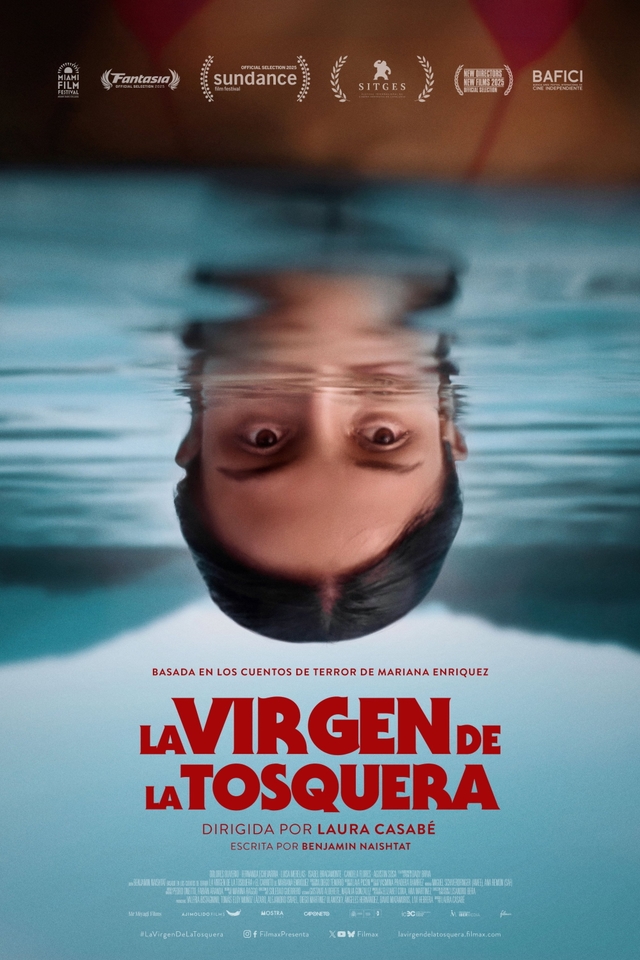
The celluloid unspools like a moth-eaten scroll in Claqueta Ácida’s screening room, where the scent of stale popcorn mingles with the stench of existential despair. Laura Casabé, director of this summer abomination, arrives with the mission of adapting Mariana Enríquez’s tales—Argentina’s gothic queen of the outskirts, who writes with the same effortlessness others breathe. Yet here, between the sweat of the Dustbowl and the sighs of three horny teenagers, terror dissolves like a sugar cube in a glass of cheap fernet. The result? A failed exorcism where the demon is none other than boredom disguised as bargain-bin magical realism.
Casabé isn’t exactly a rookie when it comes to smearing the screen with bodily fluids and cheap symbolism. Her debut, Winter, already warned us of her obsession with claustrophobic spaces and dialogue that sounds like group therapy. But in The Virgin of the Dustbowl, she seems to have confused atmospheric with soporific. The script, penned by the ever-interesting Benjamín Naishtat (yes, the man behind Rojo, a film that at least had the decency to be uncomfortable), here merely regurgitates Latin American coming-of-age tropes: first love, teenage jealousy, the witchy grandmother, and, of course, the cursed lagoon hiding more secrets than a WhatsApp group chat. Where Enríquez wrote with the precision of a scalpel, Naishtat and Casabé operate with a rusty kitchen knife.
The summer of 2001 in Argentina wasn’t exactly a garden of stability. The country bled between corralitos, cacerolazos, and presidents who lasted shorter than an ice cream in the sun. Yet in the Dustbowl—that imaginary wasteland smelling of damp earth and despair—time seems stuck in a cheap telenovela loop. The protagonists, Natalia, Mariela, and Josefina, are three friends who share more than a taste for Diego, that small-town heartthrob plucked straight from a Floricienta casting call. But when Silvia (Fernanda Echevarría) slinks in as the bargain-bin femme fatale, the trio crumbles like a house of cards in a windstorm. Grandma Rita (Isabel Bracamonte) tries to salvage the situation with a spell straight out of an Emir Kusturica movie, but the incantation fizzles into nothing. Literally.
What could’ve been a dark, sensual exploration of teenage desire becomes a parade of clichés with more Instagram filters than psychological depth. The Dustbowl, that cursed place where the supernatural supposedly lurks, ends up as threatening as a puddle after the rain. And the hidden lagoon, that watery MacGuffin meant to drip with symbolism, is nothing more than a poorly lit pond. Diego Tenorio, the cinematographer, seems more concerned with emulating Luca Bigazzi’s style in The Great Beauty than capturing the story’s sweaty, visceral essence. The result is a color palette oscillating between desaturated and artificial, as if the film were shot through a 2015 VSCO filter.
Direction: The Art of Drowning in a Glass of Water
Casabé directs with the same delicacy as an elephant attempting ballet. Her narrative pulse is so erratic it seems to suffer from cinematic Parkinson’s. Some scenes drag on like gum under a shoe—like that interminable sequence where the friends argue over Diego while eating ice cream—while others flash by so quickly you wonder if the projectionist skipped a reel. The editing, handled by an anonymous professional who deserves to stay that way, is so jarring it feels hacked together with an axe. The abrupt cuts don’t build tension; they breed confusion, as if the film has ADHD.
The problem isn’t that Casabé lacks ideas—it’s that she seems to have too many and none at once. She wants to make a gothic horror film, a teen drama, and a black comedy, but ends up with a genre collage that sticks together like a bad glue job. The macumba scenes—meant to be the film’s dark heart—are so ridiculous they could’ve been lifted from a El Chavo del 8 episode directed by Guillermo del Toro on his worst day. Grandma Rita chants her spells with the conviction of a community theater actress reciting The House of Bernarda Alba. And the spell, of course, doesn’t work. Because in Casabé’s cinema, magic never does. As if the director were afraid the audience might take her premise seriously.
Performances: The Cast That Deserved a Better Script
If anything saves The Virgin of the Dustbowl from eternal oblivion, it’s ironically its cast. Dolores Oliverio (Natalia) is the only one who seems to understand she’s in a movie, not a group therapy session. Her gaze of contained desperation is the sole thing lending humanity to this mess. Fernanda Echevarría, as Silvia, tries to infuse her character with mystery but ends up resembling a telenovela villain more than a femme fatale. Her performance swings between overacting and expressionlessness, as if she’s playing two different characters in the same scene.
The rest of the ensemble seems lost in an interpretive limbo. Luisa Merelas and Candela Flores (Mariela and Josefina) share a chemistry reminiscent of two strangers forced to share a cab. And Agustín Sosa, as Diego, is as charismatic as an IKEA bookshelf. His performance is so flat you half-expect someone to ask him to sit in a chair to complete the set. Isabel Bracamonte, as Grandma Rita, is the only one who elicits a smile—though it’s from the absurdity of her character. Her witchy grandmother is as convincing as a TikTok tutorial on casting spells.
Technical Aspects: When the Visuals Smell Like Mothballs
The art direction and costumes are so anachronistic they seem plucked from a 90s teen fashion museum. The protagonists dress like they’re in an episode of Rebelde Way, with denim shorts painted onto their legs and tops leaving little to the imagination. The issue isn’t the style itself but the lack of coherence. One scene, the girls look like they’re in a Britney Spears music video; the next, like they’re in a documentary about Argentine urban tribes. The makeup is another weak point: Natalia’s dark circles look drawn with a Sharpie, and Silvia’s lip gloss is so exaggerated it seems she’s eaten a tub of Vaseline.
Diego Tenorio’s cinematography is, without doubt, the film’s most polished aspect. Some shots evoke the best of Lucrecia Martel, capturing the deathly glow of sunset in the countryside. But even here, the lack of narrative coherence ruins everything. Some sequences seem shot on a soundstage (with lighting so artificial it looks plastic), while others are in real exteriors, where the camera seems lost in the landscape’s vastness. The sound is another disaster: the score, composed of ambient noises and the occasional acoustic guitar chord, is so subtle it might as well not exist. And the dialogue, recorded with what sounds like a toy microphone, comes across as if the actors are speaking from the bottom of a well.
The best
- Dolores Oliverio’s performance: The only one who seems to grasp that cinema isn’t a dramatic monologue contest. Her Natalia has the gaze of someone who’s read the script and decided to get drunk to forget it.
- Diego Tenorio’s cinematography: Some shots are so beautiful you almost forget the film is a disaster. Almost.
- The attempt at magical realism: Though it fails spectacularly, at least the film tries something different. That’s more than most releases can say.
The worst
- Benjamín Naishtat’s script: What could’ve been a dark, poetic adaptation of Mariana Enríquez ends up a reheated stew of teen clichés. A waste of talent.
- Laura Casabé’s direction: It’s as if the director couldn’t decide what kind of film she wanted to make. The result is a genre Frankenstein that doesn’t work on any level.
- The rest of the cast’s performances: Aside from Oliverio and Bracamonte, the ensemble seems lost in an interpretive limbo. Agustín Sosa, in particular, is so flat he resembles a poorly rendered hologram.
The Verdict of Claqueta Ácida
The Virgin of the Dustbowl is the kind of film you start watching with hope and finish with the sensation of having wasted 95 minutes you’ll never get back. Laura Casabé and Benjamín Naishtat had the perfect material to create something dark, sensual, and disturbing, but ended up making a teen telenovela with artistic pretensions. The result is a cliché collage that smells more like mothballs than sulfur, where magical realism drowns in a sea of predictable dialogue and mediocre performances. Only Diego Tenorio’s cinematography and Dolores Oliverio’s performance salvage any dignity from this shipwreck. But let’s be honest—even the best makeup can’t hide a corpse. Final score: 5.8, because someone has to give points for trying. 💀
🎬 Tráiler Oficial
💬 El Veredicto de la Comunidad
¿Qué te ha parecido la película? Deja tu nota de 0 a 10 para contrastarla con el análisis de la redacción.
Aún no has votado
📢 ¿Te ha gustado el ácido?
Comparte esta crítica con tus amigos cinéfilos o desata la polémica en redes.
📩 📩 Get the poison in your inbox
Join our weekly mailing list. Honest film reviews, acid festival coverage, and cult recommendations every Sunday morning. Zero spam, pure celluloid.
🔒 We promise weekly poisonous reviews and exclusive coverage.Related Reviews
Recommended autopsies for demanding film buffs.
 ⚡ Ácido Cítrico6.0
The Virgin of the Dustbowl: The Exorcism of Boredom No One Asked For
Laura Casabé adapts Mariana Enríquez with more sweat than terror. An Argentine summer that reeks of mosquito repellent and textbook clichés.
 ⚡ Ácido Cítrico6.2
*Exit 8*: The Horror Station That Can’t Find Its Way Out (And Neither Can You)
Genki Kawamura adapts *The Exit 8* video game with more loops than a politician’s campaign promises. Will it escape the purgatory of J-horror, or is it doomed to linger in its own terminal?
 ⚠️ Ácido Sulfúrico4.2
**Good Boy: The Dog That Saved No One (Not Even Itself)**
A supernatural canine stars in a film that barks up the wrong tree. *Claqueta Ácida* dissects this rural dud with the precision of a scalpel in a slaughterhouse.