*"Men — Alex Garland’s Misogyny Cult Film or How to Drown in Your Own Symbolism"*
Alex Garland delivers a rural horror pamphlet with more pretension than substance. Jessie Buckley suffers, the English countryside seethes, and the patriarchy disguises itself as allegory. Masterpiece or pretentious drivel?

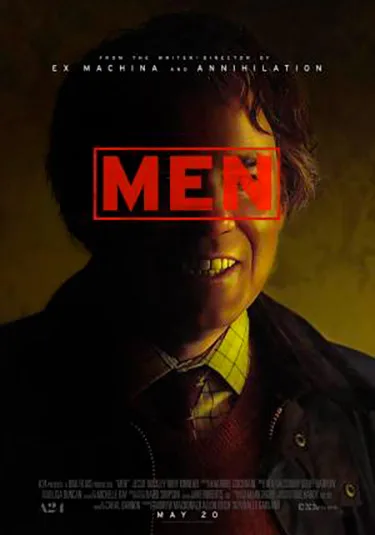
Alex Garland’s filmography has always been a stylistic exercise in search of substance—like a chef who’s mastered technique but keeps burning the rice. After Ex Machina (2014), where artificial intelligence dressed up as a robotic femme fatale, and Annihilation (2018), a psychedelic descent into female self-destruction, the British director seemed destined to become the poet laureate of cerebral horror. But Men (2022) arrives as a painful reminder: even geniuses have off days, and Garland, in his eagerness to dissect female trauma with a B-movie scalpel, ends up tripping over his own metaphors and sinking into a quagmire of cheap symbolism and unintentional misogyny. Because, let’s be honest, what’s more patriarchal than reducing a woman’s pain to a parade of grotesque men chasing her like rejects from a 2000 AD comic?
The film emerges in a cultural moment where female horror isn’t just a subgenre—it’s a genre in its own right, with works like Hereditary (2018) and The Babadook (2014) elevating domestic trauma to the level of art. Garland, however, seems more interested in playing rural Dante than exploring his protagonist’s psyche. Jessie Buckley, an actress whose intensity verges on unbearable (in the best way), is forced to carry the weight of a narrative that oscillates between the dreamlike and the ridiculous, as if David Lynch and M. Night Shyamalan had a bastard child in an English pub. The result is a film that reeks of pretension from a mile away, with a script that mistakes the cryptic for the incoherent and a visual style that, in its eagerness to impress, drowns in its own baroque excess.
That’s not to say Men lacks brilliant moments. Rob Hardy’s cinematography, with those long takes straight out of a Tarkovsky fever dream, creates a suffocating atmosphere that clings to the skin like sweat on a summer night. But even the most beautiful light can illuminate a void, and that’s essentially what Garland offers: a visual spectacle that never dares to scratch beneath the surface. The problem isn’t that the film is dark—it’s that its darkness is hollow, like a bottomless well where metaphors fall and shatter into silence.
Then there’s Rory Kinnear, Garland’s go-to actor, who here multiplies into a gallery of male faces so grotesque they seem plucked from a Victorian freak show. From the condescending cop to the leering teenager, the hyena-smiling vicar to the green-skinned creature emerging from the earth’s bowels like a carnival Cthulhu, Kinnear becomes the perfect scapegoat for the structural misogyny the film claims to critique. But isn’t it ironic that, in its rush to condemn the patriarchy, Garland reduces all men to a succession of caricatures? Feminism isn’t built with puppets, and Men seems to forget that sometimes the most terrifying thing isn’t what you see, but what you sense lurking beneath.
The direction: Garland in pretentious auteur mode
Alex Garland directs Men as if he’s solving a New Yorker crossword: one hand in his pocket, the other stroking his ego. His style, which felt fresh in Ex Machina and poetic in Annihilation, here becomes repetitive and self-satisfied. The long takes, so lauded by the snob critics, are actually a tired crutch Garland uses to mask his script’s lack of rhythm. Because let’s be clear: Men doesn’t move forward—it drags itself along like a wounded animal that doesn’t know whether to die or keep suffering.
The problem isn’t the ambition—it’s the execution. Garland wants every frame to be a statement, but he ends up settling for the obvious: the forest as a metaphor for the primitive, tunnels as symbols of the womb (or hell, depending on the day), and men as embodiments of oppression. It’s as if someone read The Second Sex and decided to adapt it without understanding a word. The film wallows in its own darkness, mistaking the sinister for the tedious and the oneiric for the confusing.
And then there’s the ending—that climax meant to shock but which ends up as predictable as a Black Mirror episode. Garland seems to believe ambiguity equals depth, when in reality it’s just an excuse to avoid taking a stance. Men isn’t a film about female trauma—it’s about Garland’s inability to tackle it without resorting to the cheapest sensationalism.
The performances: Buckley suffers, Kinnear multiplies
Jessie Buckley is, without a doubt, the soul of Men. Her portrayal of Harper, a woman fleeing her pain only to encounter distorted versions of herself, is intense, visceral, and at times unbearable. Buckley doesn’t act—she bleeds on screen, as if every scene were a personal exorcism. It’s a shame Garland doesn’t give her material worthy of her talent, because her work here deserves more than a script full of holes and textbook symbolism.
At the other extreme is Rory Kinnear, who becomes the film’s showman. His ability to transform into multiple characters is admirable but also exhausting. Kinnear shifts from a kind cop to a drooling teenager, then to a sinister vicar, and finally to a nightmare creature straight out of a Hieronymus Bosch painting. The problem is that none of these characters have depth—they’re archetypes, carnival puppets Garland uses to illustrate his thesis on toxic masculinity.
The rest of the cast, including Paapa Essiedu and Gayle Rankin, are reduced to secondary roles that add nothing to the whole. It’s as if Garland decided only Buckley and Kinnear deserved to exist in his world, leaving the rest as mere decorations in an already overloaded landscape.
The technical aspects: Hardy shines, but doesn’t save the film
Rob Hardy’s cinematography is, by far, the best thing about Men. His shots, bathed in sickly greens and bloody reds, create a suffocating atmosphere that sticks to the retina like a bad dream. Hardy once again proves why he’s one of the most interesting cinematographers in contemporary cinema, capable of turning a simple walk through the woods into a sensory experience.
The sound design is another of the film’s strengths. The wind’s whistles, the creaking branches, and the unintelligible whispers create an organic soundscape that reinforces the claustrophobic feel. However, even here Garland overdoes it: in his eagerness to be subtle, he ends up being confusing, as if the sound were designed to distract rather than complement.
The editing, by Jake Roberts, is functional but uninspired. The film lurches forward with jarring transitions that break the rhythm instead of enhancing it. And the production design, though detailed, falls into the obvious: the rural house’s interiors are so Pinteresque they look like they’re straight out of a Country Living catalog, while the exteriors—with their dark forests and damp tunnels—are too reminiscent of The Witch (2015) to feel original.
### The best
- Rob Hardy’s cinematography: A masterclass in lighting that turns the English countryside into another character. The rotten greens and bloody reds pierce the retina like needles.
- Jessie Buckley: Her performance is so intense it hurts. Buckley doesn’t act trauma—she lives it, suffers it, and exorcises it on screen with brutal honesty.
- The sound design: The whispers, creaks, and whistles create a sonic atmosphere that truly conveys terror.
- Rory Kinnear: His ability to multiply into a gallery of grotesque faces is impressive, even if the script doesn’t give him the depth he deserves.
### The worst
- Alex Garland’s script: Pretentious, confusing, and full of holes. Garland mistakes the cryptic for the incoherent and the symbolic for the obvious.
- The direction: Garland wallows in his own darkness to the point of tedium. The long takes, so celebrated, are just a crutch to hide the lack of rhythm.
- The cheap symbolism: Reducing female trauma to a parade of grotesque men is as simplistic as it is misogynistic. The patriarchy isn’t critiqued with puppets.
- The ending: It aims to shock but ends up predictable and empty. Garland confuses ambiguity with a lack of ideas.
- The lack of depth in the characters: Harper is the only one with nuance; the rest are hollow archetypes that add nothing.
### The Verdict of Claqueta Ácida
Men is a film that oscillates between the fascinating and the frustrating—like a Francis Bacon painting viewed through fogged glass. Alex Garland has talent, that’s undeniable, but here he seems more interested in impressing the snob critics than telling a coherent story. Jessie Buckley saves the ship with a memorable performance, but not even her talent can paper over the holes in a script that mistakes the dreamlike for the confusing and the symbolic for the obvious. Men isn’t a masterpiece, but it’s not a disaster either: it’s a failed experiment, a rural horror pamphlet with more pretension than substance. And at Claqueta Ácida, that earns an ironic round of applause and a sigh of relief that, at least, it’s not another superhero movie. 💀
🎬 Tráiler Oficial
💬 El Veredicto de la Comunidad
¿Qué te ha parecido la película? Deja tu nota de 0 a 10 para contrastarla con el análisis de la redacción.
Aún no has votado
📢 ¿Te ha gustado el ácido?
Comparte esta crítica con tus amigos cinéfilos o desata la polémica en redes.
📩 📩 Get the poison in your inbox
Join our weekly mailing list. Honest film reviews, acid festival coverage, and cult recommendations every Sunday morning. Zero spam, pure celluloid.
🔒 We promise weekly poisonous reviews and exclusive coverage.Related Reviews
Recommended autopsies for demanding film buffs.
 ⚡ Ácido Cítrico6.0
*"Men: Alex Garland’s Misogyny Cult Film or How to Drown in Your Own Symbolism"*
Alex Garland delivers a rural horror pamphlet with more pretension than substance. Jessie Buckley suffers, the English countryside seethes, and the patriarchy disguises itself as allegory. Masterpiece or pretentious drivel?
 🔥 Fusión Nuclear8.0
*Civil War: Alex Garland’s Chilling, Flawless, and Terrifying Postcard of America’s Collapse*
Alex Garland plunges us into an uncomfortable dystopian nightmare that refuses to offer political explanations, instead zeroing in on the desensitization of war journalism.
 ⚡ Ácido Cítrico6.2
*Exit 8*: The Horror Station That Can’t Find Its Way Out (And Neither Can You)
Genki Kawamura adapts *The Exit 8* video game with more loops than a politician’s campaign promises. Will it escape the purgatory of J-horror, or is it doomed to linger in its own terminal?