*Suspiria — Argento’s Ballet of Blood and Technicolor Nightmares*
Dario Argento turns horror into a psychedelic light show drenched in gore. Claqueta Ácida dissects his masterpiece: *art or a technicolor nightmare?*

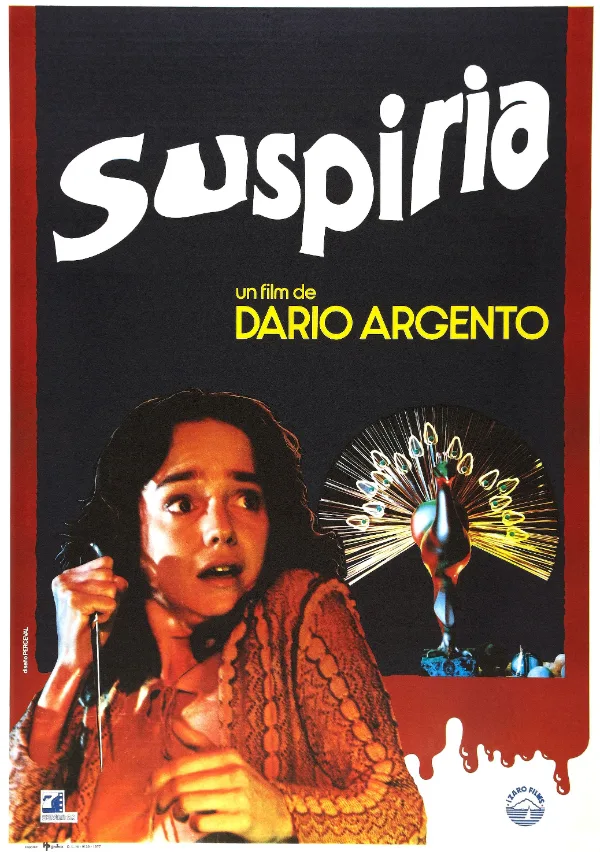
Celluloid writhes like a body possessed when Dario Argento decides horror isn’t enough—it has to be a sensory assault, a full-frontal attack on the senses that leaves the viewer staggering like a drunk in a 1970s disco. Suspiria isn’t a movie; it’s a satanic ritual filmed in Technicolor, a ballet of blood and shadows where every frame seems designed to short-circuit your brain. Released in 1977, at the height of Italy’s giallo era—that genre blending mystery with stylized murder—Argento didn’t just follow the rules: he burned them, stomped on them, and stitched them back together like a nightmare Frankenstein. It’s no coincidence the man grew up in cinema: his father, Salvatore Argento, was a producer, and his mother, Elda Luxardo, a fashion photographer. The kid was born with a camera in his veins and a knife in his hand, and Suspiria is the definitive proof that horror can be as refined as a Caravaggio painting… if Caravaggio had nightmares about witches and razor blades.
But let’s talk context, because Suspiria didn’t emerge from a vacuum. 1970s Italy was a pressure cooker of political tension, street violence, and a film industry in its golden age of exploitation. The giallo had already produced gems like Deep Red (Argento’s own 1975 masterpiece), but the maestro wanted more: he wanted horror to be physical, for the audience to feel the cold marble under Jessica Harper’s bare feet, to smell the sweat of the ballet students as the camera slithered like a predator through the academy’s halls. And damn, did he succeed. With a budget that would make today’s indie filmmakers weep (around $500,000), Argento built a world so artificial it was hypnotic, where primary colors—reds, blues, greens—weren’t just aesthetic choices but weapons of mass visual destruction. The result? A film that reeks of fresh paint and rotting flesh, a Molotov cocktail lobbed straight into the viewer’s gut.
And then there’s the sound. Good God, the sound. Goblin’s score doesn’t accompany the film—it assaults it, strangling it with synthesizer chords that sound like Satan tuning his guitar in hell. Every note is a lash, every silence a threat. Argento understood something many horror directors still don’t: fear isn’t built on what you see, but on what you feel. And in Suspiria, you feel too much. You feel the velvet curtains brushing against your skin, the crunch of broken glass under a victim’s feet, the buzz of flies over a corpse. This is tactile cinema, an experience that transcends the screen to infect your nervous system like a virus. No wonder Argento himself said he wanted audiences to leave the theater dizzy. Mission accomplished, maestro. Mission fucking accomplished.
But let’s not kid ourselves: Suspiria isn’t perfect. Its plot holes are big enough to drive a truck through, and some dialogue sounds like it was written in an LSD-induced trance. But here’s the thing: who cares? This isn’t a movie for nitpicking—it’s for living, for surrendering to its current of controlled madness. Argento doesn’t chase coherence; he chases impact, and in that, Suspiria is a well-oiled machine. Every scene is a low blow, every frame a knife to the eye. There’s no respite, no mercy: from the opening murder—filmed with a rawness that still takes your breath away—to the witch’s coven climax, where red floods the screen like someone slit a giant artery. This isn’t horror; it’s visual shock therapy, and it works like a spell.
The Direction: Argento, or the Art of the Technicolor Nightmare
If there’s a director who understands horror as choreography, it’s Dario Argento. In Suspiria, every camera movement is a dance step, every murder a macabre pirouette. The ballet academy isn’t just the setting—it’s the main character: a labyrinth of endless hallways, staircases that seem to lead straight to hell, and rooms that shift in size like a fever dream. Argento doesn’t film a movie—he builds a world, with the precision of a Swiss watchmaker and the madness of a medieval alchemist. His shots are so meticulous they look hand-painted: watch how the camera glides through the halls like a ghost, or how the close-ups of the victims’ eyes convey a terror so pure it feels real. This isn’t accidental. Argento studied every detail, from lighting to sound design, to create an immersive experience, as if the viewer were trapped in the same nightmare as Jessica Harper.
But the real genius of his direction is how he plays with color. At a time when horror settled for dark tones and elongated shadows, Argento decided his film would be a neon festival. The reds are so intense they look like fresh blood, the blues so cold they freeze your soul, and the greens so artificial they could be poison served on a platter. This isn’t just aesthetics—it’s color psychology in its purest form. Every hue is designed to provoke an emotion, to manipulate the viewer like a puppet. And it works. When blood sprays across the screen, it’s not just a special effect—it’s an explosion of art, a moment of grotesque beauty that leaves you breathless. Argento doesn’t fear excess; he embraces it, celebrates it, makes it his signature. And damn, does it suit him.
The pacing, meanwhile, is relentless. There are no filler scenes, no moments to catch your breath: from the first minute, Suspiria grabs you by the throat and doesn’t let go until the end credits roll like a sigh of relief. Argento understands that horror isn’t built on cheap scares, but on constant tension, that feeling that something bad is about to happen… and when it does, it’s worse than you imagined. The murders aren’t gratuitous—they’re death ballets, sequences so well-planned they look like they’re straight out of a macabre dance. The gore isn’t pointless; it’s artistic, a way of reminding us that in Suspiria’s world, beauty and horror go hand in hand. And that, dear readers, is what makes Argento a genius: his ability to turn the repulsive into something hypnotic, the terrifying into something fascinating.
The Performances: When Horror Dons a Ballet Slipper
If Suspiria proves anything, it’s that in horror, performances don’t need to be realistic to be effective. Jessica Harper, as Suzy Bannion, is the blonde innocence lost in a witches’ world, and her performance is so fragile it feels like porcelain. It’s not a nuanced acting job, but it doesn’t need to be: Harper conveys terror with a glance, a gesture, that quiver in her voice that makes you want to hug her—or slap her out of the screen. She’s the human anchor in a sea of madness, and her presence is as necessary as oxygen in a smoke-filled room. Without her, Suspiria would be an empty stylistic exercise; with her, it becomes a Gothic tragedy where the supernatural collides with the earthly.
The rest of the cast is a carnival of eccentricities. Stefania Casini, as the dancer Sara, has a magnetic presence, like she knows something the others don’t. Flavio Bucci, as the blind pianist Daniel, is pure pent-up tension, a character straight out of an Edgar Allan Poe tale. And then there’s the coven of witches, led by a Joan Bennett who looks like she just stepped out of a 1930s black mass. These aren’t realistic performances, but who the hell wants realism in a movie about a ballet academy run by a witch cult? Argento doesn’t seek actors who disappear into their roles—he wants presences, figures that fill the screen with their very existence. And in that, the Suspiria cast is flawless: each one feels like a ghost trapped in celluloid, a nightmare memory that refuses to fade.
The Technical Mastery: When Cinema Becomes Alchemy
If there’s one aspect where Suspiria has no equal, it’s in its production design. The ballet academy isn’t just a set—it’s a living character, a labyrinth of hallways that seem to breathe, rooms that shift shape, and staircases that defy physics. Production designer Giuseppe Bassan created a space so artificial yet hypnotic that every element—from the floor tiles to the velvet curtains—is designed to disorient the viewer. It’s no accident the academy feels like a dream: Argento wanted the audience to feel trapped in a world where reality’s rules don’t apply. And damn, did he succeed. Every frame of Suspiria is a work of art, a moving painting where color and composition are as important as the narrative.
But if the production design is a jewel, Luciano Tovoli’s cinematography is a revelation. Tovoli, who had worked with directors like Antonioni and Bertolucci, took color usage to a level never before seen in horror. The reds aren’t just red—they’re fresh blood, a life force flooding the screen like an overflowing river. The blues are so cold they seem to cut skin, and the greens so artificial they could be poison served on a platter. Tovoli doesn’t just light the scene—he paints it, molds it, brings it to life. And then there’s the use of light: in Suspiria, darkness isn’t just the absence of light—it’s a character in itself, an entity that lurks, watches, waits for its moment to strike. This is cinematography as pure terror, and it’s one of the reasons this film remains as shocking today as it was in 1977.
And we can’t forget the score. Goblin, the Italian progressive rock group, crafted a soundtrack as vital to the film as the script or direction. The synthesizers don’t accompany the action—they consume it, strangling it with chords that sound like hell’s own symphony. Every note is a lash, every silence a threat. Suspiria’s music isn’t something you hear—it’s something you feel, something that lodges in your chest and won’t let go until the film ends. Argento understood something many horror directors still don’t: fear isn’t built on what you see, but on what you hear. And in Suspiria, you hear too much. You hear the buzz of flies, the crunch of glass underfoot, the witches’ whispers in the dark. This is sound as tactile terror, and it’s one of the reasons this film remains a masterpiece.
### The Best
- Argento’s direction: A bold, brilliant stylistic exercise where every frame is a visual stab and every camera movement a macabre dance step.
- Luciano Tovoli’s cinematography: Color isn’t decoration—it’s a character. The blood-reds, icy blues, and poisonous greens turn every scene into a Technicolor nightmare.
- Goblin’s score: A soundtrack that doesn’t accompany the film but assaults it, with synthesizers that sound like hell tuning its instruments.
- The production design: The ballet academy is a nightmare labyrinth, a space so artificial yet hypnotic that every detail is designed to disorient.
### The Worst
- The script: Plot holes big enough to drive a truck through, and dialogue that sounds like it was written under the influence of LSD.
- The performances: Not bad, but not realistic either. In such a stylized film, this can be an issue for those seeking dramatic depth.
- The dubbing in some versions: The original Italian cut is the only one that does the film justice. The English dub, on the other hand, is so bad it plays like a parody.
- Lack of coherence in some moments: Argento prioritizes style over narrative, and while it mostly works, some scenes feel like they’re from another movie.
### The Verdict of Claqueta Ácida
Suspiria isn’t a movie—it’s an exorcism filmed on celluloid, a hallucinogenic trip where terror and beauty hold hands like lovers at a black mass. Dario Argento wasn’t trying to tell a story: he was trying to destroy you, and damn, did he succeed. Every frame is a stab, every color an open wound, every note of the score a lash to the soul. It’s not perfect—what masterpiece is?—but it’s necessary, one of those films that redefines a genre and leaves other horror directors crying in a corner, wondering how the hell he dared to go so far. If cinema is art, Suspiria is its purest, wildest expression; if cinema is a nightmare, this film is its epitome. Don’t watch it. Live it. And then pray it doesn’t haunt your dreams. 💀
🎬 Tráiler Oficial
💬 El Veredicto de la Comunidad
¿Qué te ha parecido la película? Deja tu nota de 0 a 10 para contrastarla con el análisis de la redacción.
Aún no has votado
📢 ¿Te ha gustado el ácido?
Comparte esta crítica con tus amigos cinéfilos o desata la polémica en redes.
📩 📩 Get the poison in your inbox
Join our weekly mailing list. Honest film reviews, acid festival coverage, and cult recommendations every Sunday morning. Zero spam, pure celluloid.
🔒 We promise weekly poisonous reviews and exclusive coverage.Related Reviews
Recommended autopsies for demanding film buffs.
 🔥 Fusión Nuclear9.0
*Suspiria: Argento’s Ballet of Blood and Technicolor Nightmares*
Dario Argento turns horror into a psychedelic light show drenched in gore. Claqueta Ácida dissects his masterpiece: *art or a technicolor nightmare?*
 🔥 Fusión Nuclear8.2
The Boarding School: A Dormitory of Dread
The Boarding School (1969), a film that revives terror within the walls of a girls' boarding school—where repression and sadism dance a waltz in crinoline
 🔥 Fusión Nuclear9.0
The Texas Chain Saw Massacre: The Bloody Dawn of Modern Terror (Or How Tobe Hooper Gifted Us Nightmares with a Chainsaw and Zero Budget)
Tobe Hooper turned $140,000 and an abandoned slaughterhouse into hell on Earth. Claqueta Ácida dissects this horror classic with a chainsaw, pitch-black humor, and a devotion to bloodstained celluloid.