*Primer* — A Mind-Bending Trip to the Heart of Scientific Paranoia (or How to Ruin Your Life with a Garage and a Quantum Physics Manual)
Shane Carruth turns a shoestring budget into a low-fi garage nightmare that’ll leave you more confused than a cat in a hall of mirrors. Science, betrayal, and bargain-bin sweat in 79 minutes of claustrophobic genius.

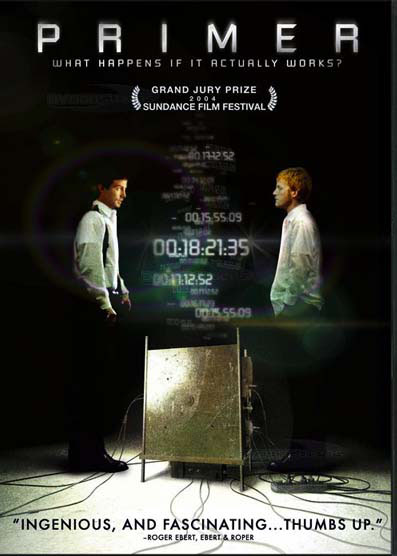
Science fiction cinema has always had two souls: one that gazes at the stars with childlike wonder, and another that digs into the grime of the human condition with dirty fingernails. Shane Carruth, that minor deity of indie film who built his own altar in a Dallas garage, didn’t hesitate to choose the latter when he set out to make Primer in 2004. With a budget that wouldn’t even cover the craft services coffee on Interstellar, Carruth didn’t just prove that ingenuity can trump money—he showed that paranoia is the most potent fuel for a narrative that devours itself like an inescapable time loop. Here, there are no caped heroes or cardboard spaceships; just four guys in plaid shirts, sweat on their temples, and a time machine that looks like it was pulled from a 1970s electronics manual. Welcome to the most claustrophobic scientific thriller since Pi—but with more incomprehensible dialogue and less urban prophet facial hair.
The backstory of Primer is as fascinating as its plot. Carruth, a former mathematician and programmer who abandoned his career to chase the dream of filmmaking, wrote, directed, starred in, edited, and scored this movie like a lab experiment: controlled, obsessive, and with a margin of error close to zero. The result is a film that reeks of motor oil, cold coffee, and the desperation of someone playing with forces they don’t understand. In an era of CGI blockbusters and recycled franchises, Primer emerged as a freak of nature, a true outsider that snuck into the 2004 Sundance Film Festival like a thief in the night and walked away with the Grand Jury Prize. And no wonder: in a landscape dominated by Hollywood’s empty glamour, Carruth offered something as rare as it is valuable—authenticity. Not the sugary authenticity of indie dramas where characters cry in long takes, but the grimy, sweaty authenticity of someone who’s spent hours soldering wires and arguing about quantum physics in a basement.
But Primer isn’t just a low-budget production miracle; it’s also a funhouse mirror reflecting humanity’s obsession with control. The time machine the protagonists build isn’t some sleek, futuristic gadget—it’s a monstrosity of exposed wires and metal boxes that looks like it was salvaged from a tech dumpster. And yet, it works. Or at least, that’s what they tell us. Because here lies Carruth’s genius—and his torture: he never gives us easy answers. The dialogue, dense and technical, layers over itself like paint on an abstract canvas, forcing the viewer to reconstruct the plot like solving a Rubik’s Cube blindfolded. Is this a cult film or a sadistic experiment disguised as a movie? The answer, like everything in Primer, depends on the angle from which you look at it. What’s clear is that, two decades after its release, it remains one of the few films to capture the essence of scientific discovery: the thrill of the breakthrough and the terror of not knowing what the hell you’ve unleashed.
The shoot, by all accounts, was a 25-day hellscape that would make a first-year film student weep. There were no detailed scripts, just a basic outline and blind faith that technical improvisation and cryptic dialogue would work. And boy, did it. The film breathes authenticity in every frame, from the tight shots of characters huddled around the time machine like it’s a campfire on a cold night, to the uncomfortable silences that fill the gaps between words. Carruth didn’t just make a movie; he filmed a state of mind. And that state of mind is pure paranoia—the feeling that something is slipping through your fingers, and you don’t know if it’s your own clumsiness or the universe conspiring against you. In Primer, even the air smells like betrayal.
Direction: The Garage as a Cathedral of Chaos
Shane Carruth doesn’t direct Primer—he sweats over it like he’s trying to solve a differential equation with his hands tied behind his back. His style is a mix of obsessive minimalism and controlled chaos, as if Tarkovsky and David Lynch locked themselves in an electronics workshop with a case of cheap beer. The shots are tight, almost suffocating, and the camera moves with the deliberate clumsiness of someone who can’t afford dollies or Steadicams. But that clumsiness is, precisely, its greatest virtue. In a genre used to fluid camera movements and elegant transitions, Primer feels like an amateur documentary about a group of scientists on the verge of a nervous breakdown. And that, dear cinephiles, is pure magic.
Carruth isn’t afraid to let characters get lost in their own dialogue, to let scenes drag longer than necessary, or to leave the audience as confused as the protagonists. This is raw, unfiltered cinema. The lighting is cold and functional, like a hospital or a mechanic’s garage, and the color palette is reduced to grays, metallic blues, and sickly greens straight out of an ’80s monitor. There’s no room for beauty here—just truth. And the truth in Primer is that time travel isn’t a passport to adventure; it’s a sentence to loneliness and mistrust. Carruth knows this, and that’s why every shot feels like a backstab.
The editing, also by Carruth, is another of the film’s strengths. Scenes overlap, time jumps blur, and dialogue collides like it’s competing to see who can say the most cryptic line. It’s calculated chaos, a puzzle the viewer must assemble with the patience of a Buddhist monk. And yet, it works. Because Primer isn’t a movie to watch—it’s a movie to live, to suffer, to break a sweat over while trying to figure out what the hell is going on. Carruth doesn’t spoon-feed you; he forces you to work. And in a world of fast-food cinema, that’s an act of rebellion as necessary as it is refreshing.
Acting: The Art of Looking Smart (and Failing Miserably)
The cast of Primer is mostly non-professionals who look like they were recruited at a convention for nerdy engineers. There are no stars here, just guys who look like they’ve pulled too many all-nighters and drunk too much cheap beer. Shane Carruth, as Abe, stands out: a man with a lost gaze and the expression of someone who’s just realized his best friend is stealing his invention. His performance is so restrained it borders on catatonic, but in the context of the film, that’s exactly what works. Abe isn’t a hero; he’s an ordinary guy on the edge of a nervous breakdown, and Carruth plays him with a naturalism that’s downright unsettling.
David Sullivan, as Aaron, is the perfect counterpoint to Abe’s coldness. His character is more impulsive, more emotional, and Sullivan nails that mix of enthusiasm and desperation that defines unstable geniuses. Their dialogues are a festival of subtext and suspicious glances, like they’re playing chess with invisible pieces. And yet, there’s a strange chemistry between them, a tension that builds until it explodes in a climax that’s as uncomfortable as it is inevitable.
The rest of the cast gets by but doesn’t stand out. Casey Gooden, Anand Upadhyaya, and the others are little more than extras with technical dialogue that sounds like Mandarin to 99% of mortals. But far from being a flaw, that’s part of Primer’s charm. This isn’t a movie about charismatic characters; it’s a movie about ideas. And in Carruth’s hands, ideas are more dangerous than a box of dynamite in a garage.
Technical Aspects: When Low-Budget Becomes Art
The cinematography of Primer, by Troy Dick, is an exercise in visual minimalism that borders on asceticism. There are no spectacular shots, no elaborate compositions, no Rembrandt-worthy lighting. What you get is cold, functional lighting—like a hospital or a mechanic’s garage—reinforcing the sense that this is a scientific experiment, not a Hollywood movie. The framing is tight, almost claustrophobic, and the camera moves with the clumsiness of an amateur. But again, that clumsiness is deliberate. Carruth doesn’t want you to admire the beauty of the shots; he wants you to feel the tension lurking beneath them.
The production design is another highlight. The time machine—a monstrosity of wires and metal boxes that looks like it was pulled from a tech dumpster—is so realistic it hurts. There are no special effects here, just ingenuity and a budget that wouldn’t even cover the coffee for Avengers’ digital effects team. And yet, it works. Because Carruth understands that science fiction doesn’t need spaceships or explosions—just a powerful idea and the ability to sell it as real. And Primer sells its premise with a conviction that borders on religious fervor.
The score, composed by Carruth himself, is another element that adds to the film’s oppressive atmosphere. There are no epic melodies or memorable themes—just a series of electronic sounds and drones that hum like a refrigerator in an empty room. It’s functional music, designed to raise the hairs on the back of your neck, not to be hummed. And it does its job perfectly. Because Primer isn’t a movie to enjoy; it’s a movie to suffer through. And the score is there to remind you of that in every frame.
### The Best
- The screenplay: A labyrinth of technical dialogue and subtext that demands your full attention like your life depends on it. Carruth doesn’t give you anything—he makes you work for it.
- The direction: Shane Carruth turns budgetary limitations into a virtue, crafting an atmosphere of paranoia and claustrophobia that’s pure narrative dynamite.
- The time machine: A production design so realistic it looks like it was pulled from a 1970s electronics manual. No special effects—just ingenuity and sweat.
- The performances: Shane Carruth and David Sullivan convey a tension and chemistry that’s the film’s beating heart. They’re ordinary guys on the verge of collapse, and that’s what makes them fascinating.
- The editing: A calculated chaos that forces you to reconstruct the plot like solving a Rubik’s Cube blindfolded. This isn’t cinema for the lazy.
### The Worst
The learning curve: Primer* isn’t a movie to watch while distracted. If you don’t pay attention, you’ll be lost within the first five minutes, and there’s no God who can save you.- The supporting cast: Casey Gooden and Anand Upadhyaya are little more than extras with technical dialogue. They don’t add anything to the main drama.
- The pacing: There are moments when the film stalls, like Carruth isn’t quite sure how to move the plot forward. It’s not a major flaw, but it’s noticeable.
- The sound: Sometimes the dialogue overlaps, making it hard to understand what the characters are saying. It’s not a technical issue—it’s a narrative choice that can be frustrating.
### The Verdict of Claqueta Ácida
Primer is one of those films that arrives without fanfare and lodges itself in your brain like a rusty nail. It’s not perfect, nor does it need to be. It’s messy, confusing, claustrophobic, and at times frustrating. But it’s also brilliant, original, and fearless. With this film, Shane Carruth proved that cinema doesn’t need million-dollar budgets or special effects to be memorable—it just needs a powerful idea and the determination to see it through to its bitter end. And boy, did he ever. Primer isn’t a movie for everyone; it’s for those willing to break a sweat, to get lost in their own thoughts, and to leave the theater with more questions than answers. It’s cinema in its purest form—uncompromising, unfiltered, and unafraid. And in a world of predictable blockbusters and recycled franchises, that’s a breath of fresh air. Or rather, a breath of stale air, like a garage filled with wires and paranoia. 💀
🎬 Tráiler Oficial
💬 El Veredicto de la Comunidad
¿Qué te ha parecido la película? Deja tu nota de 0 a 10 para contrastarla con el análisis de la redacción.
Aún no has votado
📢 ¿Te ha gustado el ácido?
Comparte esta crítica con tus amigos cinéfilos o desata la polémica en redes.
📩 📩 Get the poison in your inbox
Join our weekly mailing list. Honest film reviews, acid festival coverage, and cult recommendations every Sunday morning. Zero spam, pure celluloid.
🔒 We promise weekly poisonous reviews and exclusive coverage.Related Reviews
Recommended autopsies for demanding film buffs.
 🔥 Fusión Nuclear8.5
*Primer*: A Mind-Bending Trip to the Heart of Scientific Paranoia (or How to Ruin Your Life with a Garage and a Quantum Physics Manual)
Shane Carruth turns a shoestring budget into a low-fi garage nightmare that’ll leave you more confused than a cat in a hall of mirrors. Science, betrayal, and bargain-bin sweat in 79 minutes of claustrophobic genius.
 ⚡ Ácido Cítrico6.2
*Exit 8*: The Horror Station That Can’t Find Its Way Out (And Neither Can You)
Genki Kawamura adapts *The Exit 8* video game with more loops than a politician’s campaign promises. Will it escape the purgatory of J-horror, or is it doomed to linger in its own terminal?
 ⚠️ Ácido Sulfúrico4.2
**Good Boy: The Dog That Saved No One (Not Even Itself)**
A supernatural canine stars in a film that barks up the wrong tree. *Claqueta Ácida* dissects this rural dud with the precision of a scalpel in a slaughterhouse.