*Timecrimes — The Time Loop That Dooms Us to Be (and Screw Up as) Ourselves*
Nacho Vigalondo turns time travel into a maze of flesh, blood, and stupid decisions. 92 minutes of low-budget paranoia that outshine the entire *Terminator* saga.

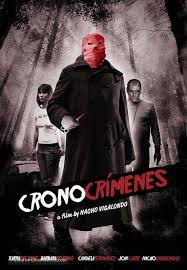
Timecrimes: When Time Is a Vicious Circle (and the Budget, a Glorious Excuse)
Some movies are born with the low-budget stigma tattooed on their foreheads, as if a shoestring budget were a contagious disease dooming them to obscurity. Then there’s Timecrimes (2007), a narrative juggling act where Nacho Vigalondo proves that when money’s tight, ingenuity doesn’t just compensate—it steals the show. It’s not that the film overcomes its financial limits; it flaunts them like badges of honor, as if every tight shot, recycled location, and janky practical effect were part of a punk manifesto against Hollywood excess. And the irony? In mocking blockbusters, Vigalondo ended up crafting one of the smartest, most claustrophobic, and brutally human sci-fi films of the 21st century.
The Premise: A Time Travel Story That Smells Like Sweat and Bad Decisions
Timecrimes’ plot is deceptively simple, like a quantum physicist’s joke: Héctor (Karra Elejalde), a middle-aged man whose face permanently reads "I’ve just realized my life is a mistake," chases a naked woman through the woods near his home. What starts as textbook rural voyeurism—"looking doesn’t cost a thing," but with zero glamour—spirals into a chase ending with Héctor stabbed in the arm and fleeing toward an abandoned scientific facility. There, a mysterious operator (played by Vigalondo himself, because who better to embody the guy who ruins your life?) offers him the solution to all his problems: time travel. Or, more accurately, a temporary fix to a problem that, as he’ll soon learn, has only just begun.
What’s fascinating isn’t the time travel itself—let’s be honest, in cinema, it’s been smelling like mothballs since Back to the Future—but how Vigalondo turns a tired trope into an existential thriller where the real monster isn’t an alien, a robot, or a mad scientist, but Héctor himself, multiplied by three. The film plays with the doppelgänger paradox so obsessively that by the time the third Héctor appears, the audience is as lost in the loop as the protagonist. And the best part? No grand explanations. No wormhole lectures, no equations on chalkboards, no German-accented scientists explaining how the machine works. The time machine is a rusty metal cubicle with a car seat and a red button. Period. Vigalondo trusts the audience’s intelligence so much he doesn’t even bother justifying the impossible. And, against all odds, it works.
The Script: Narrative Efficiency at Its Finest (or How to Say a Lot with Very Little)
What defines Timecrimes is its surgical script, a narrative mechanism where every line of dialogue, every silence, and every glance is calculated to maximize chaos. Vigalondo doesn’t write scenes; he designs traps. The film moves like clockwork, but one that, instead of telling time, stabs you in the ribs and whispers, "See? You did this to yourself."
The first act is a masterclass in tension-building. Héctor chases the naked woman (Bárbara Goenaga, whose role could be summed up as "the McGuffin with legs"), slices his arm on barbed wire, and flees toward the time machine. So far, so rural slasher with Twilight Zone vibes. But then comes the twist: future Héctor warns present Héctor not to use the machine. Just like that, Vigalondo hurls us into a loop of self-destructive decisions where every attempt Héctor makes to "fix" things only makes them worse. It’s like watching a man try to put out a fire with gasoline—except here, the man is his own arsonist.
The script’s brilliance lies in how it exploits human nature. Héctor isn’t a hero, a villain, or even an antihero: he’s an everyman trapped in an extraordinary situation, and his reactions are as predictable as they are pathetic. He tries to save himself, sure, but he also lies, cheats, and—in a particularly glorious moment—takes advantage of his past self to hit on his own wife (Candela Fernández, in a role that oscillates between comedy and deep discomfort). Vigalondo doesn’t judge his protagonist; he exposes him, like an entomologist pinning an insect to a board to study its desperate flailing. And in this case, the insect is all of us.
The Direction: Vigalondo, the Surgeon Who Doesn’t Need Anesthesia
Nacho Vigalondo directs Timecrimes with the precision of a neurosurgeon and the cruelty of a medieval torturer. Every frame is designed to suffocate the audience, whether through claustrophobic compositions (those narrow hallways in the facility, those trees closing in on Héctor like coffin walls) or off-screen space used with sadistic flair. A particular standout—the car scene with Héctor and his doppelgänger—is a masterclass in sustained tension: two actors, one vehicle, a knife, and a silence heavier than lead. Vigalondo doesn’t need special effects or blaring music to raise the hairs on your neck; he just lets the characters breathe (or stop breathing) at the right moment.
But where the director truly shines is in his handling of dark humor. Timecrimes isn’t a comedy, but it has moments so absurdly bleak you can’t help but laugh (or at least let out an uncomfortable gasp). The prime example? When Héctor tries to convince his wife he’s not himself while his other self nonchalantly eats a sandwich in the kitchen. The situation is so ridiculous, so human, it hurts. Vigalondo understands that the most effective horror isn’t the kind that makes you scream—it’s the kind that makes you laugh to keep from crying.
The Performances: Karra Elejalde and the Art of Suffering with Elegance
If anyone deserves credit for Timecrimes working on an emotional level, it’s Karra Elejalde. The Basque actor doesn’t play Héctor; he inhabits him, with a naturalism that makes every gesture—sweat on his brow, trembling hands, that trapped-animal look—feel ripped from real life. Elejalde doesn’t need grand monologues or explosive action scenes to convey his character’s existential terror; he just exists in the frame, as if every second is bleeding him dry.
The rest of the cast delivers, though it’s fair to say Bárbara Goenaga and Candela Fernández have more limited roles (the former as the plot’s catalyst, the latter as the confused, betrayed wife). But where the ensemble truly shines is in the moments when the three Héctors interact. Vigalondo doesn’t rely on CGI to differentiate the doppelgängers; instead, he exploits subtle variations in body language and tone. The "original" Héctor is the clumsiest, most desperate; future Héctor is cold, calculating, almost sadistic; and the middle Héctor (the third arrival) is a mix of both, caught between innocence and corruption. It’s fascinating to watch Elejalde modulate his performance so each version feels distinct yet recognizable.
The Cinematography: When Green Becomes Sinister
Flavio Martínez Labiano turns Cantabria’s rural landscape into a character in its own right. The exteriors, bathed in an oppressive green light, seem plucked from a David Lynch fever dream, where nature isn’t a peaceful retreat but a labyrinth with no exit. The wide shots of the woods are beautiful, yes, but also unsettling: the trees close in on Héctor as if trying to swallow him, and the sky, when visible, has that leaden hue that heralds a storm (or, in this case, impending disaster).
Indoors, Labiano opts for a near-documentary aesthetic, with harsh lighting that spares no flaw. There’s no glamour in Timecrimes; there’s sweat, blood, and bad lighting, as if we’re watching a survival reality show where the only contestant is a man who hates himself. And yet, that rawness is exactly what makes the film work. There’s no escape, no filters: just Héctor, his mistakes, and the consequences of his actions.
The Score: Silence as a Lethal Weapon
Chucky Namanera’s music is so minimalist and atmospheric that on first viewing, it’s easy to overlook. And maybe that’s the point. The score doesn’t impose itself; it blends with the sound design, creating a subliminal layer of tension that keeps you on edge without you realizing it. Sometimes, the only sounds are the crunch of leaves under Héctor’s feet, the hum of the time machine, or the accelerated heartbeat of the audience. Vigalondo understands that silence is often the most terrifying sound effect.
The Editing: A Loop You Won’t Want to Escape
Editor Santi Anaya works magic with material that, in less skilled hands, could’ve become an incomprehensible mess. The transitions between time loops are so seamless the audience barely notices the cuts, yet distinct enough to maintain tension. A particular moment—when future Héctor whispers something to present Héctor—is a perfect example of how editing can manipulate the audience. We don’t hear what’s said, but the jump cut and Héctor’s reaction are enough for our imaginations to fill in the blanks. And as Vigalondo knows, the imagination is always scarier than any image.
The Context: Spain in 2007, or Filmmaking on the Eve of the Apocalypse
Timecrimes premiered in 2007, a year before Spain’s housing bubble burst like a glitter-filled balloon. In that sense, the film is an unintentional mirror of its era: a story about decisions that seem smart in the moment but drag you into the abyss. Héctor isn’t a hero; he’s a middle-class Spaniard, a guy who thinks he can control his fate until reality proves otherwise. Vigalondo, knowingly or not, captured the spirit of a generation living on credit, both financial and moral.
Credit is also due to Arsénico Producciones and Zip Films for betting on such a risky project. In a country where genre cinema often defaults to romantic comedies or post-war dramas, Timecrimes was a slap of originality. And, most importantly: it worked. Not just at festivals (where it cleaned up) but at the box office, proving that Spanish audiences aren’t as unsophisticated as some producers think.
Film Buff Comparisons: The Spanish Primer (But with More Sweat and Less Pretension)
If Timecrimes shares DNA with any film, it’s Shane Carruth’s Primer (2004). Both are low-budget sci-fi exercises, both play with time travel intelligently, and both feature protagonists undone by their own decisions. But where Primer is cold, cerebral, and almost mathematical, Timecrimes is gritty, visceral, and deeply human. Carruth talks about temporal paradoxes; Vigalondo talks about men stabbing themselves and then wondering why it hurts.
There are also echoes of David Cronenberg in how the film explores the body as a battleground (that wounded arm Héctor drags around like a constant reminder of his failure), and of Alfred Hitchcock in its use of suspense and off-screen space. But ultimately, Timecrimes is 100% Vigalondo: a mix of dark humor, existential terror, and a fetishistic love for plot twists that leave you gaping.
### The best
- Nacho Vigalondo’s script: A poisoned Swiss watch that burrows into your brain and won’t let go until the fade to black. Every twist is a gut punch, but one that leaves you breathless and craving more.
- Karra Elejalde, or how to suffer with dignity: Elejalde doesn’t act; he bleeds on screen, and he does it with a naturalism that’s terrifying. It’s the kind of performance that makes you forget you’re watching a movie.
### The worst
- The pacing in the second act: There are a couple of moments where the film takes a breather before strangling you again, as if Vigalondo needs a running start for the next blow. It’s not a dealbreaker, but it’s noticeable.
- Chucky Namanera’s score: So subtle it’s easy to mistake for ambient noise. It’s not bad, but it’s so unobtrusive you wonder if it was even necessary.
### The Verdict of Claqueta Ácida (8.5/10)
Timecrimes is that rare gem of Spanish cinema: a film that needs no special effects, no stars, no million-dollar budgets to leave its mark. Nacho Vigalondo turns a seemingly simple premise into a hall of mirrors where the only monster is yourself, and he does it with a cruelty and wit that should be required study in every film school. It’s not perfect—it has minor pacing hiccups, and its score is so discreet it’s practically a ghost—but it’s essential. Because in the end, the real time travel isn’t Héctor’s; it’s the audience’s, walking out of the theater wondering what they would’ve done in his place. And that, dear readers, is the question that haunts us all. Like a doppelgänger. Like a past mistake. Like a knife in the arm. 🔪🎬 Tráiler Oficial
💬 El Veredicto de la Comunidad
¿Qué te ha parecido la película? Deja tu nota de 0 a 10 para contrastarla con el análisis de la redacción.
Aún no has votado
📢 ¿Te ha gustado el ácido?
Comparte esta crítica con tus amigos cinéfilos o desata la polémica en redes.
📩 📩 Get the poison in your inbox
Join our weekly mailing list. Honest film reviews, acid festival coverage, and cult recommendations every Sunday morning. Zero spam, pure celluloid.
🔒 We promise weekly poisonous reviews and exclusive coverage.Related Reviews
Recommended autopsies for demanding film buffs.
 🔥 Fusión Nuclear8.5
*Timecrimes: The Time Loop That Dooms Us to Be (and Screw Up as) Ourselves*
Nacho Vigalondo turns time travel into a maze of flesh, blood, and stupid decisions. 92 minutes of low-budget paranoia that outshine the entire *Terminator* saga.
 ⚡ Ácido Cítrico6.2
*Exit 8*: The Horror Station That Can’t Find Its Way Out (And Neither Can You)
Genki Kawamura adapts *The Exit 8* video game with more loops than a politician’s campaign promises. Will it escape the purgatory of J-horror, or is it doomed to linger in its own terminal?
 ⚠️ Ácido Sulfúrico4.2
**Good Boy: The Dog That Saved No One (Not Even Itself)**
A supernatural canine stars in a film that barks up the wrong tree. *Claqueta Ácida* dissects this rural dud with the precision of a scalpel in a slaughterhouse.