"Yummy — The All-You-Can-Eat Zombie Buffet No One Asked For (And Everyone Would Puke Over Twice)"
**"Lars Damoiseaux serves up a low-budget zombie feast with plastic surgeons more sinister than a 1970s operating room. Cheap blood, unintentional laughs, and a script that reeks of expired formaldehyde."**

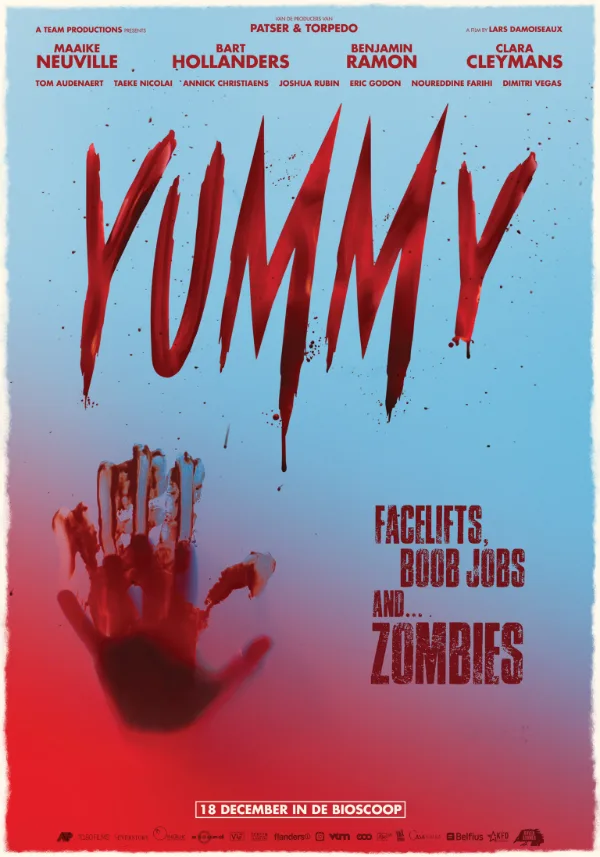
Belgian horror cinema has never exactly been a beacon of sophistication. Between the folk horror of Adoration and the surreal gore of Calvaire, the country seems specialized in distilling nightmares with a dash of European absurdity—as if Hieronymus Bosch had been born in Brussels and raised on Eurotrash. Yummy, Lars Damoiseaux’s directorial debut, doesn’t escape this tradition, but it doesn’t exactly elevate it either. Instead, it shuffles through the halls of an abandoned hospital like one of its own zombies: good intentions, poor balance, and a stench of rot that somehow never quite feels intentional. Released in 2019, this film arrived at a time when the zombie movie seemed to have exhausted all its variants, from The Walking Dead’s slow burn to 28 Days Later’s fast zombies. Yet instead of reinventing the wheel, Damoiseaux chose to grease it with cheap silicone and pray no one noticed the squeaking. The result is a movie that smells like a 1990s direct-to-video flick, but with the budget of a Black Mirror pilot rejected by Channel 4.
The production context of Yummy is as murky as its premise. Produced by A Team Productions and 10.80 Films, two Belgian outfits with more enthusiasm than resources, the film looks like it was shot over a long weekend, with a crew alternating between terror and nervous laughter. Lars Damoiseaux, whose previous experience was limited to short films and technical TV work, dove into feature filmmaking with the same grace as his protagonist freeing a zombie from a lab: no looking back, trusting that the ensuing chaos would be entertaining. The script, penned by Eveline Hagenbeek, is a Frankenstein’s monster of recycled ideas, blending Cronenberg’s body horror with Shaun of the Dead’s dark humor—but without the coherence of either. The premise—a couple traveling to Eastern Europe for plastic surgery and ending up in the middle of a zombie outbreak—had the potential for a biting satire on beauty obsession and low-cost medical tourism. But instead of sharpening the scalpel, Hagenbeek drops it on the viewer’s foot, no anesthesia.
The hospital where most of the action takes place is a character in its own right, though one as underdeveloped as the supporting cast. With its hallways lit by flickering fluorescents like dying fireflies and walls tiled like a 1970s slaughterhouse, the place has an oppressive atmosphere reminiscent of The Hospital (1971), but without its irony or style. Here, the production design seems more concerned with hiding the low budget than creating a cohesive aesthetic. The zombies, meanwhile, are a case study in how not to do practical effects: from the woman freed by the protagonist—who looks like an inflatable doll with Halloween makeup—to the transformed patients, whose wounds appear painted with tempera by a five-year-old. The contrast between the pretension of realism and the shoddy execution is so glaring that, more than once, you wonder if the crew hadn’t just followed a “How to Make Zombies at Home” YouTube tutorial to the letter.
The cast, led by Maaike Neuville and Bart Hollanders, does what it can with material that oscillates between the ridiculous and the pathetic. Neuville, as Alison, tries to give her character a humanity the script systematically denies her. Her chemistry with Hollanders, who plays her boyfriend Michael, is as forced as a cheek implant, and their dialogue sounds like it was written by a Twilight fanfiction algorithm. The real problem, though, isn’t the actors’ lack of talent but the absence of direction. Damoiseaux seems more interested in framing shots than guiding his performers, resulting in performances ranging from flat (Clara Cleymans as the mother-in-law) to histrionic (Éric Godon as the chief surgeon, who looks like he wandered in from a Hostel parody). The only one having fun is Benjamin Ramon, whose character—a patient with a sense of humor darker than a morgue’s coffee—steals every scene he’s in. His line, “I’d rather die with my own teeth than live with someone else’s,” is, ironically, the most memorable thing in the entire film.
Direction: The Blunt Scalpel
Lars Damoiseaux debuts with direction that wavers between functional and clumsy, like a surgeon who’s watched too many episodes of House but never set foot in an operating room. His visual style is about as subtle as a knee to the groin: medium shots straight out of an ‘80s filmmaking manual, unnecessary zooms that evoke ‘70s Italian horror, and lighting that alternates between too dark (to hide the cheap effects) and too bright (so you don’t notice the lack of texture). The editing, meanwhile, is a continuity disaster, with temporal jumps that feel like mistakes rather than narrative choices. There’s a scene where a character opens a door, and in the next shot, the door is closed again—as if the hospital had a life of its own and was playing hide-and-seek with the protagonists. The pacing is as irregular as a flatlining heartbeat: moments of poorly constructed tension followed by unintentional humor, like when a zombie trips over its own intestines and collapses like a sack of potatoes.
Damoiseaux’s biggest sin, however, is his inability to balance the tone. Yummy wants to be a black comedy, a body horror film, and a social satire all at once, but it ends up a generic Frankenstein that never gels. There are glimpses of what it could have been: the scene where Alison’s mother-in-law looks in the mirror after her botched lift, her face sagging like a deflated balloon, has a grotesque potential reminiscent of Society (1989). But Damoiseaux doesn’t dare delve into body horror, and the sequence ends up more ridiculous than disturbing. The same goes for the freed zombie woman, whose transformation could have been a powerful metaphor for female objectification, but is reduced to a clumsy plot device. Instead of exploring the symbolism of a woman trapped in a lab, turned into an experiment and then a monster, the film takes the easy route: blood, screams, and an ending scribbled in five minutes.
Performances: A Cast That Deserved Better
The Yummy ensemble seems like it was cast from a Belgian reality show, where the only requirement was “must know how to scream and look scared.” Maaike Neuville is the exception that proves the rule: her Alison is a nuanced character, a woman seeking plastic surgery as a solution to her emotional problems. Neuville manages to convey that vulnerability with a naturalness that contrasts with the rest of the cast, but even she’s weighed down by a script that turns her character into a passive victim, more concerned about her boyfriend than her own survival. Bart Hollanders, as Michael, is the typical male horror protagonist: selfish, cowardly, and astonishingly good at making the worst decisions possible. His chemistry with Neuville is nonexistent, and their dialogue is so forced you half-expect someone to yell “Cut!” and hand them a new script.
The real crime, though, is what they do to Clara Cleymans, whose character—Alison’s mother-in-law—has the potential to be the film’s most interesting. Cleymans, an actress with theater and TV experience, tries to give her role depth, but the script reduces her to a cliché: the vain woman who pays for her youth obsession. Her zombie transformation is one of the film’s most promising moments, but Damoiseaux doesn’t know what to do with her, and she ends up just another generic monster. Éric Godon, meanwhile, has a blast as the chief surgeon, a villain who seems straight out of an American Horror Story parody. His performance is so over-the-top it borders on camp, but at least it’s entertaining. The real discovery, though, is Benjamin Ramon, whose character, Jan, delivers the film’s only intentional moments of humor. His line about preferring to die with his own teeth is so absurd and well-delivered you wish the script had given him more screen time.
Technical Aspects: The Makeup That’s Scarier Than the Zombies
If Yummy proves anything, it’s that low budget isn’t an excuse for technical laziness. The production design, handled by a team that seems to have decorated the hospital with whatever they found in a medical prop warehouse, is a continuity disaster. The hospital hallways change color and size depending on the scene, and objects seem to move on their own, as if the set were haunted. The costumes are so generic the characters could be in any low-budget horror film from the last twenty years. The only exception is the freed zombie’s outfit, which looks stitched together from spiderweb scraps and rotten meat, but whose effect is ruined by makeup that looks like it was applied with a paintbrush.
The real low point, though, is the zombie makeup. In a film that aims to be body horror, the fact that the practical effects look like they’re straight out of a Power Rangers episode is a cardinal sin. The zombies’ wounds are so unconvincing you expect someone to yell, “It’s just ketchup!” and end the movie. The worst moment comes when a character is bitten in the neck, and the blood looks more like tomato sauce than vital fluid. The sound is just as uneven as the rest of the film: from screams recorded in a bathroom to sound effects pulled from a 1990s audio library. The score, composed by Steve Willaert, is a generic synth soundtrack trying to emulate John Carpenter but ending up sounding like mobile game music.
The cinematography by Daan Nieuwenhuijs is, by far, the film’s most salvageable technical aspect. Though limited by the budget, Nieuwenhuijs creates an oppressive atmosphere in the hospital hallways, using lighting to highlight the decay. The night scenes, with their palette of sickly greens and cold blues, evoke Roger Deakins’ work in The Assassination of Jesse James—but on a low-cost scale. Even here, though, there are flaws: the lack of texture in close-ups and overexposure in some scenes betray the lack of resources. The editing, meanwhile, is a continuity mess, with temporal jumps that feel like mistakes rather than narrative choices. In one scene, a character opens a door, and in the next shot, the door is closed again—as if the hospital had a life of its own and was playing hide-and-seek with the protagonists.
The Best
The premise: An original idea blending body horror*, social satire, and zombies with a dash of dark humor. It had cult potential, but the execution leaves it stranded.- Benjamin Ramon: The only actor who seems to be having fun, and his character, Jan, is the only one who brings intentional humor and freshness to an otherwise predictable script.
- Daan Nieuwenhuijs’ cinematography: Though limited by the budget, it creates an oppressive, sickly atmosphere that elevates some scenes above the rest.
- Alison’s mother-in-law: Clara Cleymans does what she can with a character reduced to a cliché, but her zombie transformation has a grotesque potential that, with better direction, could have been memorable.
- The hospital as a setting: The production design, though cheap, manages to convey a sense of decay and abandonment that fits the film’s premise.
The Worst
The zombie makeup: Looks like it’s from a 1990s Halloween kit, and the characters’ wounds are so unconvincing they ruin any attempt at body horror*.- Eveline Hagenbeek’s script: A mishmash of recycled ideas, forced dialogue, and flat characters that fail to connect with the audience. The promised social satire remains a clumsy sketch.
- The uneven pacing: Poorly constructed tension followed by unintentional humor, as if the film can’t decide what tone it wants.
- The lead performances: Maaike Neuville is the only one trying to give her character humanity, but the rest of the cast seems lost, especially Bart Hollanders, whose Michael is an insufferable protagonist.
- Lars Damoiseaux’s direction: Functional but clumsy, with shots straight out of an ‘80s filmmaking manual and editing that betrays inexperience.
- The rushed ending: Seems written in five minutes and doesn’t resolve any of the open plot threads, leaving a taste of missed opportunity.
The Verdict of Claqueta Ácida
Yummy is like fast food: it tastes like something, looks vaguely appetizing, but ultimately leaves you with a hollow feeling and a craving for something more substantial. Lars Damoiseaux and his team had a premise with the potential to be a biting satire on beauty obsession, low-cost medical tourism, and body horror, but instead, they serve up a generic zombie flick with shoddy effects, uneven performances, and a script that reeks of expired formaldehyde. There are glimpses of what it could have been—Nieuwenhuijs’ sickly cinematography, Benjamin Ramon’s dark humor, the mother-in-law’s grotesque transformation—but they’re drowned in a sea of poor decisions and lack of ambition. Yummy isn’t a bad movie, but it’s not a good one either: it’s mediocre, forgettable, and, above all, a reminder that low-budget horror needs more than fake blood and screams to work. A 6/10—enough to avoid a lawsuit, but not enough to avoid nausea. 💀
🎬 Tráiler Oficial
💬 El Veredicto de la Comunidad
¿Qué te ha parecido la película? Deja tu nota de 0 a 10 para contrastarla con el análisis de la redacción.
Aún no has votado
📢 ¿Te ha gustado el ácido?
Comparte esta crítica con tus amigos cinéfilos o desata la polémica en redes.
📩 📩 Get the poison in your inbox
Join our weekly mailing list. Honest film reviews, acid festival coverage, and cult recommendations every Sunday morning. Zero spam, pure celluloid.
🔒 We promise weekly poisonous reviews and exclusive coverage.Related Reviews
Recommended autopsies for demanding film buffs.
 ⚡ Ácido Cítrico6.0
**"Yummy: The All-You-Can-Eat Zombie Buffet No One Asked For (And Everyone Would Puke Over Twice)"**
**"Lars Damoiseaux serves up a low-budget zombie feast with plastic surgeons more sinister than a 1970s operating room. Cheap blood, unintentional laughs, and a script that reeks of expired formaldehyde."**
 ⚡ Ácido Cítrico6.2
*Exit 8*: The Horror Station That Can’t Find Its Way Out (And Neither Can You)
Genki Kawamura adapts *The Exit 8* video game with more loops than a politician’s campaign promises. Will it escape the purgatory of J-horror, or is it doomed to linger in its own terminal?
 ⚠️ Ácido Sulfúrico4.2
**Good Boy: The Dog That Saved No One (Not Even Itself)**
A supernatural canine stars in a film that barks up the wrong tree. *Claqueta Ácida* dissects this rural dud with the precision of a scalpel in a slaughterhouse.