"Hostel — The Tourist Trap Where They Butcher You with a Smile"
Eli Roth turns Slovakia into a backpacker slaughterhouse with this festive gore-fest that reeks of blood, sweat, and adolescent testosterone. Art? No. Fun? Plenty.

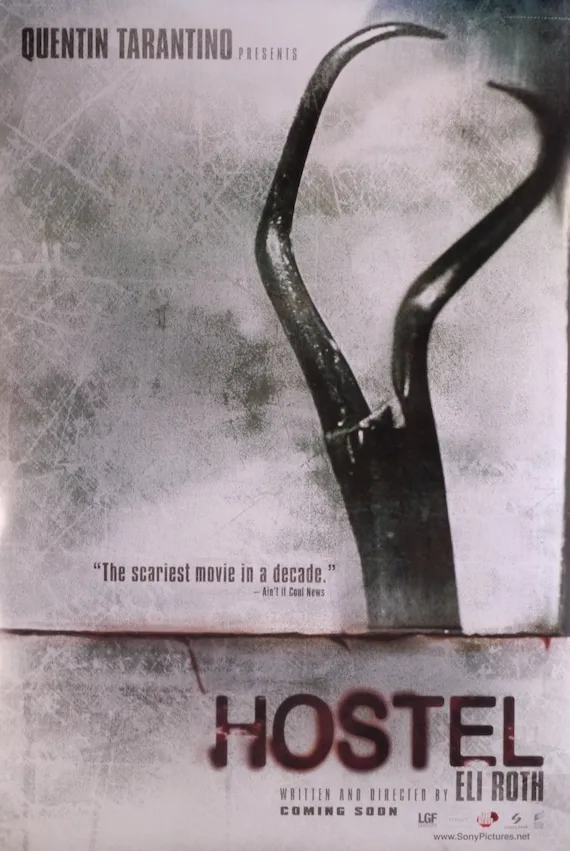
Celluloid bleeds, guts churn, and the stench of charred flesh fills the theater as if the projector were a back-alley rotisserie. Hostel isn’t a movie—it’s a snuff film with a Sundance budget and the charm of a Chernobyl tourism brochure. Eli Roth, that wunderkind of gore who grew up watching The Texas Chain Saw Massacre while picking his nose, decided Eastern Europe needed an urgent rebrand: from “cheap destination for drunk backpackers” to “paradise for psychopaths with a credit card.” And boy, did he deliver. In 2006, as the world was still reeling from 9/11 and reality TV turned humiliation into entertainment, Roth unleashed this minced-meat bomb, making even Saw fans clutch their mouths—not in terror, but in nausea. Because Hostel isn’t psychological horror; it’s physiological horror. It hits you where it hurts most, just below the belt, right where fear blends with disgust and that nervous laugh of someone who knows they’re watching something forbidden. And the forbidden, dear readers, always sells better than bread in a famine.
But let’s talk context, because Hostel didn’t spring from nowhere. It was born from a Molotov cocktail of Roth’s obsession with 1970s exploitation cinema, his love for New York’s grindhouse theaters (where the sticky floor was part of the experience), and, above all, his desire to take a dump on political correctness. In an era when Hollywood was drowning in superhero sequels and sanitized remakes, Roth arrived like a punk with a butcher’s knife and a script that smelled of cheap beer and alleyway piss. The film was shot in Slovakia, a country that until then only appeared on maps as “that place between Austria and Ukraine,” suddenly transformed into the nightmare setting for three backpacking idiots who mistake sex tourism for local culture. Exploitative? Absolutely. Offensive? To the bone. Necessary? Like a punch to the throat when you’ve been holding your breath for five minutes. Because Hostel isn’t just a horror movie—it’s a funhouse mirror reflecting post-9/11 America: a country exporting its paranoia, its violence, and its obsession with easy money to every corner of the globe, even if that corner is a slaughterhouse repurposed as a tourist attraction.
And then there’s the most macabre detail of all: Hostel is, at its core, a movie about capitalism. Not the abstract capitalism of economists, but visceral capitalism—the kind that turns human suffering into a luxury product with a VIP membership. The clients of Elite Hunting aren’t B-movie monsters; they’re businessmen in expensive suits, briefcases stuffed with dollars, willing to pay for the privilege of torturing a human being like they’re ordering steak tartare at a five-star restaurant. Roth doesn’t bother dressing up the metaphor: the horror here isn’t supernatural; it’s transactional. And that, dear cinephiles, is what makes Hostel hurt more than a rusty nail in the eye. Because it’s not fiction—it’s a documentary disguised as a slasher. A documentary about how the rich world pays the poor world to clean its conscience with someone else’s blood. And the worst part? If you look closely, you’ll see the real monster isn’t the guy with the saw—it’s the one signing the check.
The film’s editing is a collage of sweat, screams, and close-ups of torn flesh, as if the editor decided every frame should reek of iron and fear. The cinematography by Milan Chadima, that Czech wizard who turned sepia tones into a visual language, gives Hostel the air of a retro nightmare, as if the celluloid had been bathed in nicotine and tears. The colors are filthy, the framing claustrophobic, and every scene in the hostel looks like it was shot from the perspective of someone about to puke. But the most brilliant—and disturbing—thing is how Roth plays with the contrast between the beauty of the locations (those Slovak landscapes straight out of a fairy tale) and the absolute ugliness of what happens within them. It’s as if David Lynch had directed an episode of Jackass in the Alps. And the result is as uncomfortable as it is addictive: you know you should look away, but you can’t, because the spectacle of others’ pain has always been the world’s oldest reality show.
Direction: Roth, the Stylish Butcher
Eli Roth doesn’t direct—he slaughters. And he does it with the precision of a surgeon and the grace of an elephant in a china shop. Hostel is a gore festival that isn’t ashamed of its genre roots but, against all odds, has more brains than most “serious” horror films of its time. Roth understands something many directors forget: horror isn’t just what you see, but what you feel. And in Hostel, what you feel is a mix of disgust, nervous laughter, and that gut-punch realization that, deep down, you’re having the time of your life. The pacing is relentless: no time to breathe, to analyze, to question. The movie grabs you by the throat and drags you through a tunnel of blood and testosterone until you emerge gasping, shirt stuck to your body, wondering what the hell you just watched. And that, my friends, is the magic of good horror: it leaves you marked like a bad tattoo.
But Roth doesn’t just throw torture scenes around like confetti at a party. There’s a method to his madness. Every violent sequence is choreographed like a musical number, complete with its own score of screams, blood, and close-ups that turn suffering into something almost aesthetic. Take the eye scene, for example—it’s not just a shock moment; it’s a masterclass in mise-en-scène: the framing, the lighting, the sound of the blade scraping bone... It’s all calculated to make you feel the pain in your own retinas. And then there’s the humor, that twisted dark humor that acts like a balm for the viewer. Because let’s be honest—if Hostel didn’t have moments where you laugh out loud, you’d end up jumping out the window. Roth knows this, which is why he doses the terror with tasteless jokes, absurd dialogue, and that air of a drunk frat boy that permeates the whole film. It’s as if Troma and David Fincher had an illegitimate lovechild in a roadside motel.
Actors: A Cast of Victims (and the Occasional Executioner)
The trio of protagonists—Jay Hernandez, Derek Richardson, and Eythor Gudjonsson—are the cinematic equivalent of those groups of friends you see in bars at 3 AM and think, “My God, how did they get here?” They’re stupid, arrogant, naive, and—worst of all—believable. Because let’s face it, we’ve all known someone like them: that friend who thinks they’re the king of the world because they’ve read a couple of travel blogs and memorized four phrases in Czech. Derek Richardson, as Josh, best captures that mix of vulnerability and stupidity that makes you, deep down, kind of like him. He’s the classic nerd who thinks he’s smarter than everyone else but ends up being the first to fall into the trap. Jay Hernandez, as Paxton, has the physical presence that makes you believe he might survive... until the camera zooms in and you see the panic in his eyes. And then there’s Eythor Gudjonsson, the Icelander Oli, who’s basically the group’s token foreigner: the one who says the most absurd things, gets drunk the fastest, and, of course, is the first to die. Because in horror movies, Icelanders always die first. It’s an unwritten law.
But if there’s one performance that steals the show—and not just because her character spends half the runtime in her underwear—it’s Barbara Nedeljakova as Natalya. The Slovak actress isn’t just the most lethal femme fatale since Basic Instinct; she also has the gift of making sadism look sexy. Her smile is a weapon of mass destruction, and every time she appears on screen, you know someone’s going to suffer. A lot. Nedeljakova doesn’t play a villain; she plays a predator: cold, calculating, with a smile that could melt steel. She’s the kind of character that makes you wonder if the real horror of Hostel isn’t the torture, but the fact that, deep down, we’ve all fallen a little bit in love with her. And that, dear readers, is what separates a good horror movie from a masterpiece of the genre.
Technical Aspects: When Gore Becomes Art
Roth’s script is a masterclass in narrative economy: no time for subplots, character development, or the kind of filler Hollywood loves. Hostel gets to the point like an uppercut to the jaw, and every scene is designed to advance the plot or make you squirm in your seat. The dialogue is functional, sometimes clunky, but always authentic—it sounds like what three drunk idiots in a hostel in Eastern Europe would actually say. And in a horror movie, that’s a luxury. Because when the script is so tight that not a single comma is wasted, the terror becomes more real, more immediate. There’s no time to think, only to feel.
The cinematography by Milan Chadima is another highlight. The Czech cinematographer turns every shot into a nightmare painting, with a color palette that oscillates between sickly sepia and blood red. The hostel’s interiors are lit like a morgue, with elongated shadows and cold lights that make every corner seem like a place where horrible things could happen. And, of course, they do. Chadima also has a knack for close-ups: a bloodied knife, a terrified eye, a trembling hand... These are images that stab your retinas like needles. And then there’s the editing, that frenetic pace that gives you no respite, dragging you from one torture scene to the next without time to recover. It’s as if the editor decided the audience didn’t deserve a single second of peace. And, honestly, they’re right.
The score, composed by Nathan Barr, is another success. It’s not an epic soundtrack, nor does it try to be. It’s a mix of industrial sounds, ambient noise, and distorted melodies that sound like someone recorded the screams of the damned and turned them into music. There are moments when the music disappears entirely, leaving only the sound of the characters’ ragged breathing or the crunch of a breaking bone. And those silences, my friends, are more terrifying than any jump scare. Because the real terror isn’t what you see—it’s what you imagine. And in Hostel, the imagination is the viewer’s worst enemy.
The best
The premise: A brilliantly simple idea: what if sex tourism became murder* tourism? Roth turns a teenage fantasy into a capitalist nightmare.- Barbara Nedeljakova: An instant horror icon. Her smile is deadlier than any chainsaw.
- The dark humor: Without it, the movie would be unbearable. With it, it’s addictive.
- The social critique: Roth doesn’t just scare—he spits in the face of the most depraved capitalism.
The worst
- The protagonists: Three backpacking idiots who make you want to scream, “Run, for God’s sake, run!”
- Some dialogue: There are moments when the script sounds like it was written by a drunk teenager.
- The third act: The final escape is so over-the-top it borders on ridiculous.
- The cheap CGI: A couple of digital effects look like they’re from a 1990s video game.
The Verdict of Claqueta Ácida
Hostel isn’t a movie—it’s a social experiment. An experiment that proves that, deep down, we’re all a little voyeuristic, that we enjoy others’ pain as long as it’s not our own. Eli Roth didn’t invent torture porn, but he took it to its extreme: a mix of gore, dark humor, and social critique that hurts, entertains, and disturbs in equal measure. It’s not a cinematic masterpiece, but it’s a masterpiece of horror: dirty, violent, intelligent, and, above all, necessary. Because in a world where suffering has become entertainment, Hostel is the mirror that shows us our own monstrous faces. And that, dear readers, is something you don’t forget easily. Though after watching it, you might wish you could. 💀🎬 Tráiler Oficial
💬 El Veredicto de la Comunidad
¿Qué te ha parecido la película? Deja tu nota de 0 a 10 para contrastarla con el análisis de la redacción.
Aún no has votado
📢 ¿Te ha gustado el ácido?
Comparte esta crítica con tus amigos cinéfilos o desata la polémica en redes.
📩 📩 Get the poison in your inbox
Join our weekly mailing list. Honest film reviews, acid festival coverage, and cult recommendations every Sunday morning. Zero spam, pure celluloid.
🔒 We promise weekly poisonous reviews and exclusive coverage.Related Reviews
Recommended autopsies for demanding film buffs.
 ⚡ Ácido Cítrico7.0
"Hostel: The Tourist Trap Where They Butcher You with a Smile"
Eli Roth turns Slovakia into a backpacker slaughterhouse with this festive gore-fest that reeks of blood, sweat, and adolescent testosterone. Art? No. Fun? Plenty.
 ⚡ Ácido Cítrico7.5
*The Green Inferno: A Trip to the Heart of Darkness (And a One-Way Ticket to Nausea)*
*The most scathing, gut-wrenching takedown of *The Green Inferno*—a film that will make you question humanity (and your own gag reflex).*
 ⚡ Ácido Cítrico6.2
*Exit 8*: The Horror Station That Can’t Find Its Way Out (And Neither Can You)
Genki Kawamura adapts *The Exit 8* video game with more loops than a politician’s campaign promises. Will it escape the purgatory of J-horror, or is it doomed to linger in its own terminal?