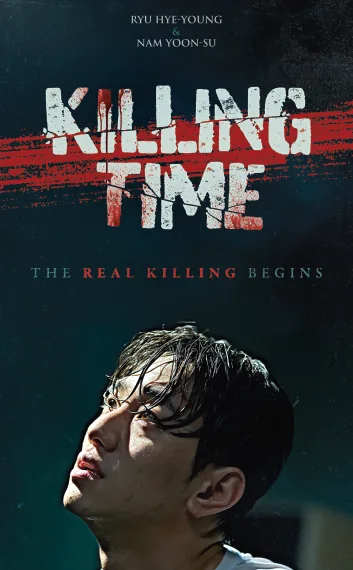
Killing Time
A dark fable by Jang Joon-yeop that dances between the poetic and the pretentious. A choreography of shadows and silences, but it lacks the teeth to bite.

For years, Korean cinema has been bleeding out on the red carpets of international festivals, offering the world a lethal cocktail of social melodrama, stylized violence, and that gritty realism that reeks of cheap soju and maternal tears. But amid the tsunami of revenge thrillers and family dramas flooding streaming platforms, Jang Joon-yeop sneaks in through the back door with Killing Time, a film seemingly conceived during a midnight ritual—between melting wax candles and the whispers of ancestors no one listens to. This isn’t the first time Korean folk horror has tried to seduce us with its masked dances and rural curses—just recall the icy chill of The Wailing (2016) or the macabre elegance of Gonjiam: Haunted Asylum (2018)—but here, the director bets on something subtler, almost ethereal, as if terror didn’t lurk in ghosts but in the weight of silences. The problem? Sometimes, silence can be boring. And Killing Time flirts dangerously with that thin line between the enigmatic and the soporific, like a shaman who forgets the words to his own spell.
The project is born under the wing of Studio Santa Claus Entertainment and Perfect Storm Film, two production companies that, judging by their names, seem to have been christened during a drunken night of delusions of grandeur among executives. The first, known for its indie-genre cinema, already gifted us gems like The Odd Family: Zombie On Sale (2019), a zombie comedy proving that even the undead can be endearing if Koreans put their minds to it. The second, a newcomer to the ring, evokes perfect storms… though in this case, the storm feels more like a persistent drizzle that never quite soaks you through. Jang Joon-yeop, for his part, makes his feature debut with a script that smells like a recycled university thesis, where every shot seems calculated to impress a festival jury rather than a theatergoer. He’s not a talentless filmmaker—his earlier shorts, like The Last Supper (2020), already hinted at an obsession with claustrophobic spaces and dialogue laden with symbolism—but here, he seems more concerned with crafting a mood than telling a story. And when the mood becomes the protagonist, the risk of self-indulgence is as high as the risk of dozing off in the cinema.
The premise of Killing Time—if you can even call it a premise, given its refusal to reveal itself—revolves around a group of characters lost in a rural village where time seems to have stopped, as if the local church clock had been cursed by a drunken watchmaker. The villagers, with their weathered faces and empty stares, seem plucked from a Brueghel the Elder painting, though with less joy and more fermented soybeans. Among them, Nam Yoon-soo plays a stranger who arrives in town seeking answers—or maybe just a cell signal—while Ryu Hye-young embodies a woman who seems to know more than she lets on, as if harboring a secret so heavy she doesn’t dare bring it to light. The rest of the cast, composed of supporting actors who might as well be wax statues with circulation problems, move through the frame as if under a collective sleepiness spell. There are no clear villains, no narrative twists to leave you gaping, not even a climax that justifies the 83-minute wait. Instead, Killing Time wallows in its own atmosphere, like a cat licking its wounds while the viewer wonders whether to do the same or just get up and leave.
The cultural context framing this film is fascinating, as South Korea is experiencing a surge in horror cinema where the supernatural isn’t just about scares but serves as a metaphor for the country’s historical and social traumas. Films like The Night of the Undead (2020) or Host (2020) have shown that terror can reflect collective anxiety as much as offer an escape from it. Yet Killing Time seems more interested in looking inward, toward that rural folklore urban Koreans have left behind but which still haunts them like a ghost from the past. The problem? In its quest to be poetic, the film forgets that terror—even slow, atmospheric terror—needs a heartbeat, a pulse to keep the viewer hooked. And here, that heartbeat is so faint it sometimes seems to have stopped entirely, as if the film itself had fallen under the spell of its own stagnant time.
Direction: The Art of Saying Nothing with Style
If there’s one thing to credit Jang Joon-yeop for, it’s knowing how to compose a shot. Every frame in Killing Time looks plucked from a 1970s photography book, with that desaturated color palette evoking autumn in an abandoned village, where greens turn mustard and reds look rusted. The influence of directors like Apichatpong Weerasethakul—that Thai master of slow, dreamlike cinema—is evident in how the camera lingers on the most mundane details: a creaking door, a cat licking its paws, steam rising from a cup of tea. But while Weerasethakul makes even the most trivial act seem laden with meaning, Jang sometimes stays on the surface, as if confusing mood with message. There are moments when the film feels like a succession of pretty postcards with nothing behind them, as if the director forgot that cinema isn’t just about images but also emotion.
The pacing, however, is Killing Time’s Achilles’ heel. The film moves like a lazy river, dragging the viewer along on a journey with no hurry—and no destination. Entire scenes could be cut without the plot (if you can even call it that) suffering in the slightest. For example, a sequence where characters walk through a forest while the camera lingers on sunlight filtering through the leaves lasts nearly five minutes but contributes absolutely nothing to the story. It’s as if Jang mistook the audience’s patience for the screenwriter’s laziness. And while it’s true that slow cinema can be hypnotic—just look at Tarkovsky’s Stalker (1979) or The Mirror (1975)—it also requires a depth that Killing Time doesn’t always achieve. Sometimes, it feels like the film is more interested in impressing us with its aesthetics than engaging us with its narrative.
The sound design is another of the film’s strengths—and weaknesses. The score, composed of minimal piano notes and strings that sound as if played underwater, reinforces that sense of unreality permeating the runtime. Yet silence also plays a crucial role, and here Jang demonstrates his skill at creating tension with what isn’t said. There are scenes where the only sound is the crunch of leaves underfoot or the wind whistling through abandoned houses, and those moments work best. The problem arises when the film breaks that silence with dialogue—so cryptic and pretentious it sounds like it’s been lifted from a self-help manual for frustrated poets. Lines like «Time isn’t killed, it’s embraced» or «The dead don’t speak, but their shadows do» sound profound on paper, but on screen, they land like stones in a pond, leaving barely a ripple.
Performances: Faces That Hide More Than They Reveal
The cast of Killing Time consists of actors seemingly chosen for their ability to maintain an expression of existential perplexity for extended periods. Nam Yoon-soo, as the stranger, has a magnetic presence, blending vulnerability and determination in a way that recalls Sergio Leone’s Western protagonists. However, his character is so ill-defined he sometimes feels like just another ghost in the village, a specter wandering without purpose. His chemistry with Ryu Hye-young is one of the film’s few bright spots, though their relationship is built more on glances than words. There’s a scene where they sit across from each other at a wooden table, drinking tea in silence, and for a moment, it seems like the film might take an emotional turn. But no. The moment passes, and with it, any hope of their characters developing anything beyond a vague, ill-defined attraction.
Ryu Hye-young, meanwhile, is the true standout. Her character—a woman who seems to know more than she lets on—has an unsettling presence, as if carrying a secret too heavy to share. Her performance is subtle yet intense, with a gaze that could cut glass and a way of moving that suggests she’s used to walking among shadows. She’s the kind of character who could have been the film’s heart, but Jang seems more interested in keeping her an enigma than exploring what lies beneath her facade. The rest of the cast, made up of actors who look like they’ve been plucked from a wax museum casting call, fulfill their roles without standing out. Oh Min-soo, as a villager with more wrinkles than words, has a couple of memorable moments, but his character is so stereotypical he feels lifted from a rural folklore cliché manual.
The biggest issue with the performances in Killing Time is that the characters don’t evolve. They’re like figures in a painting that never come to life, doomed to repeat the same gestures and cryptic lines over and over. There are no narrative arcs, no internal conflicts to resolve, not even a clear goal to pursue. At best, they’re symbols; at worst, human set dressing. And while it’s true that auteur cinema sometimes plays with character ambiguity, here it feels more like an excuse for not developing anything than a conscious artistic choice.
Technical Aspects: The Beauty of the Incomplete
If anything saves Killing Time from being a complete disaster, it’s its technical execution. The cinematography—though uncredited—is one of the film’s strongest points. Every frame seems designed to be framed, with a composition reminiscent of Andrei Tarkovsky or Béla Tarr, where space and time dissolve into a dance of light and shadow. The interiors, lit with a dim, yellowish glow evoking candlelight, create an oppressive yet intimate atmosphere, as if we’re spying on a secret ritual. The exteriors, bathed in earthy tones, reinforce that sense of rural decay, where nature seems to be reclaiming what man has taken from it.
The production design is another success. The village houses, with their rotting wooden walls and thatched roofs, look plucked from a dark fairy tale, where every corner hides a secret or a trap. The objects populating the frames—stopped clocks, fogged mirrors, rag dolls with stitched eyes—are laden with symbolism, though sometimes that symbolism feels forced rather than organic. For example, there’s a scene where Ryu Hye-young’s character holds an hourglass while staring directly at the camera, and you can’t help but think, «Wow, how subtle.» But even in those moments of obviousness, the production design manages to create a sense of visual coherence that keeps the viewer engaged.
The editing, however, is uneven. Some sequences flow with hypnotic elegance, like a long take where the camera follows the characters through a misty forest. But there are also moments where the pacing stalls, as if the editor decided a scene deserved to last twice as long just because it looked pretty. The sound, as mentioned earlier, is another strong point, though its use is so sporadic it sometimes feels like the film is afraid to break its own silence. The score, composed of minimal, repetitive notes, reinforces that sense of unreality but can also come off as monotonous if you’re not in the right mood.
The best
- The cinematography: A flawless visual work that turns every frame into a living painting. The desaturated color palette and dim lighting create an atmosphere that’s both oppressive and poetic.
- Ryu Hye-young: Her performance is the film’s beating heart. With a gaze that could freeze hell and an enigmatic presence, she makes her character the most memorable part of the runtime.
- The production design: Abandoned houses, objects laden with symbolism, and claustrophobic spaces reinforce the feeling of being trapped in a dream—or a nightmare—you can’t wake up from.
- The use of silence: There are moments where the absence of sound is as eloquent as dialogue. The film proves that terror doesn’t always need screams to be effective.
The worst
- The pacing: The film moves like a lazy river, dragging the viewer along on a journey with no hurry and no destination. Entire scenes could be cut without the plot suffering in the slightest.
- The lack of character development: They’re more symbols than people, doomed to repeat the same gestures and cryptic lines over and over. There are no narrative arcs, no internal conflicts, not even a clear goal.
- The forced ambiguity: Sometimes, it feels like the film is more interested in impressing us with its aesthetics than telling a story. The ambiguity feels like an excuse for not developing anything.
- The ending: After 83 minutes of waiting, the climax is so anticlimactic you can’t help but wonder if the film ran out of budget or simply forgot how to end.
The Verdict of Claqueta Ácida
Killing Time is one of those films seemingly conceived to win awards at auteur film festivals rather than connect with a real audience. Jang Joon-yeop proves he knows how to compose a shot and create an atmosphere, but he also shows that sometimes mood isn’t enough. There’s beauty in its images, mystery in its silences, and a standout performance from Ryu Hye-young, but all of that dissolves into uneven pacing, pretentious dialogue, and a narrative more interested in impressing than moving. It’s not a bad film, but it’s not the masterpiece its director seemed hellbent on creating. In the end, Killing Time achieves what it sets out to do: kill time. The problem is, sometimes the time it kills is the viewer’s. 💀
💬 El Veredicto de la Comunidad
¿Qué te ha parecido la película? Deja tu nota de 0 a 10 para contrastarla con el análisis de la redacción.
Aún no has votado
📢 ¿Te ha gustado el ácido?
Comparte esta crítica con tus amigos cinéfilos o desata la polémica en redes.
📩 📩 Get the poison in your inbox
Join our weekly mailing list. Honest film reviews, acid festival coverage, and cult recommendations every Sunday morning. Zero spam, pure celluloid.
🔒 We promise weekly poisonous reviews and exclusive coverage.Related Reviews
Recommended autopsies for demanding film buffs.
 ⚡ Ácido Cítrico7.0
Killing Time
A dark fable by Jang Joon-yeop that dances between the poetic and the pretentious. A choreography of shadows and silences, but it lacks the teeth to bite.
 ⚠️ Ácido Sulfúrico0.0
**PUFA 2026: "Bad Haircut" Wins the Festival—and Its Barber Gives Us a One-Way Ticket to Nuremberg (The Definitive Palmares, or How to Learn to Love the Absurd)**
*"Bad Haircut" takes home Best Film at the third edition of the Valladolid International Fantastic and Horror Film Festival, while the jury and critics remain deeply divided over the film’s quality.*
 ⚡ Ácido Cítrico5.0
Quantum Rave: The Neon Feast Nobody Asked For (And We All Deserved)
Paco Campano serves us a cocktail of cheap psychedelia and rusted robotics in 'Quantum Rave.' Art or cosmic vomit? Claqueta Ácida decides with boxing gloves on.