*Jack's House — A Descent into the Abyss (Or How to Turn Your Audience into an Emotional Crime Scene)*
Lars von Trier drags us into the heart of darkness with *The House That Jack Built*. Can we survive the bloodbath and madness—or will we beg for an intermission from hell?

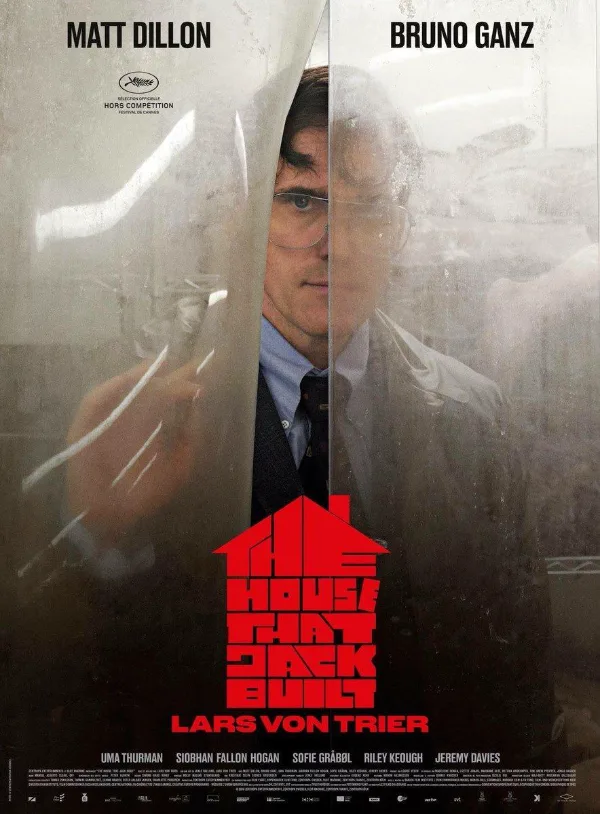
The screening begins with the crackle of burning celluloid, as if hell itself had loaned us its film reel for the occasion. Lars von Trier, that enfant terrible of European cinema who signs his films in blood and provocation, gifts us The House That Jack Built—a movie that refuses to be just a movie. It’s a full-blown exorcism, an autopsy of morality where the scalpel is the camera and the corpse is our own conscience. Premiering in 2018 after a traumatic birth at Cannes (met with boos, ovations, and more than a few viewers fleeing the theater mid-vomit), this masterpiece of bad taste (in the best possible way) is the cinematic equivalent of sticking your head in a meat grinder while Nietzsche recites poetry in Old High German. Von Trier doesn’t make films; he commits artistic terrorism, and The House That Jack Built is his most refined dirty bomb: a cocktail of Dancer in the Dark, Antichrist, and that lost instruction manual Jack the Ripper must’ve misplaced in Whitechapel.
The project was born from von Trier’s sick obsession with pushing the boundaries of art and morality—a theme he’d toyed with in Dogville and Melancholia, but here tackles with a rawness that makes his past work look like a Disney cartoon. After the commercial flop of Nymphomaniac (2013), a film that promised to be the Citizen Kane of intellectual porn but ended up as the Showgirls of pretension, the Danish provocateur needed a comeback. And boy, did he deliver. The House That Jack Built is his Apocalypse Now—a one-way trip into the darkest corners of the human soul, where the horror isn’t in what’s shown, but in what’s implied. Von Trier, who in 2014 announced he had Parkinson’s and that this would be his final film (spoiler: it wasn’t), poured all his rage, cynicism, and genius into this project—proof that when the world is rotten, you don’t cry; you laugh while setting it all on fire. The script, written by von Trier himself, is a fragmented structure that mirrors Jack’s incidents: five chapters (plus an epilogue that’s pure visual dynamite) that work as standalone vignettes but together form a macabre altarpiece of obsession, art, and death. Every murder is a performance, every victim a canvas, and Jack—played by a Matt Dillon who looks like he crawled out of a Francis Bacon painting—the cursed artist signing his work in viscera.
The shoot was hell on earth, as is tradition in von Trier’s productions. Filmed in Sweden and Denmark on a shoestring budget (a mere $10 million, peanuts for a film of this caliber), the movie required a crew willing to suffer for art. Manuel Alberto Claro, von Trier’s regular cinematographer, had to wrestle with the Dane’s demands: an image oscillating between the dreamlike and the documentary, as if Jack himself were filming his crimes with an 8mm camera smeared in blood. The result is a visuals straight out of a fever dream—desaturated tones, cold lighting that cuts like blades, a color palette shifting from ashen gray to blood red, as if the film were dyed in its victims’ fluids. The editing, by Molly Malene Stensgaard, is another highlight: jarring time jumps, brutal ellipses, and long takes that stretch into eternity create a constant sense of unease, like being trapped in an elevator with Jack and no emergency button.
But what truly makes The House That Jack Built a singular experience is its ability to split the audience like the Red Sea. For some, it’s a masterpiece of auteur cinema—a profound meditation on the nature of evil and the aesthetics of violence. For others, it’s a pretentious exercise in self-indulgence, a blood-soaked misogyny fest masquerading as art. Von Trier, who’s never shied away from controversy (remember his ill-advised Hitler joke at Cannes in 2011?), seems to relish this divide. As he once said: «If you’re not scandalizing, you’re not doing your job right.» And scandalize he does. From the opening scene—where Jack murders an old woman with a cat (yes, you read that correctly)—to the literal hellscape of the epilogue, the film never lets up. There’s no room for redemption or hope: just blood, sweat, and tears (and not the emotional kind).
Direction: The Art of Provocation as Shock Therapy
If there’s a filmmaker today who understands shock as a narrative tool, it’s Lars von Trier. In The House That Jack Built, the Dane doesn’t just tell a story—he stages it like a surgeon operating without anesthesia, with the camera as his scalpel and the audience as his unwilling patient. Von Trier employs a visual style that swings between the clinical and the poetic, as if Stanley Kubrick and David Lynch teamed up to shoot a documentary on a psychopath’s mind. The long takes—like the forest murder scene with a crane shot straight out of The Shining—are sickeningly beautiful, while the animated inserts (those childlike drawings explaining Jack’s art theory) add a layer of surrealism reminiscent of Luis Buñuel at his best. But the real horror isn’t in what’s shown; it’s in Jack’s smile as he spills blood.
Von Trier also toys with narrative structure like a kid breaking his toys. The film’s five chapters don’t follow a strict timeline but overlap, contradict, and complement each other, like the fragmented memories of a killer who’s lost track of time. This isn’t accidental: von Trier wants the audience to feel as lost as Jack, unsure if what they’re seeing is real or a hallucination. And then there’s the epilogue, shot in a hell seemingly designed by Hieronymus Bosch on a bad day—a gut punch to the audience. It’s not an ending; it’s a manifesto: art doesn’t redeem, it justifies.
Performances: Matt Dillon and the Cast, or How to Sell Your Soul to the Devil
Matt Dillon doesn’t play Jack—he becomes him, devours him, and spits him out on screen with an intensity that borders on the obscene. The actor, who’d already proven his chops for dark roles in Crash (1996) and Drugstore Cowboy (1989), here reaches heights of controlled madness reminiscent of Travis Bickle in Taxi Driver, but with a sadistic elegance only Dillon can deliver. Jack isn’t a one-dimensional monster; he’s a cultured, refined man obsessed with perfection, convinced every murder is a masterpiece. Dillon conveys this duality with chilling naturalness: one moment, he’s reciting William Blake while dissecting a victim; the next, he’s complaining about bloodstains on his Persian rug. It’s as if Hannibal Lecter and Patrick Bateman had an illegitimate child, and that child was played by an actor who sold his soul to the devil for an Oscar (which, of course, he didn’t win—because the Academy prefers actors who don’t kill cats on screen).
But Dillon isn’t alone in this depravity festival. Riley Keough, Elvis Presley’s granddaughter and von Trier’s muse, plays the enigmatic Simple, a woman who crosses Jack’s path and seems plucked from a Grimm Brothers’ tale. Keough, with her doe-eyed gaze and whispery voice, provides a fascinating contrast to Jack: she’s the innocence he wants to corrupt, the purity he longs to defile. Their on-screen chemistry is electric, like a macabre dance where the prize is survival. Then there’s Bruno Ganz, in one of his final roles before his 2019 death, as Verge, Jack’s guide through hell. Ganz, with his gravelly voice and ethereal presence, is the perfect foil to Dillon’s madness—embodying reason, morality, and final judgment. His closing scene, reciting a Dante poem while walking through an apocalyptic landscape, is one of those cinematic moments that leaves you breathless.
The rest of the cast delivers, though it’s hard to stand out when Dillon and Keough steal every scene. Uma Thurman, in a brief but intense role, plays one of Jack’s victims with a mix of terror and resignation that recalls her best horror work. And Siobhan Fallon Hogan, as the woman in the first murder, conveys desperation in minutes that lingers like a rusty knife in the memory.
Technical Aspects: When Art Imitates Horror (and Vice Versa)
What defines The House That Jack Built is its ability to make the technical feel organic, almost alive. Manuel Alberto Claro’s cinematography is a modern chiaroscuro masterpiece—every frame painted in blood and shadows, as if Caravaggio decided to shoot a snuff film. Claro uses a cold color palette dominated by grays and blues, contrasting with the blood’s vivid reds to create an oppressive atmosphere that hooks you from the first frame. The close-ups—like Jack’s finger slicing a victim’s skin or the dead cat in the trunk—are almost unbearably raw yet disturbingly beautiful. The wide shots, like the forest where Jack buries a victim, are pure visual poetry: nature as a silent witness to human barbarism.
The score, composed by Victor Reyes, is another standout. Reyes, known for his work on The Night Manager, crafts a soundtrack that swings between minimalism and grandeur, with Gregorian choirs that sound like they’re sung by damned souls and strings that scrape at the audience’s eardrums. The music doesn’t just accompany the action; it comments on it, ironizes it, elevates it to the level of a macabre opera. And then there are the silences—moments where the absence of sound is more terrifying than any scream. Like when Jack strangles a woman and all you hear is the crunch of bones and his ragged breathing.
Simone Grau Roney’s production design is another technical triumph. The film’s sets, from Jack’s house to the hellish epilogue, are meticulously detailed, as if every object has a story to tell. Jack’s house, in particular, is a character in itself—a claustrophobic space filled with objects straight out of a torture museum, where every corner hides a macabre secret. And hell, with its icy and fiery landscapes, naked bodies, and impossible structures, feels like a collaboration between Dante and M.C. Escher.
Von Trier’s script is a mix of philosophical dialogue, grandiose monologues, and dark humor that leaves you stunned. Jack isn’t just a killer; he’s an art theorist, a man who sees beauty in death and justifies his crimes with quotes from Goethe or Baudelaire. His conversations with Verge in hell are like a debate between a professor and a rebellious student, where morality is the topic and the prize is salvation or damnation. The flashbacks—showing Jack’s childhood and his relationship with his mother—add a layer of tragedy to a character who’s already a bottomless pit of madness.
### The best
- Lars von Trier’s direction: A masterclass in style and provocation, proving why the Dane is one of cinema’s most important (and hated) directors. His ability to blend the poetic with the grotesque, the philosophical with the visceral, is nothing short of genius.
- Matt Dillon’s performance: An otherworldly portrayal where Dillon conveys the complexity of a character who’s both genius and monster, artist and psychopath. A performance that deserves a spot on any list of the decade’s best.
- Manuel Alberto Claro’s cinematography: A modern chiaroscuro masterpiece, where every frame feels painted in blood and shadows. Claro creates an oppressive yet beautiful atmosphere that grips you from the first shot.
- Production design: The film’s sets, from Jack’s house to the hellish epilogue, are obsessively detailed, making them characters in their own right.
- Victor Reyes’ score: A soundtrack that swings between minimalism and grandeur, with Gregorian choirs and strings that scrape at the audience’s nerves. The music doesn’t accompany the action—it comments on it, ironizes it, elevates it to a macabre opera.
### The worst
- Graphic violence: Not for the squeamish. Von Trier doesn’t hold back on blood, guts, or torture scenes that might be unbearable for some. Not a film to watch after a big meal.
- Uneven pacing: The fragmented structure can be confusing at times, and some chapters drag more than others, risking the audience’s engagement.
- Implicit misogyny: Though von Trier denies the film is misogynistic, many of Jack’s victims are women, and some scenes (like the cat murder) may be especially uncomfortable for female viewers.
- Philosophical pretension: Jack’s monologues on art and morality can come off as pedantic or pretentious, especially for those unfamiliar with von Trier or auteur cinema.
- The unnecessary epilogue: While von Trier’s hell is visually striking, some critics argue it breaks the film’s tone and adds little to the story. It’s as if the director wanted to ensure the audience left the theater with a bad taste in their mouths.
### The Verdict of Claqueta Ácida
The House That Jack Built isn’t a movie—it’s a sensory experience, a one-way trip into the darkest corners of the human soul, where art and horror hold hands in a macabre dance. Lars von Trier, that born provocateur who signs his works in blood and cynicism, delivers his most ambitious, disturbing, and yes, pretentious film yet. But pretension isn’t synonymous with failure, and The House That Jack Built is living proof. With masterful direction, a powerhouse performance from Matt Dillon, and flawless technical execution, the film achieves its goal: to unsettle, scandalize, and above all, make you think. It’s not a film for everyone (in fact, it’s a film for almost no one), but those brave enough to enter its labyrinth of madness and violence will find one of the most original and audacious films in recent years. Just don’t say we didn’t warn you: if you enter Jack’s house, you won’t leave unscathed. Welcome to hell, cinephiles. The show has just begun. 💀
🎬 Tráiler Oficial
💬 El Veredicto de la Comunidad
¿Qué te ha parecido la película? Deja tu nota de 0 a 10 para contrastarla con el análisis de la redacción.
Aún no has votado
📢 ¿Te ha gustado el ácido?
Comparte esta crítica con tus amigos cinéfilos o desata la polémica en redes.
📩 📩 Get the poison in your inbox
Join our weekly mailing list. Honest film reviews, acid festival coverage, and cult recommendations every Sunday morning. Zero spam, pure celluloid.
🔒 We promise weekly poisonous reviews and exclusive coverage.Related Reviews
Recommended autopsies for demanding film buffs.
 🔥 Fusión Nuclear8.5
*Jack's House: A Descent into the Abyss (Or How to Turn Your Audience into an Emotional Crime Scene)*
Lars von Trier drags us into the heart of darkness with *The House That Jack Built*. Can we survive the bloodbath and madness—or will we beg for an intermission from hell?
 ⚡ Ácido Cítrico6.2
*Exit 8*: The Horror Station That Can’t Find Its Way Out (And Neither Can You)
Genki Kawamura adapts *The Exit 8* video game with more loops than a politician’s campaign promises. Will it escape the purgatory of J-horror, or is it doomed to linger in its own terminal?
 ⚠️ Ácido Sulfúrico4.2
**Good Boy: The Dog That Saved No One (Not Even Itself)**
A supernatural canine stars in a film that barks up the wrong tree. *Claqueta Ácida* dissects this rural dud with the precision of a scalpel in a slaughterhouse.