*Mandy — Hell on Celluloid or How Cosmatos Turned a Garage Budget into a Psychedelic Nightmare*
Panos Cosmatos delivers a visual orgy of revenge, acid, and chainsaws that makes Tarantino look like an altar boy. There’s no redemption here—just charred flesh and demonic synthesizers.

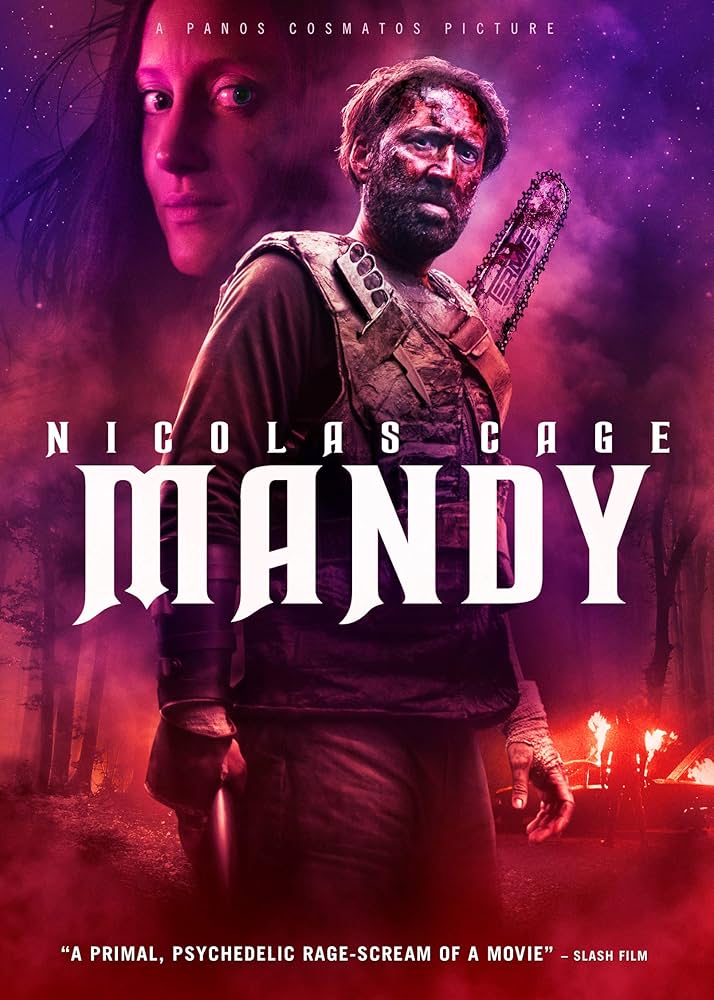
Cult cinema isn’t born—it’s forged in the hell of shoestring budgets and personal obsessions. Panos Cosmatos, that wandering Greek who previously gifted us the retro-futuristic nightmare Beyond the Black Rainbow (2010), returned in 2018 with Mandy, a film that seems conceived during a three-day LSD binge while listening to The Dark Side of the Moon backward and flipping through a 1983 issue of Fangoria with pages stuck together by a gorehound’s sweat. But make no mistake: this isn’t an empty stylistic exercise or a postmodern collage of hollow references for hipsters with thick-rimmed glasses. Mandy is the materialization of an almost religious obsession with ‘80s genre cinema—an era when celluloid smelled like fake blood, directors still believed excess was a virtue, and practical effects had the texture of a real corpse. Cosmatos doesn’t just pay homage to that era; he sodomizes it with a chainsaw, bathes it in acid, and leaves it burning on an altar of demonic synthesizers and color palettes plucked from a fever dream John Carpenter might’ve had after a peyote overdose and a Videodrome marathon.
The genesis of Mandy is as fascinating as its final product, because in a Hollywood obsessed with shared universes and reboots of franchises no one asked for, the film is a reminder that cinema can—and should—be an act of controlled madness. Produced by SpectreVision, Elijah Wood’s production company that specializes in birthing the most beautiful and disturbing nightmares (The Greasy Strangler, I Don’t Feel at Home in This World Anymore), Mandy was born with a budget of just $6 million—a pittance compared to the bloated blockbusters clogging multiplexes. But here’s the magic: Cosmatos and his team turned that limitation into a virtue, shooting in Belgium (because Europe is always cheaper and has forests straight out of a Brothers Grimm tale rewritten by Charles Bukowski) and filming on 35mm as if digital had never existed. The result is a visual texture that reeks of burnt celluloid, coarse grain, and the sweat of a drunk projectionist who passed out in the booth after three straight shifts. Every frame of Mandy feels designed to be watched in a rundown theater at 3 AM, with the sound of an old projector buzzing like a swarm of crazed bees and the scent of stale popcorn mixed with existential despair.
But let’s talk about the elephant in the room—that 6’1” behemoth with eyebrows like two furious caterpillars: Nicolas Cage. The man who once won an Oscar for pretending to care in Leaving Las Vegas now seems hellbent on becoming the Shakespeare of exploitation cinema, delivering performances that oscillate between the sublime and the ridiculous with the grace of a drunk tightrope walker who’s forgotten there’s a net below. In Mandy, Cage doesn’t act—he bleeds on screen. His portrayal of Red Miller, a lumberjack shattered by the loss of his beloved Mandy (Andrea Riseborough, ethereal as an ‘80s ghost who’s smoked too much incense), is a cocktail of existential pain, primal rage, and controlled insanity that can only be described as "what would happen if Charles Bukowski and Jason Voorhees had a child and raised him on whiskey and Italian revenge flicks." When Cage weeps while forging an axe in his shed, shirtless with muscles taut as violin strings about to snap, or when he howls Mandy’s name while wielding a chainsaw like Thor’s hammer after a bender with the Norse gods, we’re not watching acting. We’re witnessing a pagan ritual, a performance that transcends cinema and enters the realm of the sacred. Cosmatos knows this, which is why he gives Cage the space to shine (or burn) like a human torch in the middle of a black mass where the only sacrament is vengeance.
Then there’s the technical department, that Frankenstein’s monster of references, textures, and obsessions that Cosmatos assembles with the precision of a surgeon and the madness of a mad scientist. Benjamin Loeb’s cinematography is a nightmare in red and blue, a color palette plucked from a bootleg Hellraiser VHS that’s been played so many times it’s become a living thing. The shots are composed like oil paintings by an artist in the throes of a psychotic break, with lighting that oscillates between the oneiric and the outright infernal, as if Satan himself designed the lighting schemes with a neon highlighter. The production design, by Hanna Beachler (yes, the same one who won an Oscar for Black Panther and here proves she can also craft personal hells), turns every setting into a character: from Red’s cabin, straight out of a Lovecraft story rewritten by a hippie with Diogenes syndrome, to the Black Skulls’ camp—a demonic biker cult that looks like it crawled out of a ‘70s underground comic drawn by someone who huffed too much glue. And the score, that sickly synthesizer composed by Cosmatos and Jóhann Jóhannsson (in one of his final collaborations before his death, lending the music a cosmic elegy vibe), is the auditory equivalent of a heroin overdose mixed with Red Bull and served in a chalice carved by Beelzebub himself. Every note feels designed to make you feel like your brain is being liquefied by a Satanic DJ at an infernal rave, while your body floats in a sea of psychedelic colors and your soul is dragged into the abyss of madness.
Direction: The Controlled Chaos of a Visionary (or How Panos Cosmatos Turned a Walking Dead Episode Budget into a Masterpiece of Excess)
Panos Cosmatos doesn’t direct Mandy—he conjures it. Every stylistic choice seems made in a trance, as if the film were the result of a cinematic séance where the spirits of Dario Argento, John Carpenter, and Alejandro Jodorowsky possessed the director’s body and forced him to shoot their sickest vision while whispering in his ear: "More red. More blood. More madness." The first half of the film is an exercise in slow, oppressive tension, a nightmare of grimy realism where Red and Mandy live their love in a cabin lost in the woods, surrounded by a nature that breathes with them like a living, hungry organism. The shots are long, almost contemplative, but laden with latent menace, as if at any moment the forest might open its maw and devour them. Cosmatos takes his time building the relationship between the protagonists, showing their daily routine with an intimacy that borders on voyeurism: Mandy painting watercolor dragons while Red reads Conan comics aloud, sex scenes straight out of a horny ‘80s teen’s wet dream, and dialogue that oscillates between the poetic and the outright cheesy. But all this is merely the prologue to a Greek tragedy written in blood and LSD.
When the Black Skulls sect bursts into their lives like metastatic cancer, the film mutates. The colors become more saturated, as if someone had injected neon straight into the film’s veins; the framing distorts, with impossible angles straight out of a funhouse mirror, and the narrative dissolves into an orgy of violence and revenge plucked from a gorehound’s fever dream after a Cannibal Holocaust and The Evil Dead marathon. What’s most fascinating about Cosmatos’ direction is his ability to balance excess with surgical precision. Every shot seems calculated to the millimeter, but the final result is chaotic, as if the film were edited by a lunatic with scissors and duct tape in a basement lit by strobe lights. The action sequences aren’t choreographed like a Marvel blockbuster, where every punch looks rehearsed by a team of stuntmen and every wound is as superficial as a cat scratch. Here, violence has the clumsy, brutal physics of a real fight: Red hits, bleeds, stumbles, and weeps, and we suffer with him because every blow hurts, every wound festers, and every scream of pain echoes like a knife in our own guts.
When Red finally wields his homemade axe—forged in a fit of madness and grief—and sets off to hunt those responsible for Mandy’s death, we’re not watching a stylized revenge flick in the vein of Kill Bill or John Wick. We’re witnessing a blood ritual, an act of purification through pain that has more in common with The Texas Chain Saw Massacre than any modern action film. Cosmatos gives us no respite: he drags us into hell alongside his protagonist and forces us to look, to feel the weight of every blow, the smell of charred flesh, the metallic taste of blood in our mouths. The sequence where Red faces the Black Skulls in their lair is a masterpiece of cosmic horror and visceral violence, a mix of Hellraiser and Mad Max shot with the urgency of a director who knows he only has one chance to blow the audience’s mind. And blow it he does.
But Cosmatos’ brilliance lies in how he plays with audience expectations. Just when you think you’ve seen it all, that the film can’t get any crazier, Mandy takes an unexpected turn and ventures into even darker territory. The introduction of Jeremiah Sand (Linus Roache), the cult’s leader, is a moment of pure genius. Sand isn’t your typical villain—he’s not a cardboard monster or a masked psychopath. He’s a two-bit guru, a charlatan who mixes cheap philosophy with Christian rock and believes his life’s mission is to "liberate" lost souls through music and drugs. His spiel is a blend of Jim Jones and Charles Manson, but with the charisma of a drunk televangelist. When he sings his cursed song, "Starlight", accompanied by his band of masked followers, the moment is so uncomfortable, so surreal, and so deeply disturbing that you don’t know whether to laugh, cry, or call the cops. It’s like Cosmatos took the worst of ‘70s counterculture—the narcissism, the self-righteousness, the pretension—and turned it into a villain worthy of a nightmare.
And then there’s the climax, that final sequence where a drugged-up, half-mad Red faces Sand in a battle that’s less physical than metaphysical. The scene is shot like a fever dream, with distorted shots, impossible colors, and editing designed to induce migraines. It’s as if Cosmatos wanted to capture the sensation of a bad LSD trip, where time stretches and compresses, where the line between reality and hallucination blurs, and where the only comfort is violence. When Red finally kills Sand, it’s not an act of justice but an exorcism. The film ends on a note of poetic ambiguity: Red, covered in blood and tears, walks into the void as the camera pulls back and Jóhannsson’s music floods the screen like a requiem. There’s no redemption, no happy ending—just emptiness and the certainty that, in Mandy’s world, love and madness are two sides of the same coin.
Performances: Cage and Riseborough, or the Art of Controlled Madness (and the Rest of the Cast, Straight Out of an ‘80s Asylum)
If Mandy proves anything, it’s that Nicolas Cage is the last great method actor of modern cinema—a man who’s turned overacting into such a refined art that we no longer know if we’re watching a performance or a live exorcism. Cage doesn’t act in this movie; he bleeds, he tears himself apart, and he rebuilds himself in front of the camera, as if every scene were a shock-therapy session where the only goal is to plumb the depths of his own psyche and dredge up the darkest demons. His Red Miller isn’t a character—he’s an archetype: the man broken by grief, the betrayed lover, the avenging angel walking the razor’s edge between sanity and madness. When Cage weeps in the shed, forging his axe with tears and sweat, he’s not performing pain—he’s living it, as if every hammer blow against the metal were a lash across his own back. And when he howls Mandy’s name in the middle of the woods, voice cracking and eyes bloodshot, it’s not an actor’s scream—it’s the howl of a wounded animal, a sound so primal and raw that you feel you should cover your ears to block out the echo of your own despair.
But Cage isn’t alone in his madness. Andrea Riseborough, as Mandy, is the perfect counterpart: ethereal, mysterious, almost ghostly. Riseborough doesn’t play Mandy—she embodies her, as if she were a spirit who decided to inhabit an actress’s body for a couple of hours. Her Mandy isn’t a damsel in distress or a typical femme fatale. She’s a free woman, an artist living in her own world of dragons and nightmares, who loves Red with an intensity that borders on obsession. When the Black Skulls kidnap her, she’s not a victim—she’s a martyr, a woman who chooses her fate with a serenity more terrifying than any scream. Riseborough conveys all this with an economy of gestures and words that’s simply masterful. Her final scene, where she’s burned alive on a wooden cross while smiling with supernatural peace, is one of the most disturbing and beautiful moments in recent cinema. It’s not a death—it’s a transfiguration.
The rest of the cast doesn’t lag far behind, though it’s fair to say Linus Roache takes the prize for the year’s most unsettlingly ridiculous villain. His Jeremiah Sand is a mix of Jim Morrison and David Koresh, a two-bit guru who believes his life’s mission is to "save" people through music and drugs. Roache plays the role with a seriousness that borders on the comedic, as if he’s convinced his character is the messiah and not a charlatan with a god complex. His scene singing "Starlight" with his band of masked followers is so uncomfortable that you don’t know whether to laugh, cry, or dial 911. It’s a moment of unintentional genius, as if Cosmatos wanted to expose how absurd and dangerous the cult of personality can be.
And then there are the Black Skulls, those demonic bikers who look like they crawled out of a Heavy Metal comic drawn by someone who’s dropped too much acid. Played by a group of actors who seem recruited from an ‘80s asylum, the Black Skulls are a mix of Hell’s Angels and Cthulhu worshippers, with masks carved from bone and a bloodlust that’s as comical as it is terrifying. Their leader, The Chemist (Richard Brake), is a walking nightmare—part mad scientist, part biker, all menace. The whole gang feels like they were plucked from a grindhouse double feature, and their presence is so gloriously unhinged that you can’t help but wonder if Cosmatos raided a biker bar and a mental institution to cast them. Their scenes are a masterclass in controlled camp, where the line between horror and comedy blurs so completely that you’re left unsure whether to recoil or laugh. It’s a testament to Cosmatos’ vision that even the film’s most over-the-top elements feel like essential parts of its twisted, beautiful whole.
The Best
- Nicolas Cage’s performance: A masterclass in controlled insanity. When he howls Mandy’s name, you’ll feel it in your bones.
- The cinematography: Every frame looks like a lost ‘80s horror VHS that’s been left in the sun to melt.
- The score: Jóhann Jóhannsson’s final work is a demonic lullaby that’ll haunt your dreams.
- The Black Skulls: A biker cult so ridiculous they loop back around to terrifying. Their masks alone are worth the price of admission.
- The chainsaw fight: Because of course there’s a chainsaw fight. And of course it’s glorious.
The Worst
- The pacing in the first half: If you’re not on Cosmatos’ wavelength, the slow burn might feel like watching paint dry—if the paint were mixed with blood and tears.
- Jeremiah Sand’s song: "Starlight" is so cringe it’s almost genius. Almost.
- The ambiguity: If you’re looking for a neat, satisfying ending, Mandy will leave you as empty as Red’s soul.
- The gore: Not for the squeamish. This is a film that wants you to flinch.
- The risk of overhyping it: If you go in expecting a nonstop adrenaline rush, you might be disappointed. Mandy is a mood, not a rollercoaster.
The Verdict of Claqueta Ácida
Mandy isn’t just a movie—it’s a religious experience for the damned, a film that demands to be seen on the biggest screen possible, at the latest hour possible, with the loudest sound possible, and preferably after a few drinks to dull the edges of its brutality. It’s a middle finger to the sanitized, focus-grouped cinema of today, a reminder that movies can still be dangerous, messy, and utterly alive. Is it pretentious? Absolutely. Is it self-indulgent? Without a doubt. Does it occasionally cross the line into outright silliness? Oh, you bet. But that’s the point. *💬 El Veredicto de la Comunidad
¿Qué te ha parecido la película? Deja tu nota de 0 a 10 para contrastarla con el análisis de la redacción.
Aún no has votado
📢 ¿Te ha gustado el ácido?
Comparte esta crítica con tus amigos cinéfilos o desata la polémica en redes.
📩 📩 Get the poison in your inbox
Join our weekly mailing list. Honest film reviews, acid festival coverage, and cult recommendations every Sunday morning. Zero spam, pure celluloid.
🔒 We promise weekly poisonous reviews and exclusive coverage.Related Reviews
Recommended autopsies for demanding film buffs.
 🔥 Fusión Nuclear8.5
*Mandy: Hell on Celluloid or How Cosmatos Turned a Garage Budget into a Psychedelic Nightmare*
Panos Cosmatos delivers a visual orgy of revenge, acid, and chainsaws that makes Tarantino look like an altar boy. There’s no redemption here—just charred flesh and demonic synthesizers.
 🔥 Fusión Nuclear8.5
**"Mandy: A Nightmare Forged in Steel and Fire"**
**"Nicolas Cage embarks on a blood-soaked rampage in this psychedelic revenge fever dream."**
 ⚡ Ácido Cítrico6.2
*Exit 8*: The Horror Station That Can’t Find Its Way Out (And Neither Can You)
Genki Kawamura adapts *The Exit 8* video game with more loops than a politician’s campaign promises. Will it escape the purgatory of J-horror, or is it doomed to linger in its own terminal?