The Last Supper — A Feast That Left Us Hungry for Anything But Meat
Aleksandr Boikov serves up a gourmet horror menu in 'The Last Supper,' but the main course tastes like thin gruel. Art or self-indulgence? Valeria Von Doom carves it open with a scalpel.

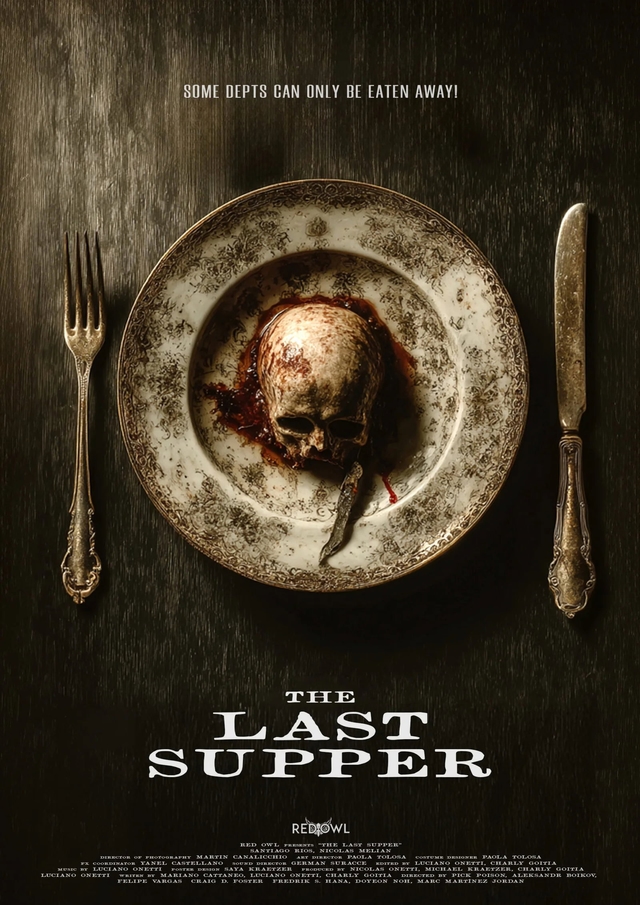
The table is set, the tablecloth as white as a screenwriter’s blank page mid-creative block, and our host—Aleksandr Boikov—invites us to sit with a smile that reeks of a trap. The Last Supper (2025) arrives like a chef’s tasting menu, served on a silver platter by a director who seems to believe horror is best cooked with silence, long takes, and a dash of pretension. But doesn’t fear taste better when seasoned with something more than unchecked ambition? The film bills itself as a banquet of terrifying tales, yet in Boikov’s kitchen, the hunger—that primal dread teased in the synopsis—remains on the menu, never making it to the plate. It’s like ordering a ribeye and being served a pencil sketch of one: pretty, but impossible to sink your teeth into.
The context of this film is as mysterious as the invisible guest haunting the protagonist. Produced in some geographic and industrial limbo (Argentina? Russia? Hell?), The Last Supper emerges at a moment when horror cinema seems to have exhausted every trick in the book, from jump scares to slow burns, forcing directors to invent new ways to bore audiences. Boikov, whose résumé gleams with obscurity—as if his career were a found footage reel lost in a basement—dives headfirst into exploring the most basic fears: hunger, flesh, survival. But isn’t the fear of mediocrity the most terrifying of all? In a world where horror has become a franchise factory of soulless reboots, The Last Supper presents itself as an oddity, a green dog barking in a language no one understands. And that, dear diners, is both its greatest virtue and its gravest sin.
The premise is so simple it hurts: a man alone in a deserted house, accompanied only by the shadow of an unseen guest, savoring an exquisite menu we, ironically, never get to see. The synopsis promises a succession of terrifying stories, but what Boikov serves is more of a collage of half-baked ideas, as if screenwriter Mariano Cattaneo scribbled each scene on a different napkin and glued them together with spit. The result is a film teetering between the poetic and the pretentious, like a drunk tightrope walker trying to cross the chasm between art and absurdity. The problem isn’t that The Last Supper is ambitious—cinema needs ambition like the body needs blood—but that its ambition seems aimed solely at impressing a festival jury rather than moving, scaring, or at least entertaining a flesh-and-blood audience.
And here’s where the film becomes a funhouse mirror of the current industry: a reflection of directors who confuse style with substance, atmosphere with emptiness, and silence with depth. Boikov films every shot as if chiseling a masterpiece in marble, but the marble is hollow inside. The cinematography—whose authorship is lost in the credits’ limbo—plays with elongated shadows and dim lighting, as if the DP studied every frame from a 1940s film noir manual. But what’s the point of flawless lighting if what it illuminates is a script limping like a zombie with a broken leg? The Last Supper is the kind of film that makes you wonder if the director is playing chess with you or simply forgot to set up the board.
Direction: The Art of Saying Nothing with Great Style
Aleksandr Boikov directs The Last Supper as if filming a fever dream, but the problem is his dreams smell more like mothballs than nightmares. Every shot is meticulously composed, as if the director spent hours adjusting the position of a spoon on the table for the perfect framing. But isn’t horror about what you don’t see, what lurks at the edges of the frame? Boikov seems obsessed with showing everything—or, rather, with showing nothing worth seeing. His long takes, meant to build tension, end up as endurance tests for the viewer, like being trapped at an endless dinner with a host who won’t stop talking about himself.
The film’s pace is so glacial you can almost hear the seconds dripping like rusty water into a bucket. Boikov seems to believe horror is built on silence, but purposeless silence is like a joke without a punchline: it just makes you uncomfortable. There are moments when the film brushes against the hypnotic, like when the protagonist—played by Santiago Rios—stares directly into the camera, as if about to reveal the universe’s secret. But the secret, in the end, is as insubstantial as a sigh. Boikov films every scene as if sculpting ice, but the ice melts before you can feel its chill.
Performances: When Silence Is the Only Dialogue
The cast of The Last Supper consists of two actors—Santiago Rios and Nicolás Melian—and you have to wonder if the budget didn’t stretch further or if Boikov simply believed horror is best built with as few voices as possible. Rios, as the enigmatic host, spends most of the film staring into the void with an intensity that wavers between disturbing and ridiculous. There are moments when his performance verges on the sublime, like when he chews an imaginary piece of meat with near-religious devotion. But in others, he looks ready to doze off, as if the film’s pretentious weight had exhausted him.
Melian, meanwhile, has even less to do. His character—the invisible guest—is little more than an excuse for Rios to monologue, like a schizophrenic in a poorly directed therapy session. The chemistry between them is nonexistent, but can there be chemistry when one of them isn’t even there? The performances in The Last Supper are like a banquet where the guests refuse to touch the food: everything is arranged with elegance, but no one seems hungry.
Screenplay: A Menu of Half-Baked Ideas
Mariano Cattaneo’s script is the cinematic equivalent of a chef promising a seven-course feast but only serving appetizers. The premise—a man alone in a deserted house, telling terrifying stories—is as old as cinema itself, but Cattaneo seems to think he can reinvent it by slathering on a layer of pretension. Each tale told in The Last Supper is like a dish arriving cold to the table: it promises a lot but delivers little. The problem isn’t that the stories are bad—some have interesting moments—but they’re so poorly developed you end up wondering if the screenwriter fell asleep mid-draft.
The film’s structure is a mess, as if Cattaneo wrote each scene in random order and taped them together. There are narrative leaps that go nowhere, characters who appear and vanish without explanation, and an ending that feels like it was written by someone who gave up halfway through the second act. The Last Supper is the kind of film that makes you question whether the screenwriter was crafting a horror story or just jotting down his dreams in a notebook. And the worst part? By the end, you’re not even sure what it was supposed to be.
The best
- The atmosphere: Boikov crafts an oppressive, claustrophobic mood, as if the house where the film unfolds is an extension of the protagonist’s own fear. The long takes and dim lighting create a sense of unease that, at its best, verges on the hypnotic.
- Santiago Rios’ performance: Though his character is little more than a mannequin with a vacant stare, Rios manages to convey a disturbing intensity in some moments. His ability to sustain tension with so little material is, without a doubt, the film’s highlight.
The worst
- The screenplay: A collage of half-developed ideas that never coalesce into a coherent narrative. Every story teased in the synopsis remains a sketch, as if the screenwriter lost interest halfway through.
- The pacing: The film crawls at such a sluggish pace you’ll have time to count the dust motes on the screen. Boikov seems to believe horror is built on silence, but purposeless silence is just boring.
- The performances: While Rios has standout moments, the cast overall seems lost, as if the actors aren’t quite sure what they’re doing there. Melian, in particular, has so little to do you wonder if his character wasn’t just a casting mistake.
- The pretension: The film tries to be profound, poetic, and terrifying, but it ends up being pretentious. Boikov seems more interested in impressing a festival jury than connecting with an audience.
The Verdict of Claqueta Ácida
The Last Supper is a film served with elegance but leaves you hungry. Aleksandr Boikov demonstrates an impeccable eye for visual composition and a knack for crafting oppressive atmospheres, but his obsession with style drowns any hint of substance. Mariano Cattaneo’s script is a menu of half-baked ideas, and the performances—though occasionally brilliant—can’t save the ship. In the end, what remains is a film more interested in being admired than felt. A feast for the eyes, but a fast for the soul. And at Claqueta Ácida, we believe cinema should nourish, not leave you starving. 💀
🎬 Tráiler Oficial
💬 El Veredicto de la Comunidad
¿Qué te ha parecido la película? Deja tu nota de 0 a 10 para contrastarla con el análisis de la redacción.
Aún no has votado
📢 ¿Te ha gustado el ácido?
Comparte esta crítica con tus amigos cinéfilos o desata la polémica en redes.
📩 📩 Get the poison in your inbox
Join our weekly mailing list. Honest film reviews, acid festival coverage, and cult recommendations every Sunday morning. Zero spam, pure celluloid.
🔒 We promise weekly poisonous reviews and exclusive coverage.Related Reviews
Recommended autopsies for demanding film buffs.
 ⚡ Ácido Cítrico6.2
The Last Supper: A Feast That Left Us Hungry for Anything But Meat
Aleksandr Boikov serves up a gourmet horror menu in 'The Last Supper,' but the main course tastes like thin gruel. Art or self-indulgence? Valeria Von Doom carves it open with a scalpel.
 ⚡ Ácido Cítrico6.2
*Exit 8*: The Horror Station That Can’t Find Its Way Out (And Neither Can You)
Genki Kawamura adapts *The Exit 8* video game with more loops than a politician’s campaign promises. Will it escape the purgatory of J-horror, or is it doomed to linger in its own terminal?
 ⚠️ Ácido Sulfúrico4.2
**Good Boy: The Dog That Saved No One (Not Even Itself)**
A supernatural canine stars in a film that barks up the wrong tree. *Claqueta Ácida* dissects this rural dud with the precision of a scalpel in a slaughterhouse.